DSG Herald News Audio Brief
Listen: Owerri West LGA Development & Representation – 🎧 Duration: 15:00 min
-Owerri West Growth Raises Questions About Development and Representation
-How Owerri West Became Imo State’s Expanding Urban Powerhouse
Owerri West Local Government Area in Imo State is increasingly emerging as one of the most strategically important urban corridors in southeastern Nigeria, driven by rapid housing expansion, federal institutions, industrial activity, and growing commercial development.
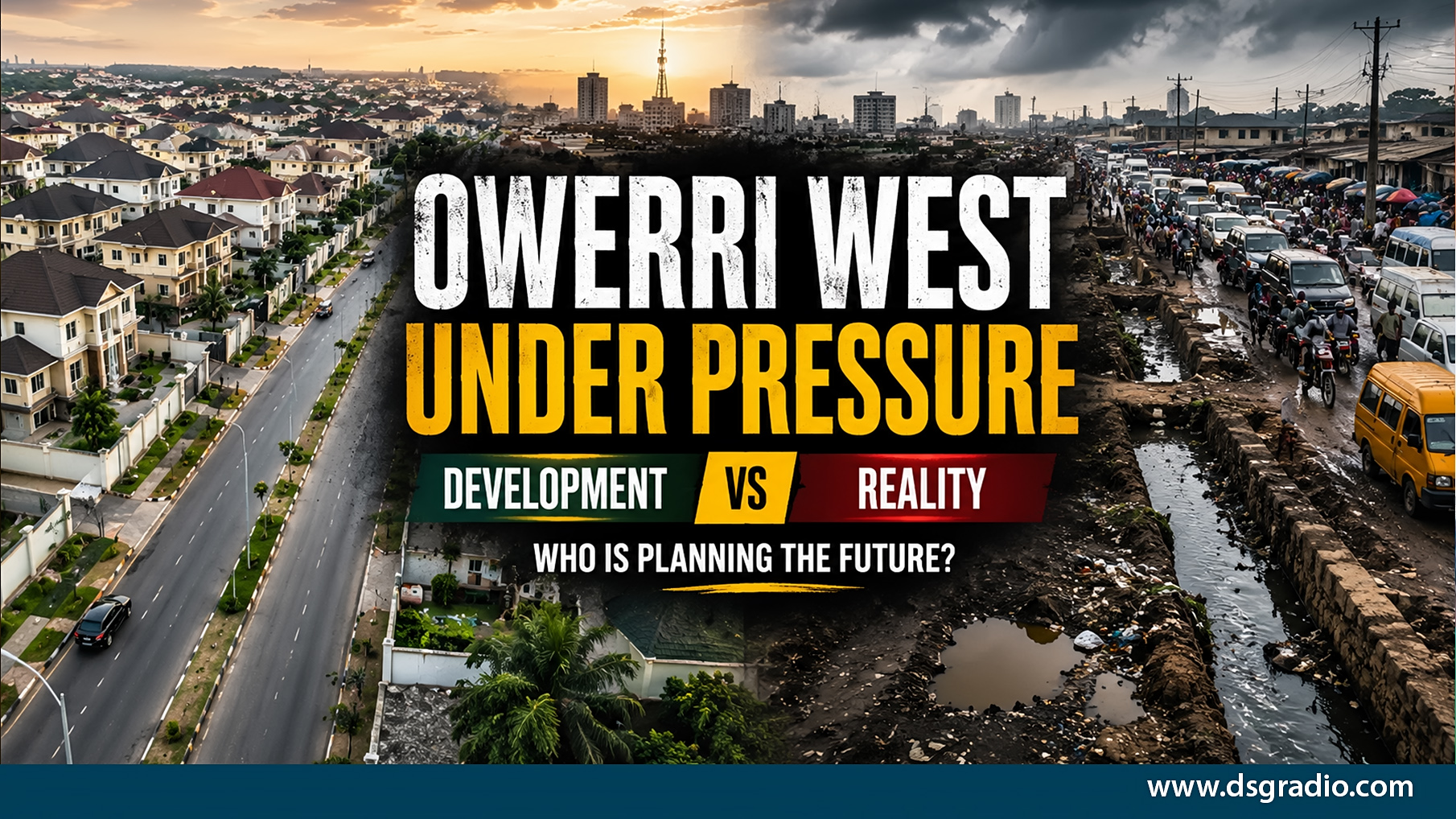
But as Owerri West’s growth accelerates, conversations are intensifying about infrastructure pressure, revenue allocation, security demands, and whether political representation has kept pace with the realities shaping the area.
Residents, development observers, and policy analysts say the debate is no longer simply about politics. Increasingly, it is becoming a broader discussion about urban planning, fiscal policy, governance, and the future direction of one of Imo State’s fastest-expanding local government areas.
The Transformation of Owerri West
For decades, many communities in Owerri West were viewed largely as semi-rural extensions of the state capital.
Today, that reality has changed dramatically.
Communities across the LGA have experienced rapid residential growth, increased commercial activity, institutional expansion, and rising population movement linked to the continued expansion of Owerri city itself.
From Nekede and Ihiagwa to Umuguma, Avu, Irete, Obinze, and Eziobodo, the effects of ongoing Owerri urban expansion are visible across multiple sectors.
Development analysts say Owerri West now functions as one of the most important support zones for the Owerri metropolis, absorbing residential overflow, transportation activity, educational expansion, and growing business operations.
The LGA is officially structured across three major blocks and 21 legally recognised autonomous communities:
Umunwoha Block
- Ohii
- Amakohia-Ubi
- Orogwe
- Irete
- Ndegwu
Ara Block
- Umuguma
- Avu
- Olaukwu
- Oforola
- Okuku
- Obinze
Ochie Block
- Ihiagwa Ancient Kingdom
- Dindi Ihiagwa
- Eziobodo
- Okolochi
- Emeabiam
- Eziokele
- Umuokpo
- Umualum Nekede
- Umudibia Nekede
- Umuoma Nekede
Observers say the geographical spread and urban integration of these communities now place Owerri West at the centre of some of the most important development conversations in Imo State.
The Institutional Weight of Owerri West
One of the strongest drivers behind the expanding Owerri West economy is the concentration of federal and state institutions located within the LGA.
The area hosts several major federal tertiary institutions, including:
- Federal University of Technology, Owerri (FUTO)
- Federal Polytechnic Nekede
- Federal College of Land Resources Technology (FECOLART)
These institutions attract thousands of students, lecturers, workers, entrepreneurs, transport operators, and visitors daily.
The Federal University of Technology, Owerri, remains one of the major institutional drivers of economic and residential expansion in Owerri West, due to its large student and workforce populations.
Analysts say the resulting economic ecosystem has transformed the local economy through:
- Transportation,
- Housing demand,
- Hospitality,
- Retail activity,
- Food businesses,
- Construction,
- and Private investments.
Beyond educational institutions, Owerri West also hosts several major federal and state government facilities.
These include:
- Federal Secretariat Complex, Umuguma
- Military Cantonment and Nigerian Army facilities in Obinze
- Nigerian Correctional Service facilities in Irete
- Federal Housing Estates
- Imo State Secretariat Complex along the Nekede axis
- State housing estates around Umuguma and New Owerri
- General Hospital Umuguma
The LGA also contains:
- Police facilities,
- Immigration and Customs operational units,
- courts,
- and historic technical institutions linked to the state’s educational development.
Development observers argue that this concentration of institutions significantly increases the strategic importance of the LGA while also placing additional pressure on Owerri West infrastructure and public services.
Housing Expansion and Urban Pressure
Perhaps one of the most striking indicators of Owerri West’s growth is the scale of residential expansion across the area.
Residents and development analysts estimate that of more than 100 housing estates across Imo State, nearly 90 are located in Owerri West.
While the estimate could not be independently verified, many observers say the statistic reflects the growing reality of housing concentration around the LGA.
Urban development experts at the World Bank have repeatedly highlighted how rapid housing expansion in growing cities can place significant pressure on roads, sanitation systems, and public infrastructure when planning fails to keep pace with population growth.
Communities such as:
- Umuguma,
- Irete,
- Avu,
- Nekede,
- Obinze,
- and New Owerri corridors
have experienced major residential expansion over the years as the state capital continues to grow outward.
This growth has triggered:
- Increased road usage,
- Rising traffic congestion,
- Sanitation pressure,
- Drainage challenges,
- Higher electricity demand,
- and greater pressure on security systems.
Observers say the rapid pace of Owerri urban expansion has effectively transformed Owerri West into one of the state’s most active residential and commercial growth corridors.
Yet many residents believe the pace of Owerri West infrastructure development has not fully matched the realities emerging across the area.
As population movement and commercial activity increase across Owerri West, concerns about security coordination reflect broader urban policing challenges that the Nigerian Police Force frequently acknowledges in rapidly expanding communities.
Readers seeking additional context can also explore Urban Expansion and Infrastructure Pressure in Owerri Suburbs.
Imo Revenue Allocation Debate and Functional Population
The issue of Imo revenue allocation has become central to the wider development debate surrounding Owerri West.
According to Nigeria’s revenue allocation framework managed by the Revenue Mobilisation Allocation and Fiscal Commission, factors such as:
- Population,
- Equality of local governments,
- Internally generated revenue,
- Landmass,
- Infrastructure needs,
- and poverty levels.
However, policy analysts argue that these formulas often fail to adequately capture “functional population” — the number of people who study, work, trade, travel, or depend on services within a particular area daily.
In the case of Owerri West growth, many observers say this issue has become increasingly significant.
Thousands of students, workers, military personnel, civil servants, traders, and commuters move across the LGA daily due to the concentration of institutions and housing estates within the area.
Development experts argue that this creates infrastructure pressure that may not always be reflected in official allocation structures.
Residents point to recurring concerns involving:
- Road maintenance,
- Traffic management,
- Waste disposal,
- Drainage systems,
- Security coordination,
- and public utilities.
For more context, readers can explore How Revenue Allocation Works in Nigeria’s Local Governments.
Questions Around Imo Political Representation
As discussions surrounding Owerri West growth intensify, attention is also turning toward the role of leadership and Imo political representation.
Many residents and policy observers argue that successive political leaders representing the area have not consistently pursued long-term, evidence-based advocacy capable of reshaping allocation conversations or attracting stronger development consideration.
Rather than emotional political attacks, analysts say the focus should remain on measurable governance outcomes and policy engagement.
Several key questions continue to emerge:
- Were updated demographic audits commissioned?
- Were institutional impact assessments conducted?
- Were economic development reports submitted?
- Were policy papers presented during allocation reviews?
- Was sustained lobbying carried out for increased infrastructure funding?
According to political observers, modern representation increasingly requires:
- Data-driven advocacy,
- Fiscal understanding,
- Economic planning,
- and long-term development strategy.
“For years, representation appears to have focused more on political survival than long-term structural advocacy,” one observer told DSG HERALD NEWS.
Another analyst argued that future leadership in the area must shift away from short-term political gestures toward measurable development planning that can influence policy outcomes.
Security and Strategic Importance
The presence of military facilities, correctional institutions, federal establishments, and major educational centres has also increased Owerri West’s strategic importance for security.
Communities such as Obinze, Irete, Nekede, and Umuguma now experience significant daily movement of students, workers, security personnel, traders, and transport operators.
Development analysts say this naturally increases pressure on:
- Security coordination,
- Road infrastructure,
- Transportation systems,
- Emergency response,
- and urban planning structures.
Some residents believe existing infrastructure and security systems are increasingly overstretched relative to the realities of urban growth.
Analysts warn that without coordinated long-term planning, rapid urban expansion can create structural vulnerabilities that affect both institutions and residential communities.
2027 and the Call for Smarter Leadership
As discussions surrounding the 2027 political cycle begin to emerge, many residents say the future of Imo political representation may depend heavily on a new generation of leaders who can understand governance beyond traditional campaign politics.
Increasingly, younger residents and development stakeholders are calling for:
- Policy-based representation,
- Economic intelligence,
- Infrastructure planning,
- Demographic studies,
- Institutional engagement,
- and strategic lobbying.
Observers say the future of Owerri West growth may ultimately depend on whether leadership evolves fast enough to match the realities shaping the LGA.
“The next political era must move beyond empowerment slogans and focus on measurable structural reforms,” one development observer said during discussions monitored by DSG HERALD NEWS.
Another analyst added:
“Representation should not end after an election victory. It should begin with policy engagement.”
The Future of Owerri West
Despite ongoing debates over Imo revenue allocation, infrastructure pressure, and governance planning, many analysts believe Owerri West remains one of the most strategically positioned LGAs in Imo State.
Its combination of:
- Educational institutions,
- Military presence,
- Expanding residential estates,
- Commercial growth,
- Government establishments,
- and proximity to the state capital
continues to strengthen the Owerri West economy and deepen its influence within the wider development structure of Imo State.
Observers say the bigger question is no longer whether Owerri West growth is happening.
The real question is whether infrastructure planning, allocation systems, and political leadership are evolving quickly enough to support it.
For many residents, that conversation may shape Owerri West’s future for years to come.
Recommended Coverage:
- Rebuild Imo Movement Gains Attention After Ihedioha Visit
Explores ongoing political realignments and development-focused conversations shaping Imo State ahead of future elections. - Imo CARE Initiative Expands Free Healthcare Access
Highlights how public policy and healthcare reforms are affecting communities across Imo State. - Irete Community Launches N50m School Revamp Project
Examines grassroots infrastructure and education development efforts within Imo communities. - Igwejiuba Francis Foundation Supports Imo Student Scholarship
Focuses on youth empowerment and human capital development initiatives connected to Imo State.
About the Author