Terrorist Reintegration Nigeria: Can Peace Heal Old Wounds?
Thousands of lives have been lost. Entire communities have been uprooted. Families remain separated by conflict, while many survivors continue to carry physical and psychological scars from more than a decade of insurgency in Nigeria’s North-East. Against this backdrop, the latest phase of the Terrorist Reintegration Nigeria programme has reignited a difficult national conversation: can a society heal by welcoming former insurgents back into its communities, or does such a policy risk reopening wounds that have never fully closed?
That debate intensified on Friday in Maiduguri, Borno State, when the state government formally reintegrated 720 former insurgents alongside 992 spouses and 2,050 children after they completed rehabilitation, deradicalisation and reintegration programmes under what authorities call the “Borno Model.” According to state officials, the latest group constitutes Batch 9 of low-risk participants processed through the state’s non-kinetic counterinsurgency strategy. The development brings the total number of individuals reintegrated under the programme to 9,680 since July 2021.
For supporters, the initiative represents a pragmatic pathway toward peace in a region that has endured years of violence. For critics, it raises persistent questions about justice, accountability, community safety, and the long-term welfare of victims.
The latest exercise therefore extends beyond the numbers. It touches on fundamental questions about how nations recover from conflict and whether forgiveness can coexist with accountability.
The Latest Milestone in the Borno Rehabilitation Programme
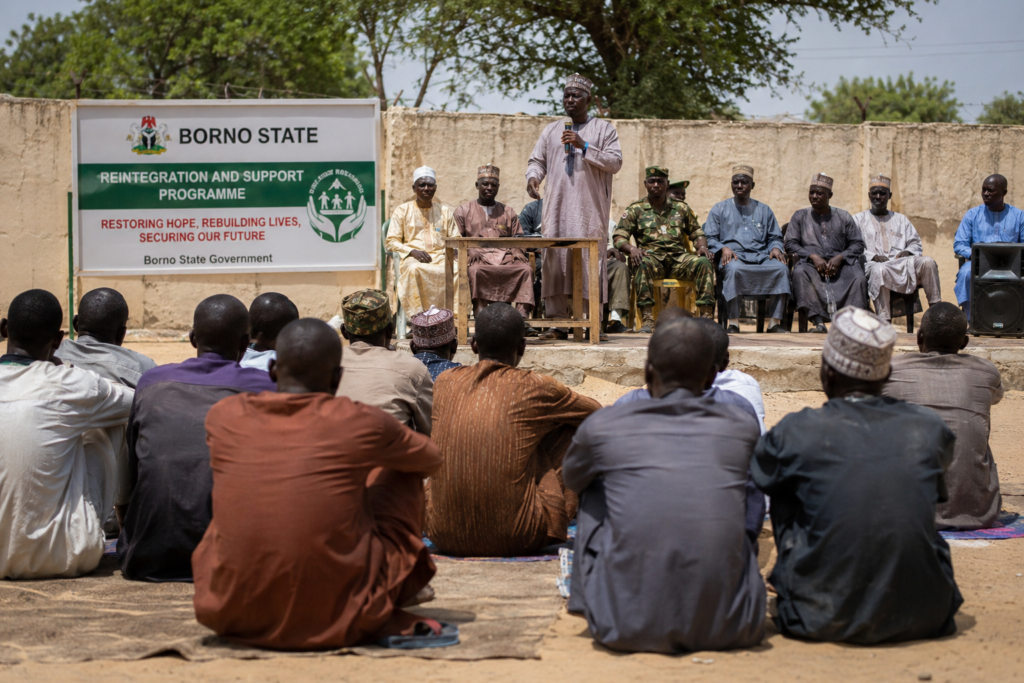
Speaking during the reintegration ceremony in Maiduguri, Brigadier General Abdullahi Ishaq (Rtd), Special Adviser to Governor Babagana Zulum on Security and a member of the state’s Deradicalisation, Rehabilitation and Reintegration Committee, described the programme as a central pillar of Borno’s response to insurgency.
According to Ishaq, the beneficiaries underwent structured rehabilitation at the Hajj Camp in Maiduguri after voluntarily surrendering to military authorities.
Officials stated that participants received:
• Counselling and behavioural reorientation
• Religious instruction
• Hygiene and anti-drug awareness education
• Vocational skills training
• Reintegration preparation programmes
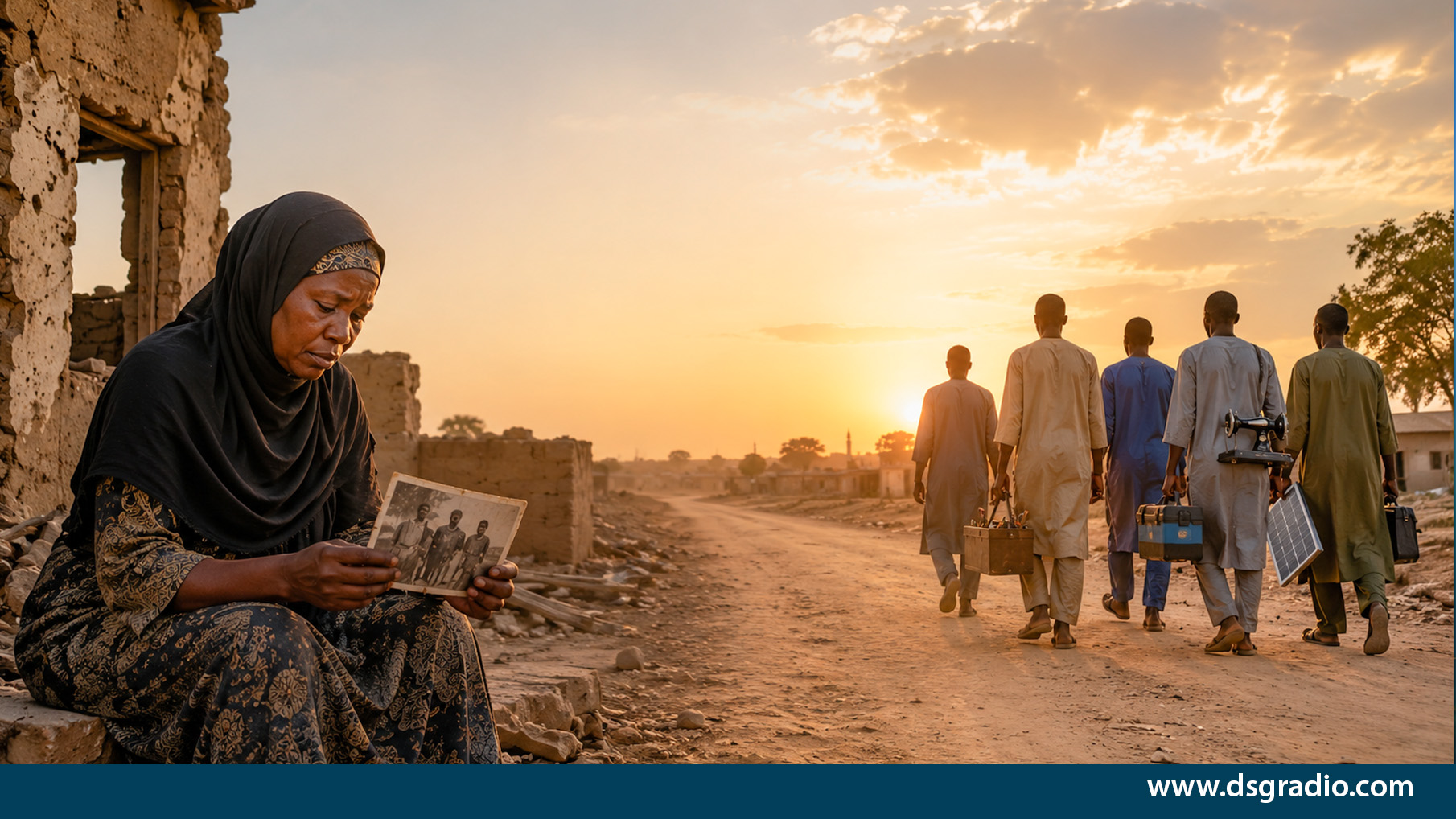
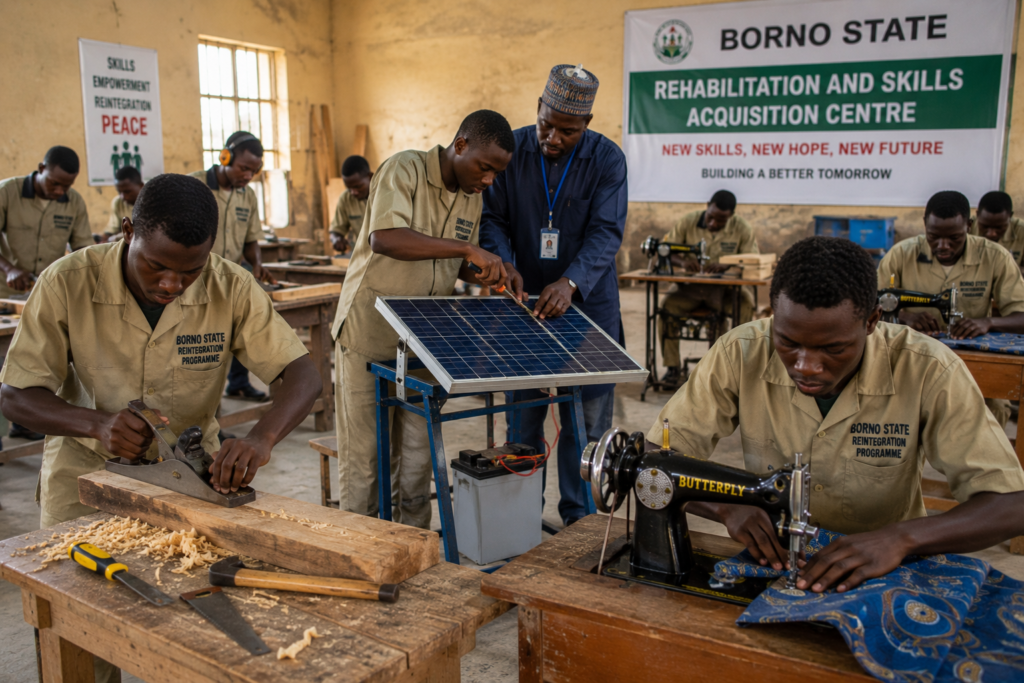
Training reportedly covered trades such as tailoring, carpentry, bricklaying, solar installation, metalwork, motorcycle repairs, vulcanising, soap making, knitting, phone repairs and related occupations.
State authorities said starter packs were also distributed to help beneficiaries rebuild their lives upon returning to their communities.
Ishaq said the initiative began on July 5, 2021, under Governor Babagana Umara Zulum’s administration and has continued to expand across multiple local government areas including Bama, Gwoza, Dikwa, Jere and Monguno.
According to the official, more than 350,000 people have reportedly exited insurgent camps over time and surrendered to security forces. However, this figure could not be independently verified.
The latest exercise adds another chapter to a programme that has become one of Nigeria’s most closely watched counterinsurgency experiments.
The Scale of the Insurgency’s Human Cost
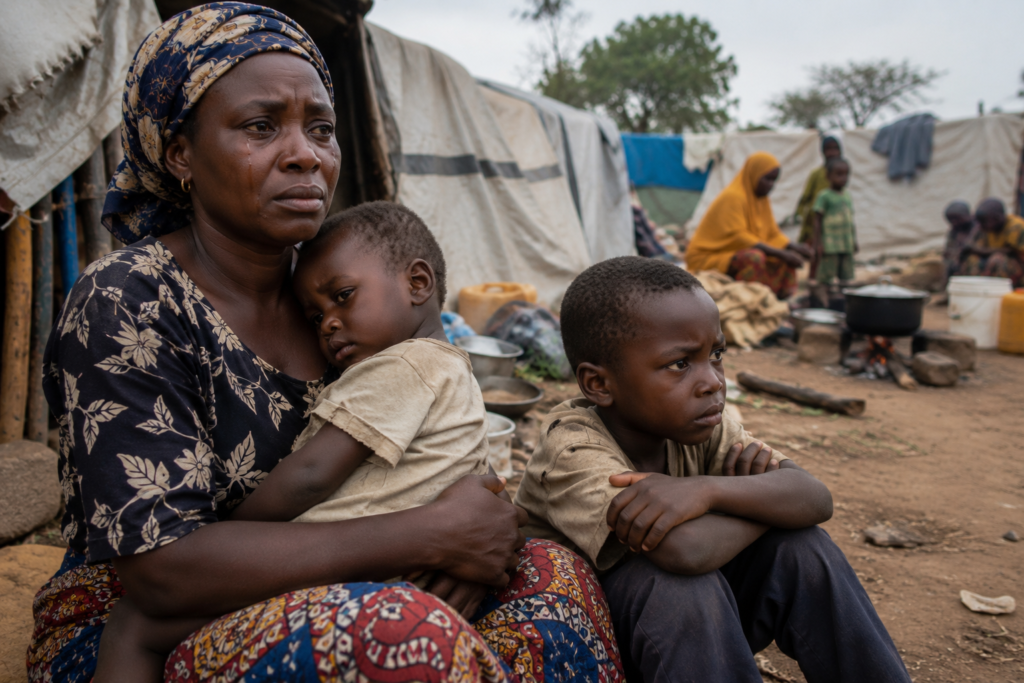
To understand why the Terrorist Reintegration Nigeria programme generates strong reactions, it is necessary to examine the scale of devastation caused by insurgency across the North-East.
Since the Boko Haram insurgency emerged in 2009, communities across Borno, Yobe and Adamawa states have experienced repeated attacks, displacement, kidnappings, destruction of infrastructure and widespread economic disruption.
Entire villages have been abandoned.
Schools have been destroyed.
Businesses have collapsed.
Farms have been left uncultivated due to insecurity.
Millions of people have at various times depended on humanitarian assistance.
Beyond physical destruction, many survivors continue to struggle with psychological trauma associated with years of violence.
For many families, memories remain vivid.
Some lost parents.
Others lost children.
Many witnessed attacks that fundamentally altered their lives.
This historical reality shapes public attitudes toward reintegration programmes.
While authorities focus on ending conflict and preventing future violence, many victims naturally evaluate policies through the lens of personal loss.
That tension lies at the centre of the national debate.
Why Government Supports Reintegration
Supporters of the Borno Rehabilitation Programme argue that military operations alone cannot permanently end insurgencies.
Modern counterinsurgency strategies often combine security operations with rehabilitation, dialogue, intelligence gathering and community reintegration.
Officials in Borno maintain that the programme encourages defections by offering insurgents a pathway back into society.
The logic is straightforward.
If fighters believe surrender leads to rehabilitation rather than certain death, more may choose to abandon insurgent groups.
Authorities argue that every fighter who surrenders weakens insurgent networks.
Fewer fighters in the bush can potentially reduce attacks.
Former members may also provide intelligence that helps security agencies better understand insurgent operations.
Supporters therefore view reintegration not as a reward but as a strategic security tool.
The programme also seeks to address practical realities.
Many of those entering rehabilitation include women and children who may have lived within insurgent-controlled territories for years.
Government officials argue that successful reintegration can reduce the risk of future radicalisation while helping communities rebuild after conflict.
This thinking aligns with broader international approaches used in conflict zones where disarmament, demobilisation and reintegration programmes have formed part of post-conflict recovery efforts.
The Pain and Concerns of Terror Victims
Yet the strongest criticism of reintegration programmes often comes from those who endured the violence firsthand.
For victims, policy discussions can feel disconnected from lived experiences.
Many families continue to ask difficult questions.
Have those responsible for violence truly accepted responsibility?
Can rehabilitation erase years of suffering?
How can trust be rebuilt between former fighters and communities they once threatened?
Will victims receive the same level of attention given to those being rehabilitated?
These questions remain central to public discourse.
In communities affected by insurgency, widows, orphans, former captives and displaced families often carry burdens that extend far beyond economic loss.
Trauma can last for years.
Fear can persist even after violence declines.
The return of former insurgents may therefore trigger anxiety among residents who still remember attacks on their communities.
Some victims may welcome efforts aimed at ending violence.
Others may feel justice remains incomplete.
Neither perspective can be dismissed.
A sustainable peace process often requires policymakers to balance competing needs: security, reconciliation, accountability and healing.
The challenge becomes even greater when communities remain divided on what forgiveness should look like.
Does Terrorist Reintegration Nigeria Improve Security?
The effectiveness of reintegration programmes remains one of the most debated aspects of counterinsurgency policy.
Supporters point to several potential benefits.
First, increased defections can weaken insurgent organisations.
Second, rehabilitation may reduce the likelihood that former fighters return to violence.
Third, intelligence obtained from defectors can support security operations.
Fourth, community reintegration can reduce recruitment opportunities for extremist groups.
These arguments help explain why authorities continue to invest in the programme.
However, critics highlight equally important concerns.
They argue that even a small number of reoffending individuals could undermine public confidence.
Communities may remain sceptical if monitoring mechanisms are not transparent.
Questions about long-term tracking, post-reintegration support and community acceptance continue to surface.
Critics also note that security success should not be measured solely by the number of people reintegrated.
Instead, they argue, outcomes should be evaluated based on sustained reductions in violence, successful community integration and public confidence in the process.
These concerns underscore the complexity of assessing success.
Numbers alone cannot fully capture whether reconciliation is working.
Political Implications Beyond Borno
The programme has implications that extend beyond Borno State.
Nigeria continues to confront multiple security challenges, including banditry, kidnapping and communal violence in different regions.
As policymakers evaluate future security strategies, the Borno Model may increasingly serve as a reference point.
Supporters see it as evidence that non-kinetic approaches can complement military operations.
Critics caution against applying similar models without robust accountability measures.
The political significance is therefore substantial.
If the programme is ultimately viewed as successful, it could influence future national security policies.
If public concerns remain unresolved, it may generate resistance to similar initiatives elsewhere.
The debate reflects broader questions about governance, conflict resolution and state capacity.
Economic Impact of Reintegration
The economic dimension is often overlooked.
Conflict imposes enormous financial costs.
Infrastructure reconstruction, humanitarian support, security operations and economic disruption all require substantial resources.
Authorities argue that successful rehabilitation can help former insurgents become productive members of society rather than remaining dependent on aid or vulnerable to re-recruitment.
Vocational training forms a major component of this objective.
Skills in carpentry, tailoring, solar installation, metalwork and related trades are intended to provide participants with livelihoods.
In theory, successful reintegration contributes to local economic recovery.
Communities benefit when more people engage in legitimate economic activity.
However, concerns remain.
Some observers question whether victims receive comparable economic support.
Others argue that rehabilitation programmes should be matched by stronger investments in affected communities.
The long-term economic success of reintegration may therefore depend not only on former insurgents but also on the recovery of victims and host communities.
International Lessons and Global Comparisons
Nigeria is not the first country to confront questions about reintegrating former combatants.
Across Africa and other regions, governments emerging from conflict have experimented with rehabilitation and reintegration programmes.
Countries recovering from civil wars have often used combinations of:
• Disarmament
• Demobilisation
• Reintegration
• Community reconciliation
• Transitional justice mechanisms
Some programmes achieved measurable success.
Others faced criticism over accountability and victim inclusion.
The international experience suggests there is no universal formula.
Successful reintegration generally depends on community participation, sustained monitoring, economic opportunities and public trust.
Nigeria’s experience therefore contributes to a broader global conversation about how societies recover from prolonged violence.
Balancing Peace and Justice
Perhaps the most important question raised by the Terrorist Reintegration Nigeria programme is whether peace and justice can advance together.
For governments, ending violence is an urgent priority.
For victims, justice often remains equally important.
A peace process that ignores victims risks losing legitimacy.
A justice process that ignores opportunities for reconciliation may prolong conflict.
Finding the right balance remains one of the most difficult challenges facing post-conflict societies.
This is why many analysts emphasize victim-centred approaches.
Beyond rehabilitating former fighters, authorities may also need to strengthen support systems for victims through:
• Trauma counselling
• Economic assistance
• Community rebuilding initiatives
• Educational support
• Livelihood programmes
• Memorialisation efforts
Such measures can help ensure that victims do not feel excluded from the peacebuilding process.
The central question is not simply whether former insurgents should be reintegrated.
It is whether reconciliation can be achieved in ways that acknowledge suffering while promoting long-term stability.
What Happens Next?
The latest batch of 720 reintegrated former insurgents marks another significant milestone for the Borno Rehabilitation Programme.
Yet the programme’s long-term success will likely be judged by outcomes that extend beyond ceremonies and statistics.
Key questions remain:
Will communities fully accept returnees?
Will participants successfully rebuild their lives?
Will security conditions continue to improve?
Will victims feel their voices are heard?
Will reconciliation translate into lasting peace?
The answers may take years to emerge.
What is clear, however, is that the debate surrounding reintegration will continue.
As Nigeria searches for sustainable solutions to complex security challenges, the experience unfolding in Borno offers lessons that could shape future policy discussions across the country.
For now, the latest reintegration exercise stands as both a symbol of hope and a reminder of unresolved pain.
Supporters see a pathway toward peace.
Critics see lingering questions about justice.
Between those positions lies the difficult work of rebuilding trust in communities that have already paid a heavy price for conflict.
In that sense, the debate over Terrorist Reintegration Nigeria is not merely about former insurgents returning home. It is about what kind of peace Nigeria seeks to build, how that peace can be sustained, and whether healing is possible when memories of violence remain fresh in the minds of those who survived it.
Recommended Coverage
- Nigeria Security Crisis: Why Lawmakers Are Pushing State Police and Forest Guards
A closer look at proposed security reforms and how they could reshape Nigeria’s response to emerging threats. - Ekiti Church Attack and ₦1 Billion Ransom: Security Concerns Deepen
Examines rising insecurity concerns and the broader implications for public safety across Nigeria. - Tinubu’s Economy: Progress, Reform or Growing Crisis?
Explores the economic challenges facing Nigeria and the policy debates surrounding current reforms. - Owerri West Growth and the Demand for Better Leadership
Analyzes governance, development pressures and community expectations in a rapidly expanding local government area. - Dr Eberechukwu Uneze: Rise, Influence and Public Impact
Profiles a public sector leader and examines the broader significance of healthcare reforms and public administration.
About the Author