Nigeria Coup Trial Raises Concerns Over Secret Military Court
Nigeria’s decision to try alleged coup plotters in a closed-door military court has triggered fresh legal and human rights concerns, as experts question whether the armed forces have jurisdiction over serious constitutional offences.
The Nigeria coup trial, involving 36 military personnel accused of plotting to overthrow President Bola Tinubu’s administration, is being conducted under heavy security at the Scorpion Officers’ Mess in Asokoro, Abuja. The proceedings, which began in April 2026, have drawn scrutiny for secrecy, legal inconsistencies, and due-process concerns.
Why This Trial Is Controversial
The Nigerian coup trial has generated significant controversy due to the conditions under which it is being conducted.
Key concerns include:
- Closed-door proceedings: The court-martial was inaugurated without public access despite its national significance.
- Journalists denied entry: Accredited defence correspondents were barred from attending, despite prior invitations.
- Strict restrictions: Security personnel prohibited the use of mobile phones and enforced tight control over documentation.
According to the report, the defendants were transported under military escort to the venue at approximately 8:53 a.m., with access tightly restricted.
The secrecy surrounding the proceedings has raised broader concerns about transparency and accountability in high-profile national security cases.
Military vs Civilian Court Clash
At the heart of the Nigeria coup trial is a growing legal debate over jurisdiction.
While the military has initiated a General Court Martial (GCM), parallel proceedings are ongoing in a civilian court. On April 22, Attorney-General of the Federation Lateef Fagbemi arraigned several suspects before Justice Joyce Abdulmalik at the Federal High Court in Abuja on charges including:
- Treason
- Terrorism
- Money laundering
The defendants pleaded not guilty.
Senior human rights lawyer Femi Falana (SAN) has questioned the legality of the military trial. He argued that:
- Section 251 of the Constitution assigns jurisdiction over treason and terrorism to the Federal High Court.
- Section 174 empowers the Attorney-General to consolidate prosecutions in a single court.
Falana described the dual-track prosecution as legally inconsistent, warning that trying suspects in both military and civilian courts for related offences could undermine the integrity of the judicial process.
Structure and Scope of the Military Trial
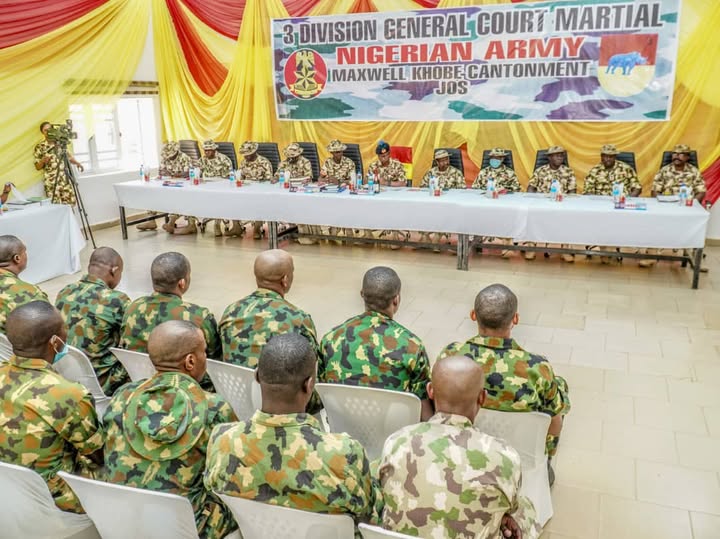
The military court martial Nigeria proceedings involve a broad cross-section of personnel from across the armed forces.
The panel is composed of senior officers from the:
- Nigerian Army
- Nigerian Navy
- Nigerian Air Force
It is chaired by Air Vice Marshal HI Alhaji, with members including Major Generals, Rear Admirals, and Air Vice Marshals. A Judge Advocate, Lt Col A. Mohammed, provides legal oversight.
The accused list spans ranks from a Brigadier General to junior non-commissioned officers. Among those named are:
- Brigadier General MA Sadiq
- Colonel MA Ma’aji
- Lieutenant Colonel IM Hussain
- Wing Commander IU Yusuf
- Major MM Jiddah
Additional personnel include captains, warrant officers, sergeants, and corporals, reflecting one of the most extensive military trials in recent Nigerian history .
The court-martial was constituted under the Armed Forces Act, Cap A20, Laws of the Federation of Nigeria 2004.
Human Rights and Due Process Concerns
Human rights concerns have intensified around the Nigeria coup trial, particularly regarding access to defendants and legal representation.
Families of the accused officers have alleged:
- Lack of communication since arrests
- Denial of access to detainees
- Restrictions on legal counsel
Sources indicated that the accused officers had been held for several months before formal proceedings began.
In addition:
- Lawyers were required to notify authorities within strict timelines
- Access to the courtroom was heavily restricted
- Security agencies conducted searches on all participants
Relatives and associates have called for the case to be transferred to a civilian court, arguing that public hearings would ensure fairness and transparency.
Activist Omoyele Sowore and others have also joined calls for a transparent process.
Parallel Prosecution Deepens Legal Debate
The court martial legal debate has been further complicated by parallel prosecutions.
In a related development:
- Six suspects, including retired military officers and civilians, were arraigned in a Federal High Court.
- Among those listed were retired Major General Mohammed Ibrahim Gana and retired Naval Captain Erasmus Ochegobia Victor.
- Former Minister of State for Petroleum Resources Timipre Sylva was named but remains “at large.”
Prosecutors alleged that the defendants conspired to “levy war against the state to overawe the President,” an offence under Section 37(2) of the Criminal Code.
As reported by Channels Television, the government maintains that the alleged plot was uncovered through internal intelligence operations and poses a serious national security threat.
What This Means for Nigeria’s Democracy
The Nigeria coup trial raises broader questions about governance, rule of law, and democratic accountability.
Key implications include:
🔹 Rule of Law
The use of both military and civilian courts for related offences raises concerns about consistency and constitutional compliance.
🔹 Military Influence
The decision to conduct proceedings within a military tribunal may reinforce perceptions of expanded military authority in legal matters.
🔹 Public Trust
Closed-door proceedings risk eroding public confidence in the justice system, particularly in politically sensitive cases.
Legal analysts warn that transparency will be critical in determining the credibility of the trial outcome.
Proceedings and Timeline
According to official documents, the General Court Martial was scheduled to begin sitting on April 23, 2026, at the Scorpion Officers’ Mess in Abuja.
Security arrangements include:
- Deployment of military, naval, and air police
- Strict access control measures
- Prohibition of unauthorised devices
The court is expected to conclude proceedings within a structured timeline, with the presiding officer required to submit records within 60 days of completion.
Related Coverage
- FG Files Treason Charges Against Sylva, Others
Explores the civilian prosecution angle tied to the same alleged coup plot. - Families Protest Detention of Military Officers in Nigeria
Highlights growing concerns from relatives over detention conditions and lack of access. - Burkina Faso’s Democratic Shift Raises Regional Questions
Provides regional context on the influence of the military in governance across West Africa.
The Nigeria coup trial represents a defining moment for Nigeria’s legal and democratic institutions. As proceedings continue behind closed doors, the balance between national security and constitutional rights remains under intense scrutiny.
Whether the trial strengthens or undermines public trust may ultimately depend on how transparently justice is seen to be served.
About the Author