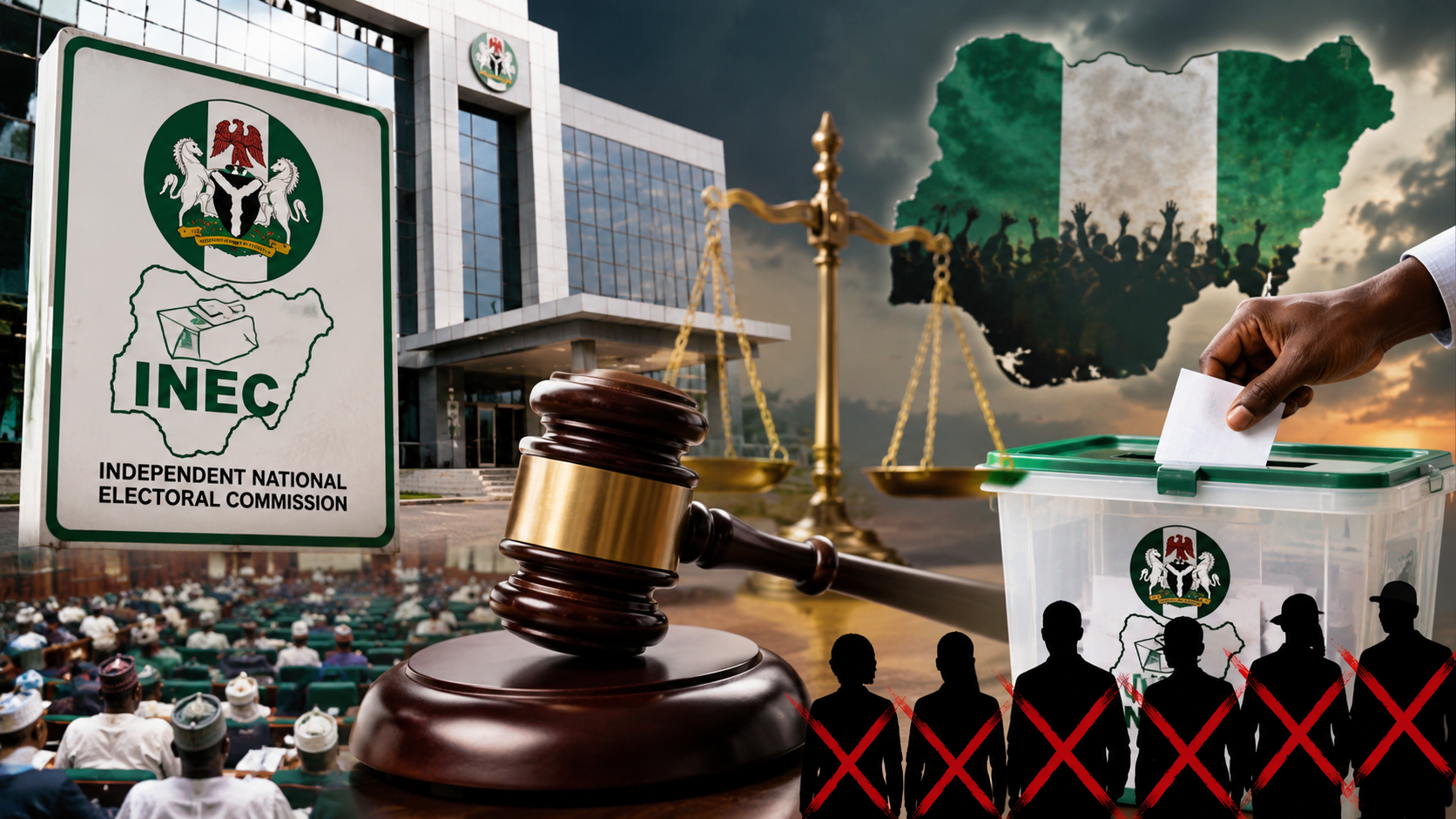
INEC Party Deregistration Order Shakes Nigeria’s Political Landscape Ahead of 2027 Elections
Nigeria’s electoral environment faces a significant legal and political test after a Federal High Court in Abuja ordered the Independent National Electoral Commission (INEC) to immediately deregister five registered political parties, including the African Democratic Congress (ADC), over what the court described as a failure to meet constitutional electoral performance requirements. The ruling, delivered by Justice Peter Lifu on June 15, 2026, could have far-reaching consequences for political competition, party organisation, and preparations for the 2027 general elections.
The judgment has already triggered resistance from affected parties, many of which are preparing appeals while warning that the decision could reshape the country’s multi-party democratic framework.
Federal High Court Directs Immediate Action
The court’s decision emerged from a suit filed by the Incorporated Trustees of the National Forum of Former Legislators.
Justice Peter Lifu ruled that the affected parties breached the provisions of Section 225A of the 1999 Constitution by failing to meet the electoral benchmarks required for continued registration.
The ruling directed INEC to proceed with the deregistration of the affected parties and cease official recognition of their activities.
The parties named in the judgment are:
- African Democratic Congress (ADC)
- Accord Party (A)
- Action Alliance (AA)
- Action Peoples Party (APP)
- Zenith Labour Party (ZLP)
The court further held that continued recognition of the parties would be inconsistent with constitutional provisions governing political party operations and electoral relevance.
The development immediately places INEC party deregistration at the centre of national political debate.
Why the Court Ordered the Deregistration
At the heart of the case was the constitutional requirement that political parties demonstrate measurable electoral relevance.
According to the judgment, the affected parties failed to secure at least 25 per cent of votes in any state during the 2023 presidential election and did not win elective offices at the federal, state, or local government levels.
The court also noted that subsequent by-elections did not produce results sufficient to justify their continued registration.
Supporters of the decision argue that political parties should demonstrate electoral viability if they are to remain on the ballot and continue benefiting from the privileges associated with registration.
Critics, however, contend that electoral success should not be the sole determinant of a party’s right to exist within a democratic system.
Why the INEC Party Deregistration Case Matters
The significance of the ruling extends beyond the five affected political organisations.
Political parties serve as the primary vehicles through which citizens organise, contest elections, and participate in governance. Any decision affecting party registration inevitably carries implications for political representation and voter choice.
The INEC party deregistration ruling arrives at a sensitive moment as politicians begin positioning themselves for the next electoral cycle.
Analysts note that smaller parties often play strategic roles in coalition-building, political negotiations, and grassroots mobilisation, even when they fail to secure major electoral victories.
As a result, the judgment raises broader questions about how Nigeria balances electoral efficiency with political pluralism.
Potential Impact on the 2027 Elections
One of the most immediate consequences of the ruling concerns the 2027 general elections.
If implemented without interruption and upheld through the appeals process, the affected parties could lose their ability to:
- Conduct party congresses
- Organize political rallies
- Hold primary elections
- Nominate candidates
- Participate in future elections
For politicians currently aligned with the affected platforms, the ruling may accelerate discussions around defections, mergers, and coalition arrangements.
Several observers believe the decision could trigger a fresh round of political realignment as stakeholders seek alternative platforms ahead of major electoral contests.
This could potentially reshape campaign strategies long before formal election activities begin.
Implications for Ekiti and Osun Governorship Polls
Beyond 2027, attention is also focused on upcoming off-cycle governorship elections in Ekiti and Osun states.
If the judgment is enforced immediately, candidates planning to contest under the affected party banners could face disqualification challenges.
Electoral lawyers note that the timing of implementation and the outcome of anticipated appeals will be crucial in determining whether the parties remain eligible to participate in future electoral exercises.
For voters in those states, the ruling may influence the range of political options available on the ballot.
ADC Rejects the Judgment
Among the parties most prominently affected is the African Democratic Congress.
The ADC has emerged in recent years as one of the better-known alternative political platforms outside Nigeria’s dominant parties.
Party leaders and supporters have reportedly rejected the court decision and signalled plans to challenge it at the Court of Appeal.
The response reflects broader concerns among opposition groups that the ruling could reduce political diversity and weaken smaller political movements.
The controversy also comes amid ongoing discussions surrounding the party’s internal evolution and national strategy.
For additional background, readers can review DSG HERALD’s earlier report on the ADC leadership crisis after the Supreme Court ruling:
Historical Context of Party Deregistration in Nigeria
The issue of political party deregistration is not new in Nigeria.
Over the years, debates have repeatedly emerged over whether political parties that consistently perform poorly should remain registered.
Supporters of deregistration often argue that maintaining dozens of inactive parties creates administrative burdens and voter confusion.
Opponents counter that democratic systems benefit from broad participation and that emerging political movements require time to build support.
Nigeria has previously witnessed deregistration exercises involving parties that failed to meet electoral thresholds.
However, legal disputes frequently followed such actions, underscoring the complexity of balancing constitutional requirements with democratic inclusion.
The current INEC party deregistration case may become another landmark chapter in that ongoing debate.
What Happens Next?
The next phase of the dispute is expected to unfold in the appellate courts.
Legal experts anticipate applications seeking stays of execution and other relief measures to prevent immediate implementation.
Until appellate courts provide clarity, uncertainty may persist regarding the operational status of the affected parties.
INEC itself could face legal and administrative questions about how quickly it should act while appeals remain pending.
The outcome of the appeals process may ultimately determine whether the deregistration order becomes a lasting political reality or a temporary legal development.
Wider Political Significance
The ruling arrives at a time when Nigeria’s political system is experiencing increasing competition, shifting alliances, and evolving voter expectations.
For major parties, the judgment may reduce competition from smaller platforms.
For opposition movements, however, it may serve as a reminder of the challenges associated with maintaining electoral relevance under existing constitutional requirements.
The broader debate is likely to focus on whether electoral performance standards strengthen democracy by encouraging viable political organisations or weaken it by limiting political participation.
Either way, the decision has already become one of the most consequential electoral developments of 2026. Readers seeking additional analysis may also find context in DSG HERALD’s previous coverage of political party deregistration and its implications for the 2027 race
Conclusion
The Federal High Court’s order directing INEC to deregister the parties ADC, Accord Party, Action Alliance, Action Peoples Party, and Zenith Labour Party marks a potentially defining moment in Nigeria’s electoral landscape.
While supporters view the ruling as the enforcement of constitutional standards, critics see it as a challenge to political diversity and democratic participation.
With appeals already being prepared and political stakeholders weighing their options, the ultimate fate of the affected parties may now rest with higher courts. What remains clear is that the ruling has injected fresh uncertainty into Nigeria’s political calculations ahead of the 2027 elections.
Recommended Coverage
INEC Voter Data Leak Raises Electoral Security Questions
Examines concerns surrounding election administration and voter data protection ahead of future electoral cycles.
INEC Defection Deadline Drives Party Realignment
Explores how political actors are repositioning as election timelines begin to take shape.
INEC–ADC 2027 Election Dispute Deepens
Provides additional insight into legal and political tensions involving the ADC and electoral authorities.
About the Author