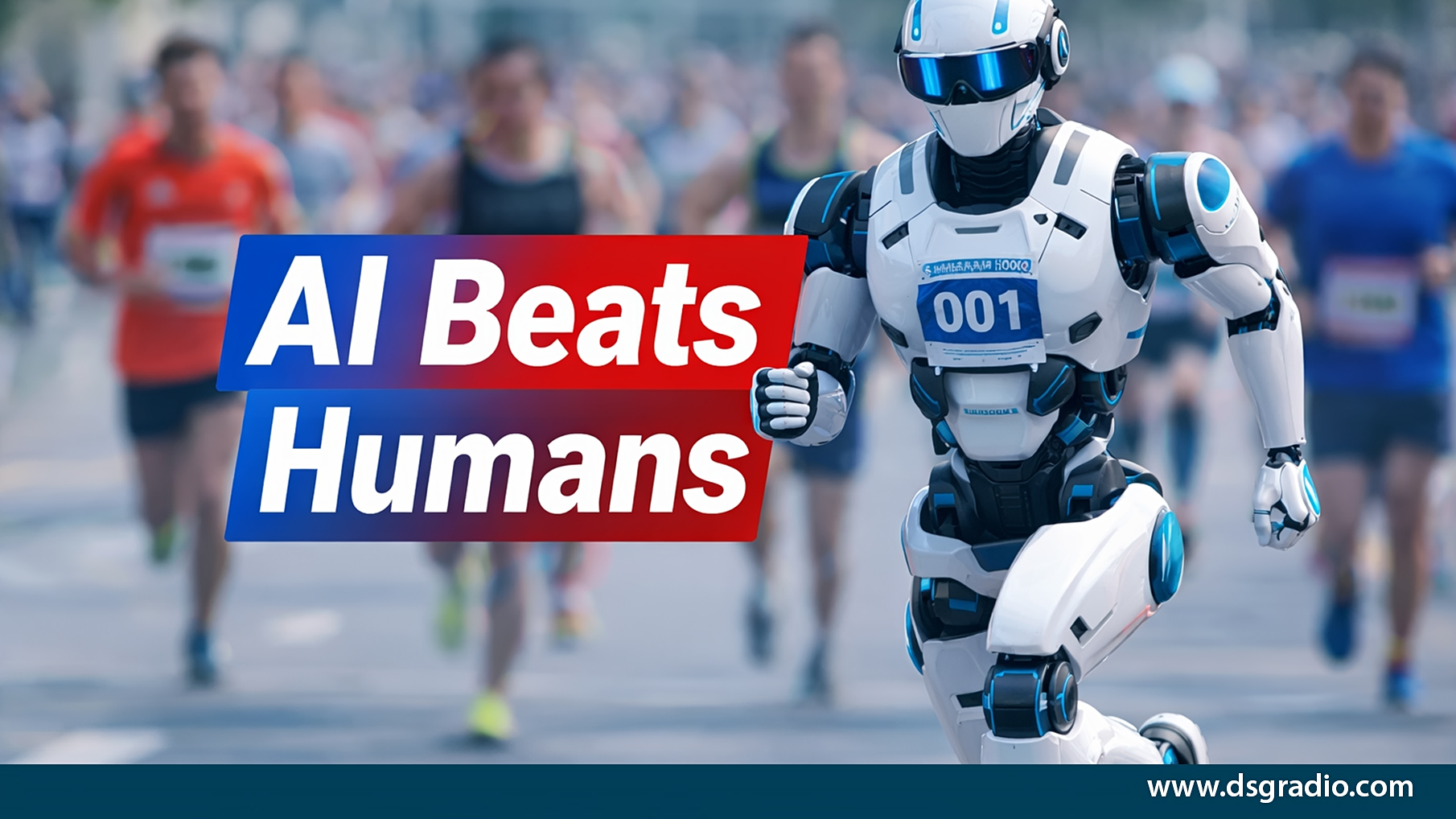
Humanoid Robot Marathon Sets Record in Beijing
The Humanoid Robot Marathon in Beijing has entered record-breaking territory after an autonomous robot named Flash completed a half-marathon in 50 minutes and 26 seconds, beating the human world record of 57:20. The race took place on April 19, 2026, at the Beijing Economic-Technological Development Area, marking a major milestone in artificial intelligence and robotics development.
AI Robot Outpaces Human Record
In a landmark moment for technology, the humanoid robot Flash, developed by Shenzhen Honour Smart Technology Development Co., Ltd., claimed victory in the autonomous navigation category of the Beijing E-Town half-marathon.
- Robot Time: 50 minutes, 26 seconds
- Human World Record: 57 minutes, 20 seconds
- Record Holder: Uganda’s Jacob Kiplimo (Lisbon Half Marathon, Portugal)
This performance represents one of the clearest real-world demonstrations of AI surpassing human endurance in running under controlled conditions.
According to report, the robot operated fully autonomously, without human intervention, during the race.
How the Humanoid Robot Marathon Works
The Beijing Robot Marathon is structured to ensure fairness and safety between human runners and machines.
- Robots and humans run on the same route
- Separate lanes are used to prevent interference
- Robots have a cutoff time of 3 hours and 40 minutes
- Two participation modes:
- Autonomous navigation
- Remote control (with time penalty coefficient of 1.2)
About 40% of participating teams chose autonomous navigation to achieve better results and enhance their technological credibility.
Liang Liang, deputy secretary-general of the Chinese Institute of Electronics, explained that the coefficient system was introduced to encourage the development of autonomous systems, which are considered essential for real-world applications of humanoid robots.
From Struggle to Breakthrough
The 2026 edition of the Humanoid Robot Marathon shows significant improvement over its inaugural event in 2025.
2025 Highlights:
- Winning robot: Tiangong Ultra
- Completion time: 2 hours, 40 minutes, 42 seconds
- Only 6 out of 20 teams finished
2026 Progress:
- Over 100 teams participated
- International teams from Germany, France, and Brazil
- Robots demonstrated:
- Increased speed
- Improved stability
- Better navigation systems
This rapid progression within just one year underscores the accelerating pace of robotics innovation.
Human Race Results Still Competitive
Despite the breakthrough in robotics, human athletes still delivered strong performances in their category:
- Men’s Winner: Zhao Haijie (China) – 1:07:47
- Women’s Winner: Wang Qiaoxia (China) – 1:18:06
While the robot outperformed the human world record, it is important to note that the competition conditions differ, particularly in lane separation and race format.
Why This Humanoid Robot Marathon Matters
The implications of this AI Running World Record go beyond sports.
1. Real-World Applications
Autonomous humanoid robots capable of sustained movement could be deployed in:
- Emergency response operations
- Logistics and delivery systems
- Hazardous environments
2. Technological Benchmark
The event provides a measurable benchmark for:
- AI decision-making
- Energy efficiency
- Mechanical endurance
3. Global Competition
With teams from Europe and South America joining, the Beijing Robot Marathon is becoming a global innovation platform.
Expert Perspective and Industry Context
The emphasis on autonomous navigation reflects a broader industry trend toward reducing reliance on human control.
As robotics continues to evolve, similar breakthroughs are emerging across other AI fields. For instance, this analysis explores developments in conversational AI, showing how machines are increasingly mimicking human capabilities across domains.
Additionally, this report examines the broader societal implications of humanoid robotics, raising questions about readiness and integration into daily life.
Verification and Source Attribution
Details of the race and results were reported by official Chinese sources, including coverage published on China’s government-affiliated platform, as seen in the original report.
Some technical aspects of robot design and performance could not be independently verified.
Future of the Humanoid Robot Marathon
The rapid improvements between 2025 and 2026 suggest that:
- Robots could soon compete under more equal conditions with humans
- AI endurance capabilities will continue to expand
- The line between human and machine athletic performance may blur further
Related Coverage
You may also want to read:
- Humanoid Robots and Society: Are We Ready?
Explores the societal and ethical implications of integrating humanoid robots into everyday life. - AI Virtual Assistants Reach Human-Like Interaction
Examines breakthroughs in AI communication that parallel physical advancements in robotics.
About the Author