Tinubu Certificate Petition Puts INEC Under Fresh Scrutiny
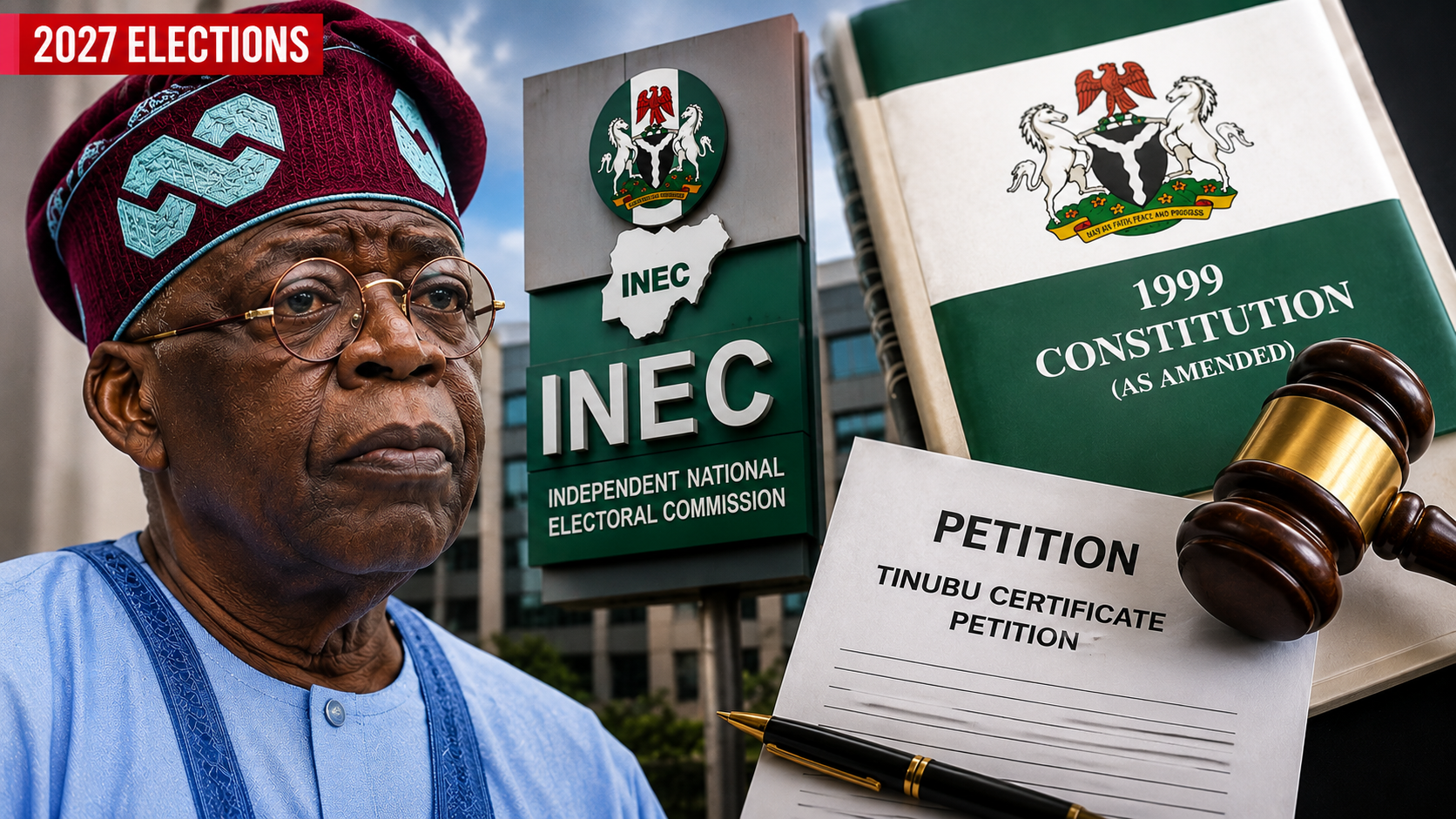
The Tinubu Certificate Petition submitted by the Center for Reform and Public Advocacy (CFRPA) has reopened a familiar but politically significant debate ahead of Nigeria’s 2027 general elections. While the petition directly questions the authenticity of President Bola Ahmed Tinubu’s academic credentials and National Youth Service Corps (NYSC) discharge certificate, the broader issue extends beyond the president himself. It places the spotlight on the Independent National Electoral Commission (INEC), the constitutional framework governing candidate qualification, and the public’s expectation that electoral institutions should provide clarity before political controversies escalate into legal battles.
The petition, dated June 19, 2026, was reportedly submitted to the INEC Chairman in Abuja. CFRPA, a civil society and anti-corruption advocacy group, requested clarification regarding Tinubu’s academic records, including his Chicago State University (CSU) certificate and NYSC discharge certificate. The group also reportedly questioned aspects of his educational history and warned that legal action could follow if the electoral commission fails to publicly respond.
Although the claims raised in the petition are not new, their re-emergence highlights a recurring feature of Nigerian politics: unresolved questions surrounding candidate credentials often return to the forefront whenever elections approach. As political actors begin positioning themselves for 2027, debates over qualification, eligibility, and institutional accountability are once again shaping the national conversation.
Why the Tinubu Certificate Petition Matters Beyond the Allegations
The significance of the current controversy lies not merely in the allegations contained in the petition but in what it demands from INEC.
Traditionally, disputes involving candidate credentials have often been settled through election tribunals and the courts after elections have taken place. Critics argue that this reactive approach creates uncertainty and allows legal disputes to become political crises.
By requesting a public clarification from INEC before the next election cycle gains momentum, CFRPA appears to be challenging the electoral body’s role in verifying documents submitted by candidates.
The petition effectively asks whether electoral institutions should take a more proactive position in determining eligibility before Nigerians cast their votes.
That question carries implications far beyond one politician or one election.
At the heart of the debate is Section 137(1)(g) of the 1999 Constitution (as amended), which disqualifies individuals found to have presented forged certificates to the electoral commission.
The constitutional provision itself is clear. What remains less clear, according to critics of the current system, is how and when allegations are thoroughly investigated and who bears primary responsibility for verification.
Understanding INEC Candidate Eligibility Requirements
The controversy has renewed public interest in INEC Candidate Eligibility procedures and the mechanisms used to assess documents submitted by political aspirants.
Candidates seeking elective office are required to submit information and supporting documents to the electoral commission through designated forms, including Form EC9.
Historically, INEC has maintained that it relies substantially on information provided by candidates, while disputes regarding authenticity often become matters for judicial determination when challenged.
This framework has generated debate among legal analysts and civil society organizations.
Supporters argue that INEC cannot realistically function as a nationwide investigative agency capable of conducting extensive forensic examinations of every document submitted by thousands of candidates.
Critics counter that advances in technology, digital verification systems, and international cooperation now make more rigorous screening possible.
The current petition has therefore revived a broader policy question: should Nigeria move toward a stronger pre-election verification system that reduces post-election litigation?
How Previous Certificate Disputes Shaped Political Debate
The current controversy cannot be separated from the intense legal and political battles that preceded the 2023 presidential election and its aftermath.
Questions regarding educational records became a major feature of national political discourse during that period, attracting both domestic and international attention.
One of the most widely discussed developments involved legal processes in the United States that sought records and testimony relating to Chicago State University.
Those proceedings generated significant media coverage and produced documents that political opponents cited in support of their arguments.
Supporters of President Tinubu maintained that the issues had already been litigated and addressed through established legal channels.
Opponents continued to argue that unresolved questions remained.
Regardless of political perspectives, the controversy demonstrated how educational records could become central issues in modern electoral contests.
The latest petition indicates that the matter has not disappeared from public discourse and may continue to influence political conversations leading up to 2027.
Why Certificate Controversies Persist in Nigerian Politics
The recurrence of credential-related disputes reflects deeper institutional and political realities.
1. Elections Are High-Stakes Competitions
Presidential elections in Nigeria carry enormous political and economic consequences.
Control of the presidency influences policy direction, federal appointments, budget priorities, and national development strategies.
Given those stakes, opposition groups often explore every available constitutional avenue to challenge rivals.
Academic qualifications remain one of the most visible and legally testable aspects of a candidate’s profile.
2. Verification Systems Remain a Subject of Debate
Many democracies continue to struggle with balancing administrative efficiency and rigorous verification.
In Nigeria, disagreements persist regarding how much investigative responsibility should rest with electoral authorities versus courts and law enforcement agencies.
As long as those questions remain unresolved, controversies over qualifications are likely to recur.
3. Public Trust Influences Political Perception
Perceptions of institutional neutrality significantly affect public confidence.
When electoral disputes emerge, citizens often expect clear communication from public institutions.
Civil society organizations frequently argue that transparency can help reduce speculation and strengthen trust in democratic processes.
4. Political Narratives Thrive on Uncertainty
Political actors naturally seek issues capable of mobilizing supporters and attracting media attention.
Credential controversies often generate intense public interest because they combine legal, ethical, and political dimensions.
As a result, unresolved questions can remain politically relevant for years.
Tinubu Certificate Petition and the 2027 Election Debate
The 2027 Election Debate is already beginning to take shape despite the election remaining some distance away.
Political alignments, coalition discussions, party restructuring efforts, and strategic calculations are increasingly influencing public discourse.
Within that context, qualification disputes become more than legal arguments.
They become political tools.
Analysts note that efforts to challenge eligibility can influence public perception even when courts ultimately determine the outcome.
Consequently, petitions such as the one submitted by CFRPA may serve multiple purposes:
- Seeking institutional clarification.
- Testing legal interpretations.
- Influencing public debate.
- Pressuring political stakeholders.
- Establishing narratives ahead of campaign season.
Whether the petition produces an official response from INEC remains to be seen.
However, its political significance extends beyond the immediate request.
The Constitutional Question at the Center of the Debate
The petition specifically references Section 137 Constitution provisions governing eligibility for the office of president.
Section 137 outlines circumstances under which an individual may be disqualified from contesting for the presidency.
The relevant subsection cited by CFRPA relates to allegations involving forged certificates.
Legal experts have long observed that disputes involving this provision typically require evidence, interpretation, and judicial determination.
As a result, constitutional debates often evolve into courtroom battles rather than administrative decisions.
This dynamic has shaped many election-related disputes in Nigeria over the years.
The latest petition may therefore become part of a larger conversation regarding whether institutional reforms are needed to reduce ambiguity before elections occur.
International Comparisons: How Other Democracies Handle Qualification Disputes
Nigeria is not alone in facing controversies over candidate qualifications.
Around the world, democracies have experienced disputes involving academic records, citizenship status, tax compliance, and eligibility requirements.
In some countries, independent verification agencies conduct extensive background checks before candidates appear on ballots.
Others rely heavily on judicial review after disputes arise.
The diversity of approaches demonstrates that no system is entirely immune from controversy.
However, international experiences suggest that transparent verification procedures and clear communication can help reduce uncertainty.
For Nigeria, the challenge is determining how best to balance constitutional rights, administrative practicality, and public confidence.
Governance, Accountability, and Institutional Credibility
The broader significance of the current controversy lies in governance rather than personality.
Regardless of political affiliation, citizens generally expect public institutions to operate transparently and consistently.
The petition therefore raises important questions:
- How should candidate credentials be verified?
- When should verification occur?
- Which institutions should lead investigations?
- What level of transparency should accompany such processes?
- How can public confidence be strengthened?
These questions are relevant not only to presidential elections but also to governorship, legislative, and local government contests.
Strengthening institutional credibility remains a central challenge for emerging and established democracies alike.
Media, Public Discourse, and the Role of Civil Society
Civil society organizations have historically played an important role in promoting accountability and transparency.
By submitting petitions, filing legal actions, conducting investigations, and engaging the public, such groups contribute to democratic oversight.
The CFRPA’s latest action reflects that tradition.
At the same time, responsible public discourse requires careful distinction between allegations, evidence, legal findings, and political claims.
As debate surrounding the petition continues, media organizations, public institutions, and political actors will likely face increased scrutiny regarding how information is presented and interpreted.
Maintaining factual accuracy and institutional neutrality will be essential.
What Happens Next?
Several possible developments could follow.
INEC may choose to publicly respond to the petition.
The commission could decline substantive comment if it considers the matter outside its administrative responsibilities.
The issue could also progress through legal channels if the petitioners pursue their stated threat of litigation.
Details regarding any future legal action remain unclear at this stage.
What is certain is that the controversy has already succeeded in reigniting discussion about electoral accountability and qualification standards.
As Nigeria moves closer to another election cycle, similar debates are likely to become more frequent.
Conclusion: A Test of Electoral Accountability
The Tinubu Certificate Petition is ultimately about more than one individual or one set of documents.
It represents a broader test of how democratic institutions respond to questions of accountability, transparency, and constitutional compliance.
For supporters of stronger verification processes, the petition presents an opportunity to push for institutional reforms.
For defenders of existing procedures, it reinforces the importance of allowing courts rather than political pressure to determine disputes.
Whatever position Nigerians take, the controversy underscores a fundamental reality of democratic governance: public confidence depends not only on election outcomes but also on trust in the systems that determine who is eligible to seek office.
As the 2027 election approaches, that trust may prove just as important as the votes themselves.
Recommended Coverage
Examines how legislative traditions and internal power structures continue to shape decision-making within Nigeria’s National Assembly.
Explores emerging coalition politics and shifting alliances that could influence the 2027 electoral landscape.
Analyzes growing concerns about freedom of expression, accountability, and legal boundaries in Nigeria’s public discourse.
Yahaya Bello Trial Faces Fresh School Fees Controversy
Provides insight into how educational and financial record disputes increasingly intersect with high-profile political and legal cases.
About the Author