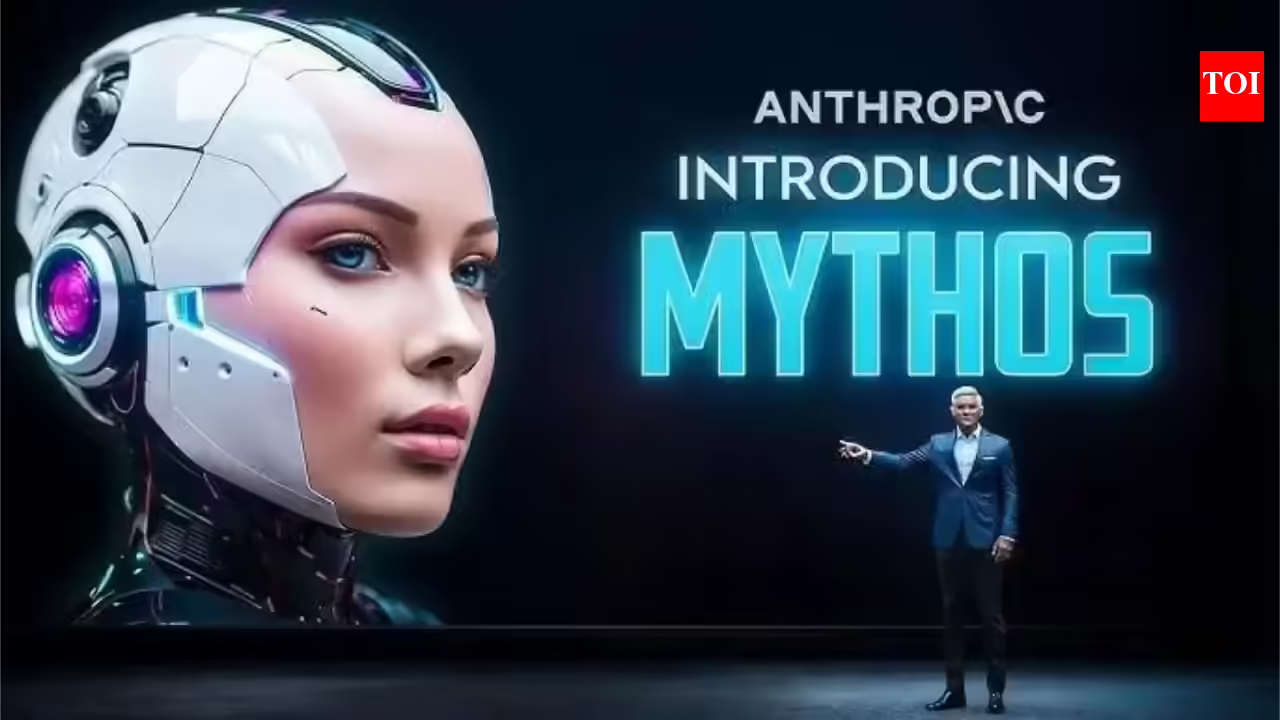
The Claude Mythos AI model has become a focal point of concern among global finance ministers, central bankers, and top financial executives, following warnings that it could expose vulnerabilities in critical financial systems. Discussions at the International Monetary Fund (IMF) meetings in Washington, DC, have highlighted potential cybersecurity risks associated with the model, as authorities assess its implications for global financial stability.
Claude Mythos AI Model Raises Alarm at IMF Meetings
The Claude Mythos AI model, developed by Anthropic, was widely discussed during IMF meetings attended by finance leaders from across the world. Canadian Finance Minister François-Philippe Champagne confirmed that the issue has drawn significant attention at the highest levels of global economic governance.
Champagne emphasised that the uncertainty surrounding the model makes it particularly concerning.
“Certainly it is serious enough to warrant the attention of all the finance ministers,” he said.
He further described the challenge as dealing with an “unknown unknown,” highlighting the difficulty in fully understanding the risks posed by the AI system.
What Is the Claude Mythos AI Model?
The Claude Mythos AI model is part of Anthropic’s Claude family of artificial intelligence systems, which compete with major AI platforms such as OpenAI’s ChatGPT and Google’s Gemini.
The model has attracted attention for its advanced capabilities in cybersecurity. Developers reported that Mythos demonstrated a “striking” capability to identify weaknesses in operating systems, software, and digital infrastructures.
Because of these capabilities, Anthropic has chosen not to release the model publicly. Instead, it has limited access to selected organisations, including major technology firms such as Amazon Web Services, Microsoft, Nvidia, and CrowdStrike.
This controlled deployment is part of Project Glasswing, an initiative that aims to strengthen global cybersecurity defences.
Cybersecurity Risks Linked to Claude Mythos AI Model
Experts warn that the Claude Mythos AI model could significantly impact cybersecurity, particularly within financial systems.
Key concerns include:
- The ability to uncover hidden vulnerabilities in banking infrastructure
- The risk that malicious actors could exploit these weaknesses
- Limited understanding of the model’s full capabilities
The UK’s AI Security Institute, which conducted an independent assessment, found that the model can successfully identify and exploit weaknesses in systems with poor security protections.
However, the institute also noted that Mythos does not appear to be significantly more advanced than earlier models, such as Claude Opus 4.
Despite this, researchers warned that similar or more powerful models are likely to emerge in the future.
Global Banks and Regulators Respond
Financial institutions and regulators are already taking precautionary measures in response to the Claude Mythos AI model.
Barclays CEO C.S. Venkatakrishnan stated that the model’s capabilities require urgent attention, emphasising the need to identify and fix vulnerabilities quickly.
Similarly, Bank of England Governor Andrew Bailey warned that the development could increase the risk of cybercrime by making it easier to detect weaknesses in core IT systems.
In the United States, the Treasury Department has reportedly engaged major banks, encouraging them to test their systems ahead of any potential public release of the model.
These actions reflect growing concern that the Claude Mythos AI model could reshape the cybersecurity landscape within the financial sector.
Testing, Access, and Industry Debate
Anthropic has taken a cautious approach by restricting access to the Claude Mythos AI model while allowing controlled testing. Governments, banks, and technology firms are being given opportunities to evaluate their systems using the model before any wider release.
To support broader testing, the company has also released a less powerful model, Claude Opus, enabling researchers to explore similar capabilities in a more controlled environment.
However, some experts have questioned whether concerns about Mythos are being overstated, noting that the model has not yet undergone extensive industry-wide evaluation.
Historical Context: AI Release Concerns Are Not New
The situation surrounding the Claude Mythos AI model echoes earlier debates in the AI industry.
In 2019, OpenAI delayed the release of GPT-2, citing fears that the technology could be misused.
While such decisions are often framed as safety measures, critics argue they can also generate public attention and hype around new technologies.
Nevertheless, the involvement of global financial institutions in the Mythos case marks a significant escalation in the stakes.
Future Implications of Claude Mythos AI Model
Experts believe the Claude Mythos AI model represents the beginning of a new era in AI-driven cybersecurity.
James Wise, a partner at Balderton Capital and chair of the Sovereign AI unit, described the model as the first of many powerful systems capable of exposing vulnerabilities.
He highlighted ongoing investments in AI safety and security, supported by £500 million in UK government funding, aimed at developing solutions to address these risks.
The dual nature of AI—both as a tool for protection and a potential threat—remains central to the debate.
The Claude Mythos AI model has quickly become a major concern for global financial leaders, highlighting the growing intersection of artificial intelligence and cybersecurity.
While the model offers the potential to strengthen defences by identifying vulnerabilities, it also raises serious questions about how such capabilities could be misused.
As testing continues and more information becomes available, governments, regulators, and financial institutions are expected to remain vigilant.
For now, the full impact of the Claude Mythos AI model remains uncertain, but its emergence signals a critical moment in the evolution of AI and global financial security.
About the Author