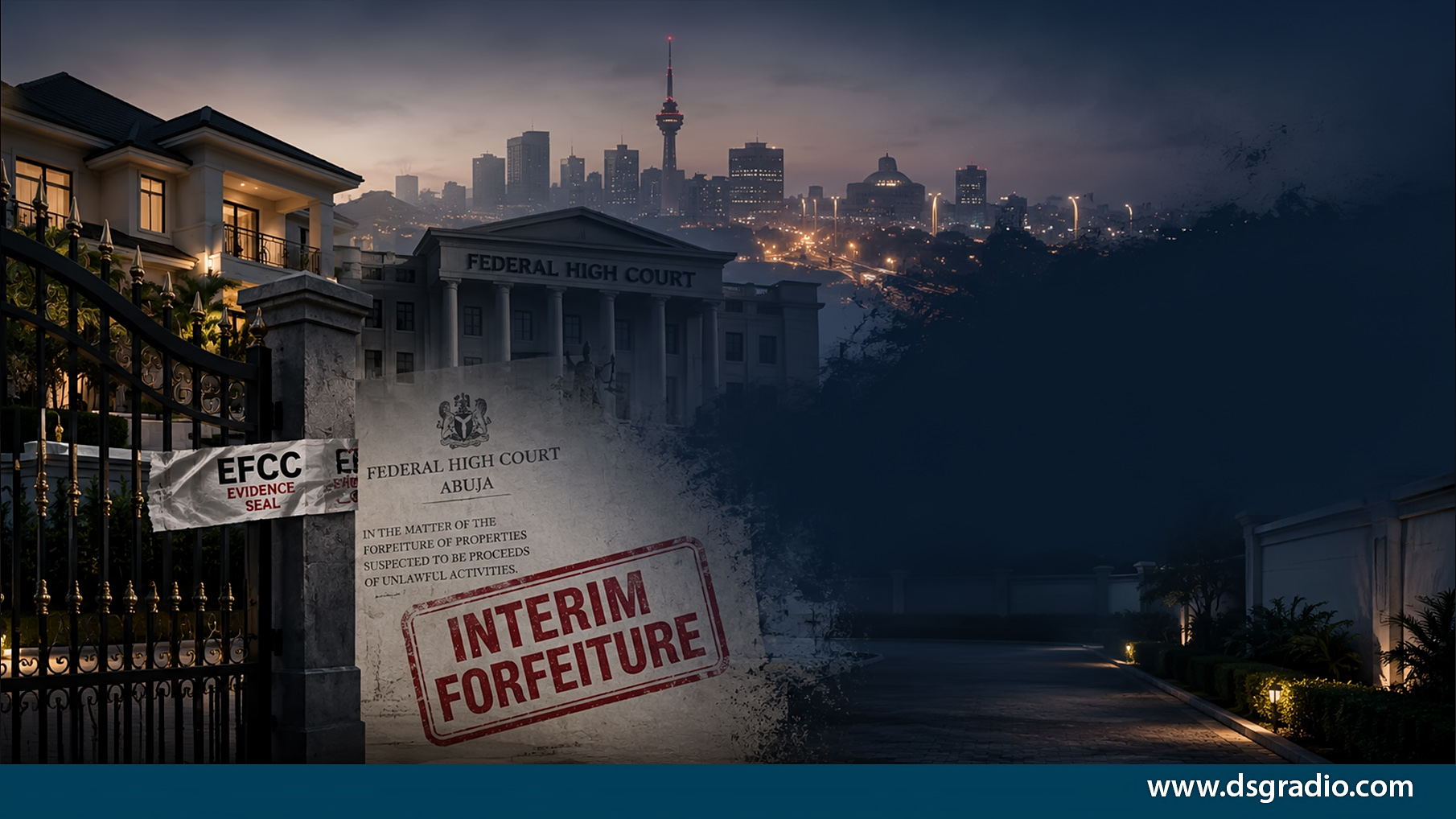
Timipre Sylva Properties Face EFCC Asset Recovery Push
Nigeria’s anti-corruption campaign has entered another high-profile phase after a Federal High Court in Abuja ordered the interim forfeiture of several high-value properties allegedly linked to former Minister of State for Petroleum Resources, Timipre Sylva.
The ruling, granted following an ex parte application filed by the Economic and Financial Crimes Commission (EFCC), affects nine properties located across some of Abuja’s most expensive districts. The court held that the assets were suspected to be proceeds of unlawful activities pending the determination of a final forfeiture application.
Justice Obiora Egwuatu issued the order after hearing arguments presented by EFCC counsel Oluwaleke Atolagbe. The court also directed that interested parties must appear within 14 days to explain why the assets should not be permanently forfeited to the Federal Government.
The decision marks another significant step in Nigeria’s expanding asset recovery efforts, as anti-graft agencies intensify investigations into politically exposed individuals and alleged illicit wealth accumulation.

Federal High Court Orders Interim Forfeiture
According to court filings, the affected assets include luxury residential and commercial properties spread across key districts of the Federal Capital Territory.
The assets reportedly include:
- Multiple terrace blocks in Dakibiyu
- Duplexes in Maitama and Mpape
- Residential apartment blocks in Wuse II and Garki
- A commercial property allegedly occupied by the National Information Technology Development Agency (NITDA)
The court ruled that the properties should remain under interim forfeiture pending the hearing of a motion seeking final confiscation.
Justice Egwuatu further ordered the EFCC to publish notices in national newspapers inviting anyone with legitimate claims to the assets to appear before the court.
The matter was adjourned to May 25 for a compliance report.
The original court proceedings were detailed in a report published by PUNCH Newspapers.
What Interim Forfeiture Means
Under Nigerian law, interim forfeiture allows the government to temporarily seize assets suspected to be connected to unlawful activities while investigations and legal proceedings continue.
Legal experts note that interim forfeiture does not automatically amount to a criminal conviction.
Instead, it enables authorities to preserve disputed assets pending final judicial determination.
In many EFCC cases, the commission seeks interim forfeiture to prevent the sale, transfer, or concealment of properties under investigation.
A final forfeiture order can only be granted after the court hears objections or counterclaims from interested parties.
This distinction remains critical in understanding the legal process surrounding the Timipre Sylva properties case.
EFCC’s Expanding Asset Recovery Campaign
The latest ruling reflects the EFCC’s broader strategy of targeting real estate assets believed to be linked to financial crimes, corruption, and illicit enrichment.
In recent years, Nigerian anti-graft agencies have increasingly focused on recovering properties, luxury assets, and offshore-linked investments connected to politically exposed persons.
The EFCC has argued in several cases that asset recovery serves as both a deterrent and a mechanism for restoring public confidence in governance.
Nigeria has also faced mounting international pressure to strengthen anti-corruption enforcement and improve transparency in public office.
Global organisations, including Transparency International and the World Bank, have repeatedly highlighted the importance of asset tracing and recovery in combating corruption.
The Sylva case now adds to a growing list of politically sensitive investigations involving former public officials.
Timipre Sylva’s Political Background
Timipre Sylva remains one of the most influential political figures from Nigeria’s oil-rich Niger Delta region.
He previously served as governor of Bayelsa State before his appointment as Minister of State for Petroleum Resources under former President Muhammadu Buhari’s administration.
Sylva also emerged as a key figure in national energy policy discussions during his time overseeing aspects of Nigeria’s petroleum sector.
His political career has included several electoral contests and strategic influence within the All Progressives Congress (APC).
The former minister has previously faced legal and political controversies, though not all resulted in convictions or formal charges.
The current EFCC forfeiture order centres specifically on properties alleged to be linked to unlawful activities.
Political and Governance Implications
Analysts say the case could carry wider political implications beyond the courtroom.
High-profile anti-corruption cases often trigger debates over accountability, selective prosecution, and the independence of law enforcement institutions.
Supporters of aggressive asset recovery measures argue that visible enforcement actions help strengthen public trust in anti-corruption agencies.
Critics, however, frequently call for greater transparency and consistency in prosecuting politically connected individuals.
The development also arrives amid heightened public attention on ongoing legal matters connected to national security and governance.
Recent reports on Nigeria’s coup-related investigations have already intensified public scrutiny of political and military accountability.
DSG HERALD previously examined how the Nigeria coup plot trial expanded through alleged financial and video evidence.
The platform also reported that the court restricted journalists’ access during proceedings linked to the coup trial.
Another DSG HERALD analysis explored the growing debate over military court jurisdiction in Nigeria’s coup-related prosecutions.
Why Abuja Real Estate Often Appears in EFCC Cases
Abuja’s luxury real estate market has repeatedly surfaced in major corruption investigations due to the concentration of high-value government-linked investments in the capital city.
Investigators frequently scrutinise:
- Luxury duplexes
- Apartment blocks
- Commercial office complexes
- High-end estates
- Shell property ownership structures
Real estate remains one of the most common channels through which illicit funds are allegedly concealed or converted into long-term assets.
Experts in financial crime investigations say tracing beneficial ownership of luxury properties has become central to anti-money laundering efforts in Nigeria.
The EFCC has increasingly relied on property documentation, land registry data, and financial transaction analysis in pursuing asset recovery cases.
Legal Questions Ahead
The next phase of the proceedings could determine whether the Federal Government secures permanent ownership of the disputed properties.
Interested individuals or entities may challenge the forfeiture application by presenting evidence before the court.
Legal observers say the case may hinge on:
- Proof of ownership
- Source-of-funds documentation
- Financial transaction records
- Compliance with due process
If uncontested, the court may proceed toward final forfeiture.
However, if objections are filed, the matter could evolve into a prolonged legal contest involving asset tracing and evidentiary disputes.
Details regarding additional evidence connected to the EFCC investigation were not fully specified in the original report.
Growing Focus on Accountability
The Timipre Sylva properties case arrives at a time when public pressure for stronger accountability mechanisms continues to rise across Nigeria.
Civil society organisations have repeatedly urged authorities to pursue transparent investigations regardless of political affiliation.
The Federal Government has also emphasised asset recovery as part of broader governance reforms aimed at strengthening institutional credibility and improving public sector transparency.
Whether the ongoing proceedings ultimately result in permanent forfeiture remains dependent on future court decisions and evidentiary findings presented during the next stages of litigation.
For now, the interim forfeiture order places another major political figure under intense legal and public scrutiny as Nigeria’s anti-corruption institutions continue expanding their asset recovery operations.
Recommended Coverage:
- Justice Crack Arraignment Fuels Free Speech Debate — The case highlights growing national conversations around law, accountability, and judicial oversight in Nigeria.
- Diezani London Trial Tests Global Anti-Corruption Enforcement — The report examines international dimensions of Nigerian corruption investigations and asset recovery efforts.
- Uche Nnaji Court Case Settlement Talks Stall Proceedings — Another high-profile legal dispute drawing attention to Nigeria’s judicial process and political accountability.
- UNILAG Lecturer Rape Case: Student Testifies in Court — A separate court-driven national story reflecting increased public focus on justice and institutional response.
About the Author