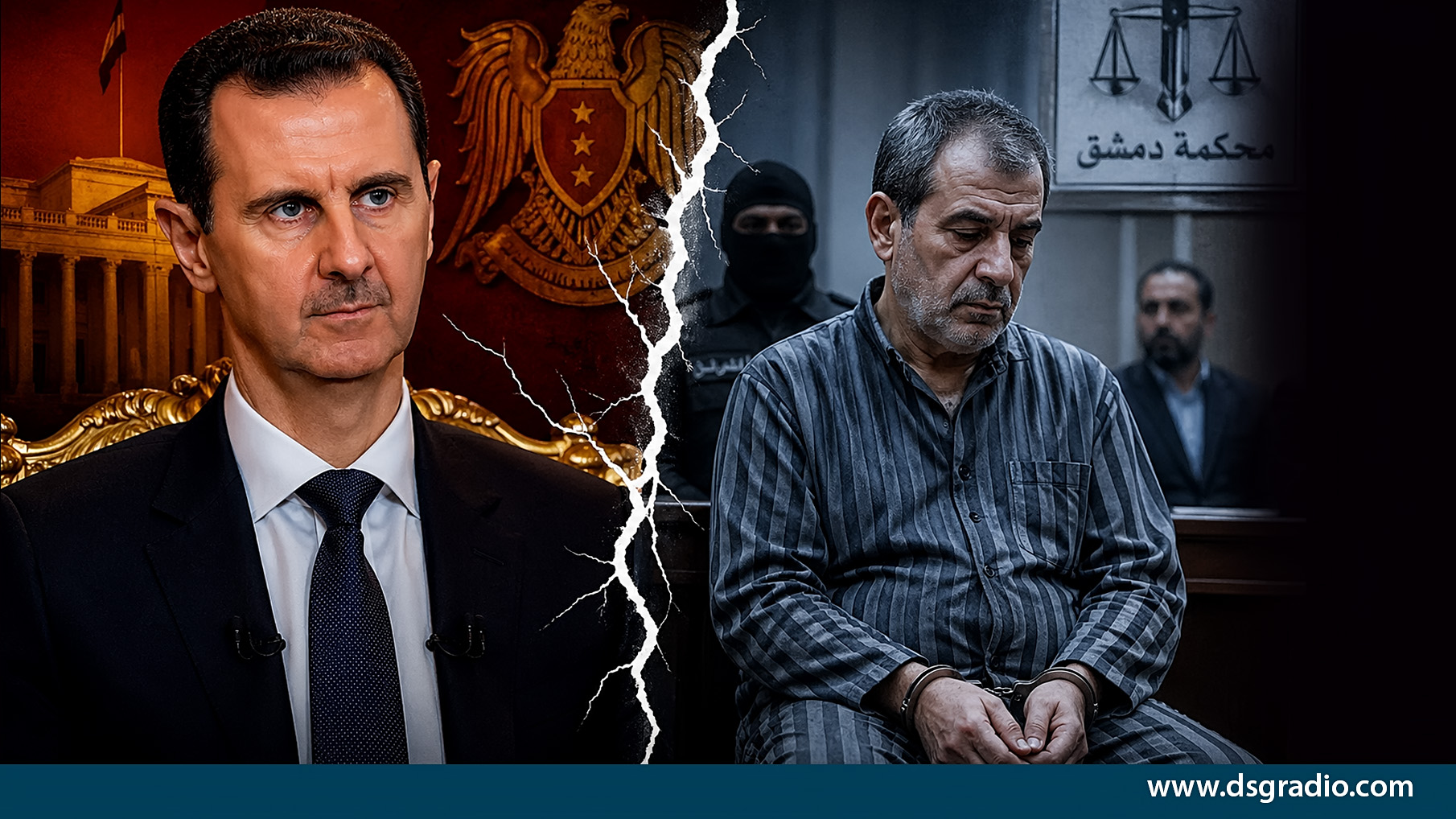
Syria Transitional Justice Begins with Landmark Assad-Era Trials
Syria has entered a defining phase of Syria transitional justice, as the first courtroom proceedings targeting former President Bashar al-Assad’s inner circle begin in Damascus, marking a historic shift toward accountability after more than a decade of civil war.
The trials, which opened on Sunday, involve former regime officials accused of crimes linked to the violent repression of protests that erupted in 2011. While Bashar al-Assad and his brother Maher al-Assad are being tried in absentia after fleeing to Russia, one key figure—former security official Atef Najib—appeared in court in handcuffs.
The proceedings represent the most visible step yet by Syria’s new authorities to deliver justice following the collapse of Assad’s government in December 2024.
From Repression to Reckoning
The Atef Najib trial carries deep symbolic weight. Najib, a cousin of Assad and former head of the Political Security Branch in Daraa, is accused of orchestrating repression during the early days of Syria’s uprising.
According to the primary report, Najib oversaw the arrest and torture of teenagers who wrote anti-government graffiti in 2011—an incident widely seen as the spark that ignited nationwide protests.
Those protests escalated into a brutal conflict that:
- Killed more than 500,000 people
- Displaced millions internally and externally
- Led to the disappearance of tens of thousands
Now, more than a decade later, the courtroom has become the stage for what officials describe as Syria’s first real attempt at justice.
Judge Fakhr al-Din al-Aryan described the proceedings as the beginning of “transitional justice,” noting that the trial includes both detained suspects and those who have fled.
Syria Transitional Justice and the New Political Order
The trials highlight a broader post-Assad Syria justice agenda led by interim President Ahmed al-Sharaa, whose administration has pledged accountability for past abuses.
Officials say the process is intended to:
- Restore trust in state institutions
- Demonstrate judicial independence
- Address the longstanding grievances of victims
Syrian authorities have framed the hearings as a foundational step toward rebuilding the country’s legal and political systems after years of authoritarian rule.
However, critics have raised concerns over delays in launching the justice process, as well as the challenges of prosecuting high-ranking figures who remain outside Syria.
Trials in Absentia: Limits of Accountability
A major limitation of the Assad trial in Syria proceedings is the absence of key defendants.
- Bashar al-Assad fled to Moscow in December 2024
- Maher al-Assad, former commander of the 4th Armoured Division, also remains abroad
- Several senior officials have reportedly taken refuge outside Syria
Their trials in absentia raise critical questions:
👉 Can justice be fully served without the presence of the accused?
👉 Will international cooperation enable future extraditions?
Legal experts note that while trials in absentia can establish historical accountability, they often struggle to deliver closure for victims.
Voices of Victims: Justice or Revenge?
Outside the Damascus courtroom, families of victims gathered to witness what many described as a long-awaited moment.
One plaintiff, Ramez Abu Nabbout, whose brother was killed during protests in Daraa, said:
“He was a civilian and peaceful, but Atef Najib greeted peaceful protesters with gunfire.”
Some victims’ families are calling for the harshest penalties, including the death sentence.
This has sparked a broader debate within Syria’s justice process:
- Should punishment prioritise retribution?
- Or should it focus on reconciliation and the rule of law?
The tension between justice and revenge remains a defining challenge in post-conflict societies.
Global Context: Lessons from Rwanda and Yugoslavia
Syria’s transitional justice process is being closely watched internationally, with comparisons drawn to:
- Rwanda’s Gacaca courts after the 1994 genocide
- International Criminal Tribunal for the former Yugoslavia (ICTY)
These precedents highlight both possibilities and limitations:
- Accountability can help rebuild national identity
- But justice processes can take decades
- Political interference can undermine outcomes
Unlike those cases, Syria’s trials are being conducted domestically, raising questions about independence and capacity.
A Fragile Path Toward National Healing
The Syrian civil war left the country deeply fractured—politically, socially, and economically.
Key unresolved issues include:
- Tens of thousands of missing persons
- Widespread infrastructure destruction
- Deep sectarian divisions
The success of Syria transitional justice will depend on whether these trials can:
- Deliver credible verdicts
- Gain public trust
- Avoid perceptions of political targeting
President Ahmed al-Sharaa stated that justice remains a “major goal that the state and its institutions strive to achieve.”
What Happens Next?
Sunday’s session focused on procedural matters, with no direct questioning of Atef Najib.
The court has scheduled the next hearing for May 10, where substantive proceedings are expected to begin.
Upcoming developments may include:
- Expansion of charges against additional officials
- Trials of other detained figures, such as Wassim al-Assad
- Potential international pressure for the extradition of fugitives
Meanwhile, Syrian authorities recently arrested Amjad Yousef, a former intelligence officer linked to alleged executions during the war, signalling a broader push to prosecute former regime figures.
Can Syria Deliver Real Justice?
The central question remains:
Can Syria deliver meaningful justice without Assad himself in the dock?
While the current trials mark a historic milestone, analysts warn that:
- Justice without top-level accountability may feel incomplete
- Political stability could influence judicial outcomes
- International legitimacy will depend on transparency
For now, the courtroom in Damascus stands as a symbol of a nation attempting to confront its past—even as many of its most powerful figures remain beyond reach.
You may also want to read:
- Global Tensions and the Risk of World War III
A broader analysis of geopolitical instability, providing context for conflicts like Syria’s and their global implications. - United Nations at 80: Challenges in a Changing World Order
Explores how global institutions respond to conflicts and justice processes like Syria’s transitional efforts. - US-Israel-Iran Conflict Escalation Across Middle East
Offers regional context on shifting alliances and tensions influencing Syria’s post-war landscape.
About the Author