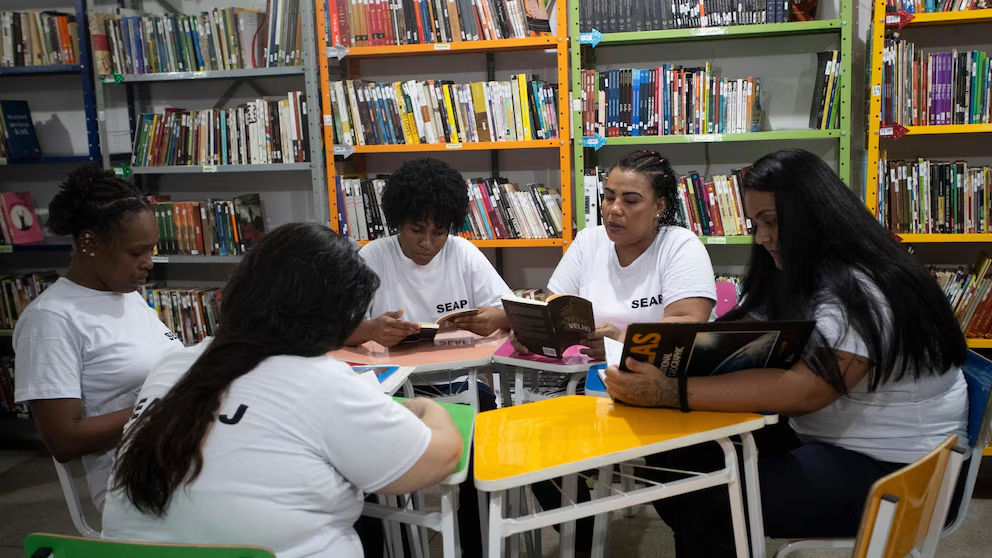
Brazilian Inmates Sentence Reduction Reading Gains National Attention
RIO DE JANEIRO, Brazil — Brazilian inmates’ sentence reduction reading programs are drawing renewed national and international attention as prisoners across the country shorten their jail terms through structured literary engagement. The initiative, which allows inmates to reduce sentences by reading books, has expanded significantly since its formal regulation in 2012 and nationwide standardisation in 2021.
According to the report , tens of thousands of detainees—including former Brazilian President Jair Bolsonaro, currently serving a 27-year sentence for attempting a coup—have enrolled in the program, which offers up to 48 days of sentence reduction annually.
How Brazilian Inmates Sentence Reduction Reading Works
The Brazilian inmates’ sentence-reduction reading program operates under a structured system in which prisoners read approved books and submit written reviews or assessments. Successful participation earns them reduced prison time.
Key features of the program include:
- Up to 4 days off per book completed
- A maximum of 48 days of reduction per year
- Participation across multiple prison facilities nationwide
- Integration with educational and rehabilitation programs
Officials say the initiative is one of the most formalised sentence remission systems globally.
Emily de Souza’s Story: A Personal Motivation
At the Djanira Dolores de Oliveira Women’s Prison in Rio de Janeiro, Emily de Souza, a 33-year-old inmate, is among those benefiting from the initiative.
The facility houses approximately 820 female detainees, though the exact local government area (LGA) and specific administrative district were not specified in the original report.
De Souza said she joined the Brazilian inmates’ sentence-reduction reading program to reconnect with her love of books and reduce her sentence.
Her motivation is deeply personal.
“One day is an eternity because it feels like it’s never going to end,” she said.
She hopes to reunite sooner with her 9-year-old autistic son, currently under the care of her mother and aunt.
Bolsonaro’s Participation Brings Renewed Spotlight
The program gained heightened attention earlier in 2026 after Brazil’s Supreme Court authorised former President Jair Bolsonaro to participate.
Bolsonaro, a high-profile political figure, is currently serving a 27-year prison sentence. His inclusion has sparked public debate about equality, justice, and access to rehabilitation programs within Brazil’s prison system.
While some see it as proof of fairness in the system, others question whether high-profile inmates receive preferential treatment.
Details about the exact prison location of Bolsonaro were not specified in the original report.
Education and Reintegration: Officials Speak
Andréia Oliveira, coordinator of female prisons and LGBTIQ+ inclusion in Rio de Janeiro state, emphasised the broader impact of the Brazilian inmates’ sentence reduction reading initiative.
She stated that access to education:
- Helps inmates reintegrate into society
- Encourages respect for laws and social norms
- Reduces recidivism
“When we encourage education, ludic activities, and knowledge, we return to society someone who can reconnect and respect rules,” Oliveira said.
Academic Support and Expansion of the Program
Since 2022, Paulo Roberto Tonani, a literature professor, has been actively conducting reading workshops in Rio’s prison system.
His work focuses on:
- Expanding access to books
- Supporting inmates in comprehension and analysis
- Promoting literature as a human right
Tonani emphasised the initiative’s philosophical foundation, citing Brazilian literary critic Antonio Candido, who argued that literature is a fundamental human right.
“Our goal… is to ensure this right. First, the right to lower one’s sentence through reading… and second, to truly consider access to literature,” he said.
Brazil’s Prison System Context
Brazil has one of the highest per-capita incarceration rates in Latin America, making rehabilitation programs critical to managing prison populations and reducing repeat offences.
The Brazilian inmates’ sentence reduction reading program stands out because:
- It is nationwide and standardised.
- It combines education with legal incentives.
- It aligns with human rights frameworks.
Experts say such programs are increasingly important as countries seek alternatives to purely punitive justice systems.
Broader Impact on Society
Authorities and experts argue that the Brazilian inmates’ sentence-reduction reading initiative benefits not only prisoners but also society at large.
Potential long-term impacts include:
- Lower recidivism rates
- Improved literacy among former inmates
- Better reintegration outcomes
- Reduced prison overcrowding
The Brazilian inmates’ sentence reduction reading program reflects a growing global shift toward rehabilitation-focused justice systems. With structured literary engagement offering tangible sentence reductions, the initiative provides inmates like Emily de Souza with hope, purpose, and a pathway back into society.
As participation expands—and high-profile figures like Jair Bolsonaro join—the program continues to spark debate about fairness, effectiveness, and the future of correctional reform in Brazil
About the Author