Breaking News: Malema Sentenced to Five Years in Prison
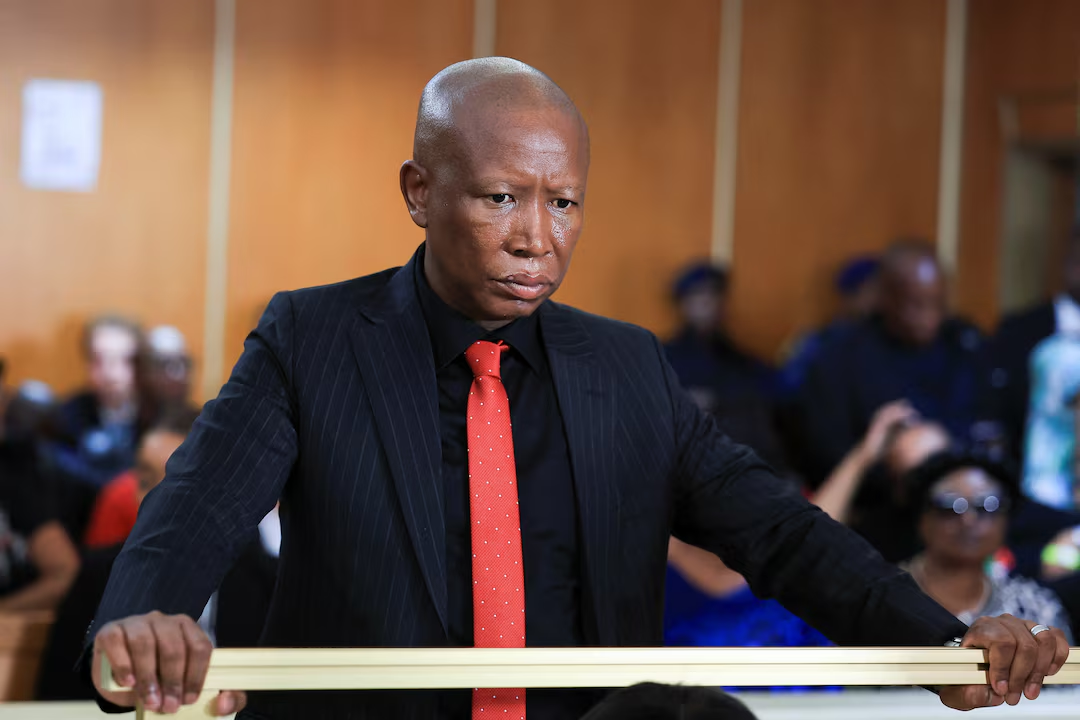
Malema Sentenced: South African opposition leader Julius Malema has been sentenced to five years in prison following a high-profile case involving the discharge of a firearm at a public event.
The ruling, delivered by a South African court, marks one of the most significant legal actions taken against a major political figure in recent years. Malema, leader of the Economic Freedom Fighters (EFF), was found guilty of violating firearm laws after footage showed him firing a rifle during a political gathering.
The case has drawn nationwide attention, raising questions about political accountability, the rule of law, and the broader implications for South Africa’s political landscape.
Malema Sentenced: Key Facts of the Case
- The incident occurred during a political rally where Malema was seen discharging a firearm.
- Video evidence of the act circulated widely on social media, sparking public outrage and legal scrutiny.
- Prosecutors argued that Malema’s actions violated national firearm regulations and posed a public safety risk.
- The court found him guilty, leading to a five-year prison sentence.
Authorities emphasised that the ruling was based strictly on legal violations, not political affiliation.
Rule of Law Tested: A Defining Moment for South Africa’s Judiciary
The sentencing of Malema is being viewed as a major test of South Africa’s judicial independence.
For many analysts, the decision sends a strong signal that no individual—regardless of political influence—is above the law. It reinforces the principle that public figures are subject to the same legal standards as ordinary citizens.
However, critics argue that the case may also expose perceived inconsistencies in how laws are enforced across different political actors. Questions are already emerging over whether similar actions by other figures have received equal legal attention.
This development places South Africa’s democratic institutions under renewed scrutiny, particularly at a time of heightened political competition.
Gun Culture and Political Messaging: A Controversial Symbol
Beyond the courtroom, the case has ignited debate about the role of symbolism in political communication.
Malema’s act of firing a weapon at a rally has been widely interpreted as a powerful—but controversial—gesture. Supporters argue it was symbolic and not intended to harm, while critics say it risks normalising violence in a country already grappling with high levels of gun-related crime.
Experts warn that such actions by influential leaders can shape public perception and behaviour, especially among young supporters. The case has therefore become part of a broader conversation about responsibility in political leadership.
Political Fallout: What It Means for the EFF and South Africa
The sentencing is expected to have immediate and long-term political consequences.
- For the EFF: Malema’s absence could create a leadership vacuum within the party, which has been largely defined by his personality and rhetoric.
- In the opposition landscape, the development may weaken one of the most vocal critics of the ruling African National Congress (ANC).
- For the ANC: While some may see this as a strategic advantage, there is also the risk of backlash if the ruling is perceived as politically motivated.
Political observers note that legal challenges involving high-profile leaders often reshape voter sentiment, sometimes strengthening support rather than diminishing it.
A Case That Goes Beyond the Courtroom
While the immediate outcome is clear—Malema sentenced to five years—the broader implications remain uncertain.
The case sits at the intersection of law, politics, and public perception:
- It tests the strength and neutrality of South Africa’s institutions
- It raises concerns about political conduct and messaging
- It reshapes the dynamics within the country’s opposition movement
As reactions continue to unfold, the story is likely to remain a central topic in South Africa’s political discourse in the coming weeks.
The sentencing of Julius Malema marks a pivotal moment in South African politics. More than just a legal decision, it represents a complex intersection of justice, leadership accountability, and political strategy.
Whether viewed as a victory for the rule of law or a controversial political development, one thing is certain: the impact of this ruling will be felt far beyond the courtroom.
About the Author