CAN Security Emergency Call Grows Amid School Abductions
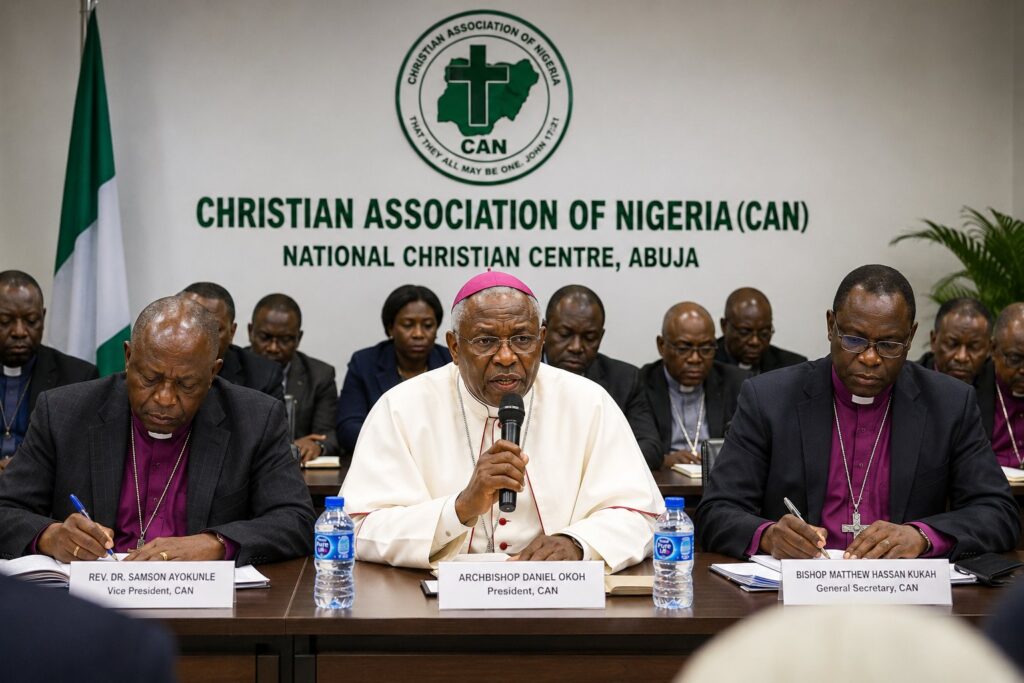
The Christian Association of Nigeria (CAN) has intensified pressure on the Federal Government by demanding what it describes as a security emergency response to Nigeria’s worsening insecurity crisis. The call comes amid rising incidents of killings, kidnappings, terrorist attacks, community destruction, and mass school abductions that have triggered nationwide concern. The demand was made during the National Church Denominational Leaders’ Summit in Abuja, where church leaders also declared a three-day national mourning period and designated a nationwide Black Sunday to honour victims of violence. The development has reignited debate about security reforms, state policing, government accountability, and the future of public safety in Africa’s most populous nation.
CAN Security Emergency Demand Reflects Growing National Anxiety
For many Nigerians, the latest intervention by CAN reflects a sentiment that has been building across communities affected by violence.
According to resolutions reached at the National Church Denominational Leaders’ Summit, church leaders expressed alarm over increasing attacks on communities, mass abductions, killings, and the displacement of thousands of citizens from their ancestral homes. The summit concluded that insecurity has reached a level requiring urgent and measurable action from government institutions.
The gathering, themed “The State of the Nation and the Way Forward,” brought together senior church leaders from across the country to review national challenges and discuss possible solutions. Participants identified insecurity as one of the most pressing threats confronting Nigeria today.
Unlike previous statements focused mainly on condolences and prayers, this intervention carried a stronger policy dimension. CAN called for structural reforms, enhanced intelligence operations, greater inter-agency cooperation, and accelerated efforts toward establishing state police structures.
The emphasis on institutional reforms demonstrates a shift from simply condemning violence to demanding specific security measures.
Why The CAN Security Emergency Call Matters
Nigeria has battled multiple security threats over the past decade.
These challenges include:
- Terrorist insurgency in the North-East
- Bandit attacks in North-West states
- Farmer-herder conflicts
- Kidnapping-for-ransom operations
- Attacks on schools
- Community invasions
- Criminal violence along major highways
While government agencies continue to report successes against criminal groups, attacks persist in many regions, creating a perception gap between official assurances and public experiences.
CAN’s latest demand is significant because it comes from one of Nigeria’s largest faith-based organizations with influence across multiple states and communities.
By framing the situation as a national emergency, the association seeks to elevate insecurity from a routine governance issue to a national priority that requires extraordinary attention.
School Abductions Continue To Shape The Debate
One of the strongest drivers behind the CAN Security Emergency demand is the resurgence of mass school kidnappings.
Church leaders specifically referenced incidents involving pupils, teachers, and educational institutions. Recent attacks have renewed fears that schools may once again become prime targets for criminal groups.
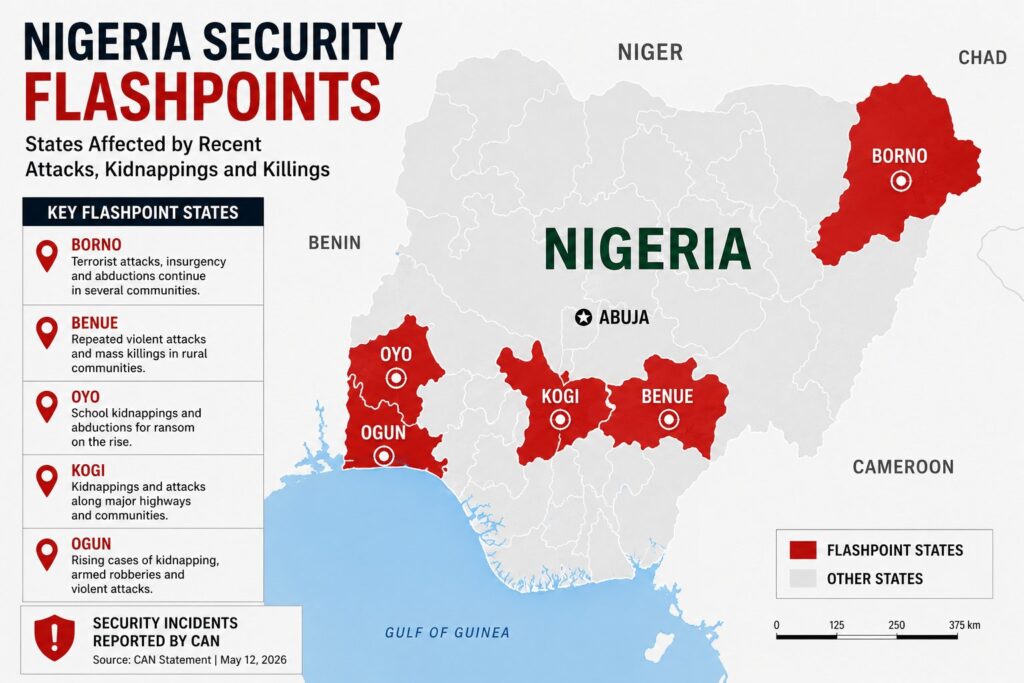
Among the incidents highlighted was the attack on schools in Oriire Local Government Area of Oyo State.
According to reports cited by church leaders:
- Thirty-nine pupils were abducted.
- Seven teachers were kidnapped.
- A vice principal was among those taken.
- A school worker was killed.
- A kidnapped mathematics teacher was reportedly beheaded.
The incident generated widespread outrage and renewed concerns about the safety of educational institutions.
The same period also witnessed reports of another mass abduction involving dozens of pupils in Borno State, adding to concerns about a possible resurgence of large-scale school kidnappings.

The Legacy Of School Kidnappings In Nigeria
School abductions occupy a unique place in Nigeria’s security history.
The issue gained international attention following the 2014 Chibok schoolgirls’ abduction.
Since then, multiple incidents have occurred in different parts of the country, affecting:
- Primary schools
- Secondary schools
- Boarding institutions
- Religious schools
These attacks often generate intense public reaction because children are involved and because schools represent places expected to be safe.
Every major kidnapping incident tends to trigger debates about:
- School security
- Intelligence gathering
- Community policing
- Security funding
- Emergency response mechanisms
The latest incidents cited by CAN have once again placed these discussions at the center of national discourse.
State Police Returns To The National Conversation
One of the most significant aspects of the CAN Security Emergency demand is its support for state police.
The organization called for accelerated constitutional and legislative processes that would allow decentralized security structures to operate legally and effectively.
The debate over state police is not new.
Supporters argue that:
- Local authorities understand local threats better.
- Intelligence gathering can improve.
- Response times may become faster.
- Security accountability may increase.
Critics, however, have raised concerns about:
- Political misuse.
- Funding challenges.
- Jurisdictional conflicts.
- Human rights risks.
Despite these concerns, mounting insecurity has continued to strengthen calls for decentralized policing models.
CAN’s endorsement adds another influential voice to the growing coalition advocating security restructuring.
National Mourning And Black Sunday Declaration
Although the broader security debate has attracted attention, the summit also announced symbolic measures intended to honour victims.
CAN declared a three-day national mourning period beginning June 12 and ending June 14. Churches across Nigeria were encouraged to participate in activities honouring victims of violence and insecurity.
The association also designated June 14 as Black Sunday.
The initiative is intended to:
- Honour victims of attacks.
- Support grieving families.
- Demonstrate national solidarity.
- Raise awareness about insecurity.
While symbolic actions alone do not solve security problems, they often serve as platforms for advocacy and public mobilization.
Government Response To Growing Security Concerns
The CAN Security Emergency demand arrives as government authorities continue implementing various security measures.
Among the actions highlighted in connection with recent incidents was the approval of 1,000 forest guards by President Bola Tinubu. Security agencies have also intensified rescue operations in affected areas.
State governments have likewise increased engagements with affected communities.
Officials have emphasized ongoing efforts aimed at:
- Intelligence gathering
- Rescue missions
- Community engagement
- Security deployment
- Infrastructure protection
However, persistent attacks continue to fuel criticism from citizens, advocacy groups, and religious organizations seeking faster and more visible results.
CAN’s Criticism Of Political Priorities
Another notable aspect of the summit was criticism directed at Nigeria’s political class.
Archbishop Daniel Okoh expressed concern that political activities, party defections, and early election calculations appear to be receiving significant attention while communities remain under threat.
This criticism reflects a broader public concern that security challenges should remain at the center of governance priorities.
Many observers argue that insecurity affects nearly every aspect of national development, including:
- Education
- Agriculture
- Business activities
- Investment
- Tourism
- Healthcare delivery
As a result, calls for greater focus on security continue to gain momentum.
Economic Consequences Of The Nigeria Insecurity Crisis
The Nigeria Insecurity Crisis extends beyond physical safety.
Violence and instability carry major economic implications.
Communities affected by attacks frequently experience:
- Reduced agricultural output
- Business closures
- Population displacement
- Loss of income
- Reduced investment confidence
When farmers abandon their lands due to insecurity, food production suffers.
When traders fear travelling on highways, commercial activity slows.
When schools close after attacks, educational outcomes decline.
The cumulative effect creates long-term development challenges that extend far beyond immediate security concerns.
Social Impact On Communities
The social consequences of insecurity are equally significant.
Thousands of families have reportedly been displaced from their homes. Communities that once functioned as stable economic and cultural centers have faced repeated disruptions.
Victims often experience:
- Trauma
- Loss of livelihoods
- Educational disruption
- Family separation
- Psychological distress
Church leaders highlighted these humanitarian concerns by calling for compensation, rehabilitation, and resettlement support for victims and affected families.
Such measures, they argued, are necessary not only for recovery but also for restoring confidence among citizens.
How Religious Organizations Shape Public Policy Debates
Faith-based organizations have historically played important roles in Nigeria’s national conversations.
Religious bodies often:
- Advocate for peace.
- Mediate disputes.
- Provide humanitarian assistance.
- Influence public opinion.
- Engage policymakers.
CAN’s latest intervention follows a long tradition of faith leaders participating in discussions about governance, justice, and national development.
Because religious institutions maintain extensive grassroots networks, their perspectives often resonate strongly with affected communities.
International Comparisons
Nigeria is not alone in confronting security challenges.
Countries across Africa and other regions have adopted various approaches to combating insurgency, organized crime, and community violence.
Common strategies include:
- Intelligence-led operations
- Community policing
- Security decentralization
- Technology-driven surveillance
- Border security reforms
The effectiveness of these approaches varies depending on political, social, and economic circumstances.
Nigeria’s ongoing debate over state police reflects broader international discussions about balancing centralized authority with local security responsiveness.
What Happens Next?
The CAN Security Emergency demand is unlikely to end with the summit.
Several issues are expected to remain central to public debate:
- Security sector reforms.
- State police legislation.
- School safety measures.
- Victim support programmes.
- Government accountability.
- Intelligence modernization.
The extent to which policymakers respond to these demands could shape future discussions about national security.
A Defining Moment For Nigeria’s Security Debate
The significance of CAN’s latest intervention lies not merely in its declaration of national mourning but in its attempt to reframe insecurity as an urgent national emergency requiring structural solutions.
By linking recent school abductions, community attacks, and rising public anxiety to broader questions of governance and security reform, the organization has pushed the conversation beyond sympathy and into policy territory.
Whether through enhanced intelligence operations, improved inter-agency coordination, state police reforms, or broader security restructuring, the message emerging from the summit is clear: many Nigerians believe the country has reached a critical moment in its security journey.
The coming months may determine whether these calls translate into lasting reforms or become another chapter in Nigeria’s long-running struggle against insecurity.
RECOMMENDED COVERAGE
This report examines the Federal Government’s deployment of forest guards and how the initiative fits into broader efforts to combat kidnapping and rural insecurity.
An in-depth look at growing concerns over attacks targeting religious institutions and the wider implications for public safety.
A report exploring international security concerns and what they reveal about perceptions of Nigeria’s security environment.
About the Author