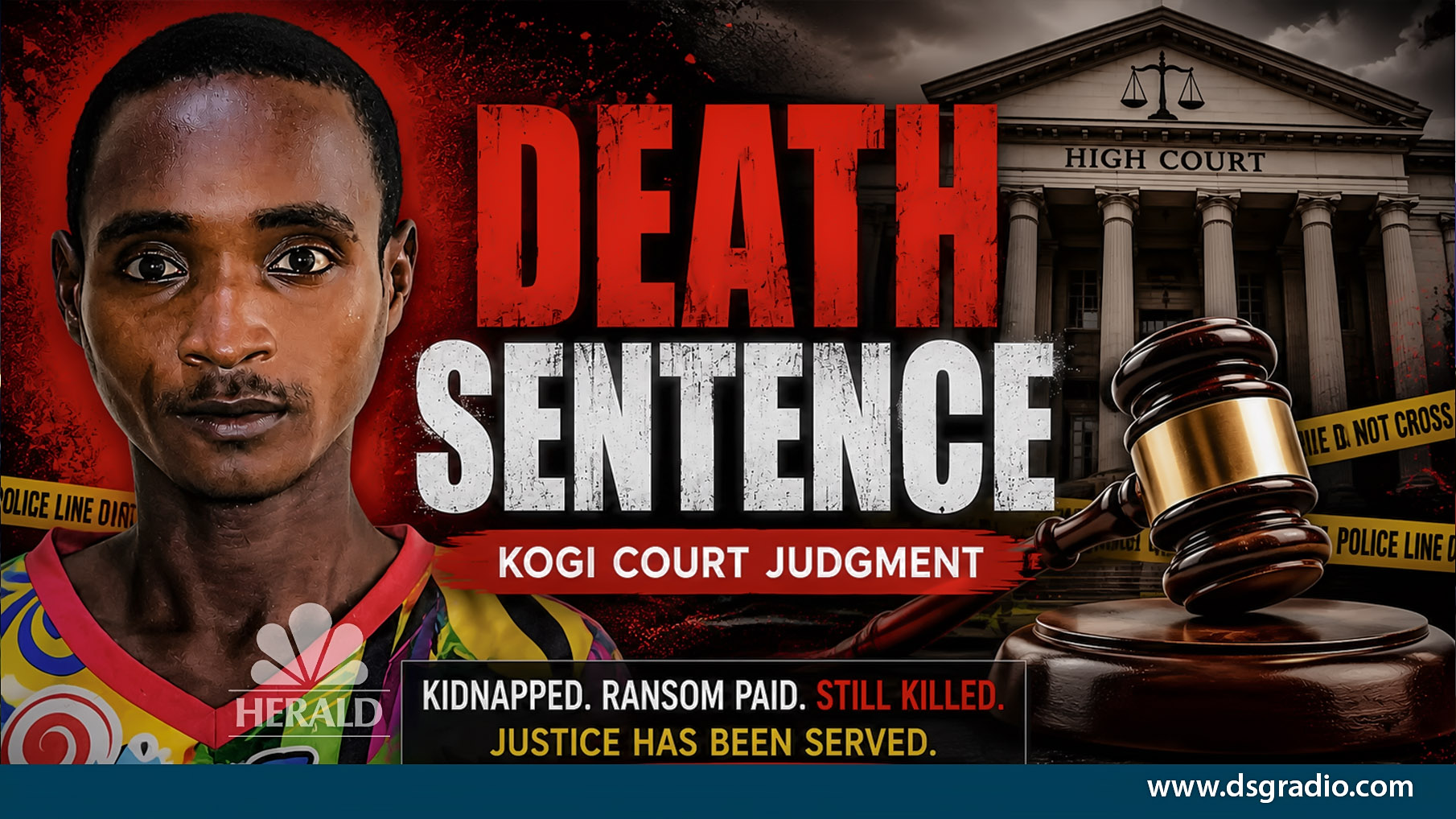
Kogi Kidnapping Case Ends With Death Sentence
The Kogi kidnapping case involving the abduction and killing of hotel proprietor Uche Andrew Offo reached a dramatic conclusion on Tuesday after a High Court in Kogi State sentenced Jibrin Halilu to death. Justice Abdul Nicodemus Awulu found Halilu guilty of conspiracy and kidnapping offences linked to the March 2023 crime in Obajana, where the victim was abducted, held for ransom and later killed despite his family paying N2.5 million demanded by the kidnappers. The ruling is being viewed as another significant judicial response to Nigeria’s persistent kidnapping crisis and a notable victory for security agencies prosecuting violent offenders.
Court Delivers Verdict In Kogi Kidnapping Case
Justice Abdul Nicodemus Awulu delivered the judgment after reviewing evidence presented during the trial, convicting Halilu on charges bordering on conspiracy and kidnapping.
The offences were prosecuted under Sections 12, 6(1), and 4(3)(a) of the Kogi State Kidnapping and Other Related Offences Prohibition Law, 2023.
According to evidence presented in court, Halilu and members of an armed gang stormed Ever Ready Hotel located in Angwa-Tiv area of Obajana on March 23, 2023, where they abducted the owner, Uche Andrew Offo.
Prosecutors told the court that Offo’s family complied with the kidnappers’ demand and paid a ransom of N2.5 million in an effort to secure his release.
However, despite receiving the payment, the kidnappers killed the victim.
The development shocked residents of Obajana and further highlighted concerns about criminal gangs operating across parts of North-Central Nigeria.
How DSS Investigators Linked The Convict To The Crime
Investigators from the Department of State Services (DSS) played a central role in the case.
According to information presented during the prosecution, Offo reportedly recognised Halilu while in captivity because the convicted man was his neighbour.
Security sources said this recognition may have influenced the decision of the kidnappers to kill the victim despite collecting the ransom.
The prosecution argued that the evidence gathered during investigations established Halilu’s involvement beyond reasonable doubt and linked him directly to the operation that led to Offo’s death.
The DSS prosecutor also informed the court that Halilu was arrested on December 4, 2025, following investigations into kidnapping activities within the state.
Additional Kidnapping Allegations Emerged During Investigation
The investigation reportedly uncovered another kidnapping incident allegedly linked to Halilu and members of his gang.
Security sources stated that the group was connected to the April 2, 2023 abduction of Ibrahim Abdullahi, a resident of Oshokoshoko community in Lokoja.
According to investigators, the gang allegedly collected N5 million ransom before releasing the victim.
Although the latest conviction focused primarily on the Offo case, the additional allegations painted a broader picture of organised criminal activity and reinforced concerns about repeat offenders involved in kidnapping operations across the region.
Why The Verdict Matters Beyond One Criminal Case
The Kogi kidnapping case comes at a time when kidnapping remains one of Nigeria’s most serious security challenges.
Across several states, criminal groups continue to target travellers, business owners, farmers, students and residents for ransom.
The financial impact on families is often devastating, while victims frequently endure psychological trauma even after release.
Security analysts note that successful prosecutions can serve multiple purposes:
- Deliver justice to victims and families.
- Strengthen public confidence in law enforcement.
- Deter criminal groups.
- Demonstrate that ransom-related crimes can lead to severe legal consequences.
The judgment therefore carries significance beyond the immediate parties involved.
For many Nigerians, the ruling represents another test of whether the criminal justice system can effectively address violent crimes that have persisted for years.
Part Of A Wider Pattern Of Terrorism And Kidnapping Convictions
The conviction also follows a series of high-profile cases involving suspects investigated and prosecuted with evidence gathered by the DSS.
Only a day before the Kogi judgment, a High Court in Katsina State reportedly sentenced a female arms courier, Hauwa’u Mukhtar, to death by hanging for offences connected to terrorism-related activities.
In another major case, a Federal High Court sitting in Abuja recently convicted four individuals over their involvement in the June 5, 2022 attack on St. Francis Catholic Church in Owo, Ondo State.
The attack resulted in dozens of deaths and injuries and remains one of the most devastating acts of violence in recent Nigerian history.
The court found four defendants guilty on multiple terrorism-related counts and sentenced them accordingly.
Together, these rulings reflect an increasing effort by courts and security agencies to pursue convictions in cases involving terrorism, kidnapping and organised violence.
Security Implications For Kogi State
Kogi State occupies a strategic position linking Nigeria’s northern and southern regions.
Because of its location, security incidents within the state often attract national attention.
Kidnapping has periodically affected communities and highways across the state, prompting repeated calls for stronger intelligence gathering, enhanced surveillance and improved cooperation among security agencies.
The successful prosecution of the case may encourage greater collaboration between investigators, prosecutors and the judiciary in handling future kidnapping cases.
It may also strengthen public willingness to provide intelligence to authorities when criminal activities occur within their communities.
Public Concern Over Ransom Payments
The killing of Offo despite the payment of ransom underscores a painful reality frequently observed in kidnapping cases.
Security experts have repeatedly warned that paying ransom does not always guarantee a victim’s release.
Families often face difficult choices when loved ones are abducted, particularly when authorities are unable to secure immediate rescue operations.
The tragedy of the Offo case is likely to renew public debate about kidnapping-for-ransom, security reforms and the protection of vulnerable communities.
The Broader Fight Against Kidnapping In Nigeria
The Kogi kidnapping case highlights the broader national struggle against criminal networks that profit from abductions.
Federal and state governments have introduced tougher laws, increased security operations and expanded intelligence-led policing efforts.
Several states have enacted specific anti-kidnapping legislation that carries severe penalties, including death sentences in certain circumstances.
While security agencies report successes in arrests and prosecutions, many communities continue to demand stronger preventive measures aimed at disrupting criminal groups before attacks occur.
Experts argue that long-term solutions will require a combination of law enforcement, economic development, community engagement and technology-driven security initiatives.
What Happens Next
With the court having delivered its judgment, the case now stands as one of the most significant kidnapping convictions recorded in Kogi State in recent years.
Legal processes available under Nigerian law remain open to the convicted individual, but the ruling sends a clear message regarding the consequences attached to kidnapping and murder offences.
For the family of Uche Andrew Offo, the judgment brings a measure of legal closure after more than three years of waiting for accountability.
For security agencies and prosecutors, it represents another high-profile conviction in the ongoing campaign against violent crime.
And for many Nigerians, the Kogi kidnapping case serves as a stark reminder of the human cost of kidnapping and the continuing importance of strengthening security and justice systems across the country.
Recommended Coverage
Constitutional Amendment Bills Advance In National Assembly
Link:37 Constitution Amendment Bills in National Assembly
A closer look at major constitutional reforms currently under consideration and their implications for governance and national development.
FAAC Allocation Rises To ₦2.257 Trillion
Link:FAAC Allocation Hits ₦2.257 Trillion in April
Examines revenue distribution among federal, state and local governments and its impact on public finances.
Nigerian Student Wins Prestigious Scholarship
Link:Kamdi Okeke Scholarship Achievement
Highlights a remarkable educational achievement and opportunities for Nigerian students abroad.
Diezani Alison-Madueke UK Case Ends
Link:Diezani Alison-Madueke Acquittal Case Explained
Provides context on one of the most closely watched legal cases involving a former Nigerian public official.
About the Author