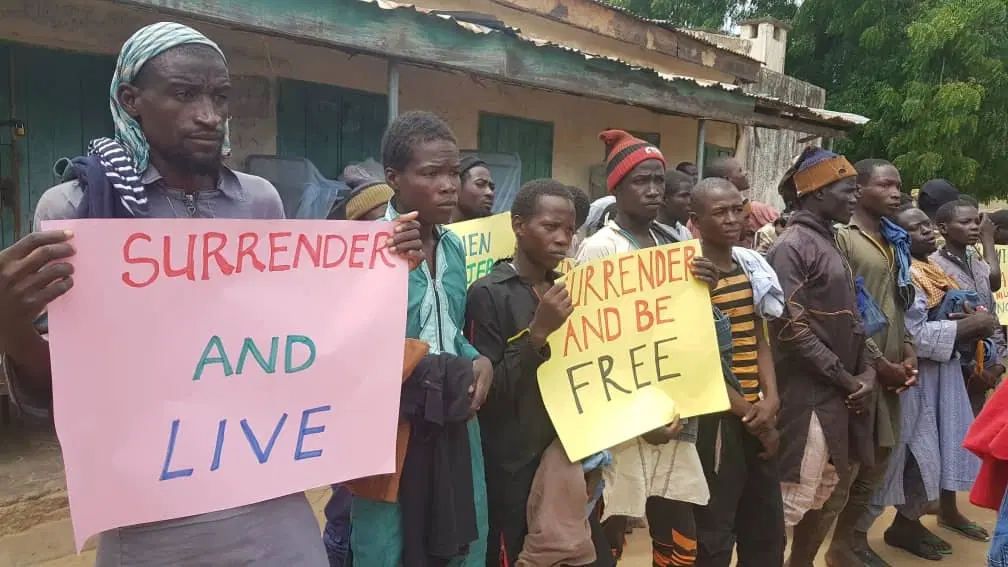
DHQ Terrorists Surrender, Nigeria Surpasses 300,000 as 2,615 Reintegrated
The Defence Headquarters (DHQ) has disclosed that more than 300,000 terrorists have surrendered to the Armed Forces of Nigeria between 2016 and 2025, while 2,615 ex-combatants have successfully undergone rehabilitation under the Operation Safe Corridor programme. The disclosure was made in Abuja on Friday by Brigadier General Yusuf Ali, National Coordinator of Operation Safe Corridor (OPSC), during an interview with THISDAY.
The DHQ terrorists’ surrender figures highlight a significant shift in the country’s counterinsurgency efforts, particularly against Boko Haram and Islamic State West Africa Province (ISWAP) fighters.
Breakdown of Surrenders and Reintegration Efforts
According to Brigadier General Yusuf Ali:
- Over 300,000 individuals surrendered during military operations.
- The figure includes men, women, and children.
- Only 2,615 ex-combatants completed the OPSC programme.
Ali clarified that:
“2,615 have so far graduated through OPSC. This is out of more than 300,000 who have surrendered, including women and children.”
However, the programme does not admit women and children, who are instead:
- Handed over to state governments
- Supported by agencies such as UNICEF for rehabilitation
This distinction is central to understanding the DHQ terrorists’ surrender of Nigerian data, as the bulk of those surrendering are not processed through the military-led deradicalisation programme.
Operation Safe Corridor: Structure and Objectives
Operation Safe Corridor (OPSC) is a federal government initiative designed to:
- Encourage the voluntary surrender of insurgents.
- Provide deradicalisation and rehabilitation.
- Facilitate reintegration into society.
The programme specifically targets:
- Low-risk fighters
- Individuals are coerced into joining insurgent groups.
- Victims of abduction or forced recruitment
Participants undergo a six-month intensive Deradicalisation, Rehabilitation, and Reintegration (DRR) programme.
Ali noted that the initiative is multi-agency, involving security services and civilian institutions to ensure a structured transition back into society.
Monitoring and Accountability Measures
Addressing concerns about post-reintegration risks, Brigadier General Ali emphasised the introduction of monitoring systems, including:
- National Identification Number (NIN) registration
- Structured tracking of ex-combatants after graduation
He stated that these measures are aimed at ensuring:
- Continued surveillance and accountability
- Prevention of recidivism (return to insurgency)
The DHQ terrorists’ surrender framework is therefore not limited to rehabilitation but extends into long-term monitoring mechanisms.
Challenges in Reintegration and Public Concerns
Ali acknowledged that the programme faces several challenges, particularly:
- Community acceptance of former insurgents
- Balancing victim justice with reintegration efforts
- Managing public scepticism and security fears
He stated:
“Community acceptance and balancing victim support with reintegration remain areas of focus.”
These concerns are consistent with global experiences in post-conflict rehabilitation programmes, especially in active insurgency environments.
Programme Evolution and Strategic Adjustments
The OPSC programme is continuously evolving in response to Nigeria’s changing security landscape.
Ali explained:
“Operation Safe Corridor is not static; it continuously evolves in response to the changing security environment.”
Key improvements include:
- Stronger community engagement initiatives
- Increased focus on victim-centred interventions
- Enhanced multi-agency collaboration
These adjustments are designed to strengthen trust and improve outcomes in areas heavily affected by insurgency.
Context: Nigeria’s Counterinsurgency Campaign
Nigeria has battled insurgency in the North-East for over a decade, primarily driven by:
- Boko Haram
- Islamic State West Africa Province (ISWAP)
The mass surrender of fighters reflects:
- Sustained military pressure
- Improved intelligence operations
- Strategic use of non-kinetic approaches, including rehabilitation
The DHQ terrorists’ surrender figures suggest that a combination of force and reintegration strategies is shaping the current phase of the conflict.
Implications for National Security
Security analysts note that the large number of surrenders could have both positive and complex implications:
Positive Indicators:
- Reduction in active combatants
- Weakening of insurgent structures
- Increased intelligence from defectors
Ongoing Risks:
- Potential infiltration risks
- Challenges in community reintegration
- Long-term monitoring burdens
Authorities maintain that the structured framework of Operation Safe Corridor is designed to mitigate these risks.
About the Author