US Mine-Clearing Strait of Hormuz Amid Fragile Ceasefire as Talks Continue in Pakistan
US Mine-Clearing Operations Begin in Strait of Hormuz as Ceasefire Talks Intensify
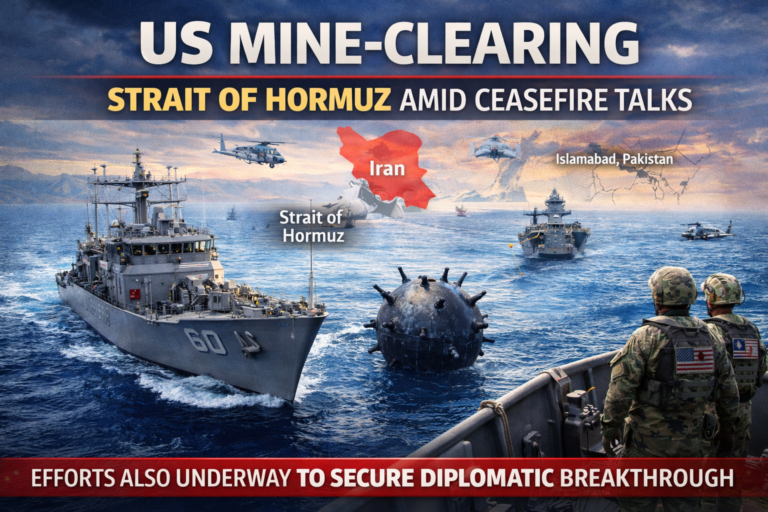
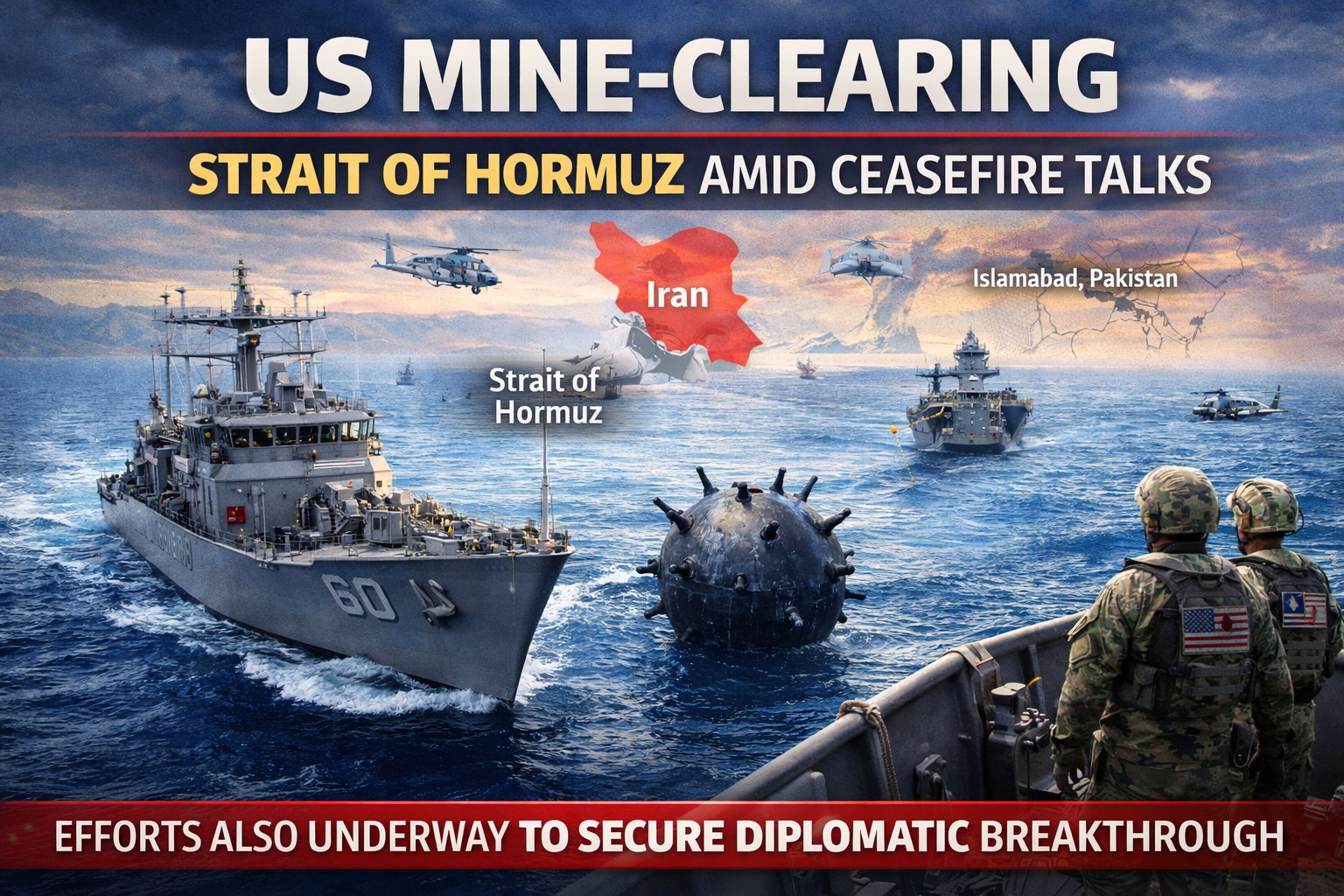
The US Mine-Clearing operation in the Strait of Hormuz has officially commenced, with the United States deploying specialised naval assets to secure and reopen one of the world’s most critical oil transit routes.
According to the US Central Command (CENTCOM), the mission aims to restore safe maritime navigation following recent hostilities that heightened tensions across the Gulf region. The move comes at a delicate moment, as diplomatic efforts between the United States and Iran continue in Islamabad, Pakistan, under a fragile ceasefire agreement.
The US Mine-Clearing initiative is seen as a crucial step toward stabilising global energy supply chains, given that the Strait of Hormuz handles a significant share of the world’s oil shipments. Analysts note that any disruption in this corridor can have immediate ripple effects on global markets.
US Naval Operation Targets Global Oil Lifeline
According to CENTCOM Commander Admiral Brad Cooper, the mission is designed to re-establish safe shipping lanes and restore confidence in global maritime trade.
“Today, we began the process of establishing a new passage, and we will share this safe pathway with the maritime industry soon to encourage the free flow of commerce,” Cooper stated.
The Strait of Hormuz handles a significant portion of the world’s oil exports, and disruptions have triggered widespread concern across global energy markets.
- Only about 30 ships have reportedly passed through the corridor since the conflict began
- Maritime traffic remains severely restricted
- Oil supply chains have faced uncertainty and volatility
US-Iran Talks Reach Expert-Level Phase in Pakistan
Parallel to the military operation, diplomatic efforts are underway in Islamabad, Pakistan, where the United States and Iran are engaged in rare direct negotiations.
Key participants include:
- JD Vance – Vice President of the United States (leading US delegation)
- Mohammad Bagher Ghalibaf – Speaker of Iran’s Parliament
- Abbas Araghchi – Iran’s Foreign Minister
The talks, described as the first direct engagement in decades, have progressed into an “expert-level stage”, involving:
- Economic discussions
- Military de-escalation frameworks
- Nuclear program negotiations
- Legal and sanctions-related issues
Iranian officials confirmed that specialised committees are working on technical details to finalise potential agreements.
Trump Downplays Negotiations Outcome
US President Donald Trump made controversial remarks suggesting that the outcome of the negotiations may not significantly impact the United States.
“Regardless of what happens, we win. We’ve defeated them militarily,” Trump said while departing the White House.
He added:
“Whether we make a deal or not makes no difference to me.”
Trump also issued a warning to China, stating:
“If China ships weapons to Iran, China will have big problems.”
These remarks highlight a continued hardline stance, even as diplomatic efforts proceed.
Regional Tensions Persist Despite Ceasefire
While a ceasefire agreement was reached earlier in the week, tensions remain high across the region.
Israeli Prime Minister Benjamin Netanyahu cast doubt on the durability of the ceasefire:
“The campaign is not yet over, but it can already be said clearly, we have achieved historic results.”
He further claimed:
- Iran is weakened
- Tehran is “begging for a ceasefire”
- Its nuclear capabilities will be dismantled “by agreement or by other means”
Meanwhile, Lebanon continues to experience violence, with the death toll exceeding 2,000, linked to ongoing clashes involving Israel and Hezbollah.
Qatar Announces Partial Maritime Resumption
In a related development, Qatar’s Ministry of Transport announced that maritime navigation in the Persian Gulf would resume under controlled conditions starting Sunday, April 12, 2026.
Key directives include:
- Sailing permitted from 6 a.m. to 6 p.m. for all vessels
- Fishing vessels allowed full-day operations
- Mandatory compliance with safety and security protocols
However, no official statement from Iran has confirmed coordination with Qatar regarding the reopening.
Macron Urges Iran to Seize Diplomatic Opportunity
French President Emmanuel Macron confirmed that he had spoken with Iranian President Masoud Pezeshkian, urging Tehran to pursue de-escalation.
Macron emphasized:
- The need for regional security guarantees
- The importance of reopening the Strait of Hormuz
- A broader ceasefire including Lebanon
His intervention underscores growing European concern over the crisis’s global implications.
Global Implications: Energy, Security, and Trade
Analysts warn that the outcome of both the US mine-clearing Strait of Hormuz operation and the US-Iran talks in Pakistan will significantly shape global stability.
Potential impacts include:
If Successful:
- Restoration of global oil supply routes
- Stabilisation of energy prices
- Reduced geopolitical tension
If Talks Fail:
- Renewed military escalation
- Prolonged disruption of shipping lanes
- Increased global economic uncertainty
About the Author