Tinubu Airport Meeting Plateau Victims Sparks National Debate
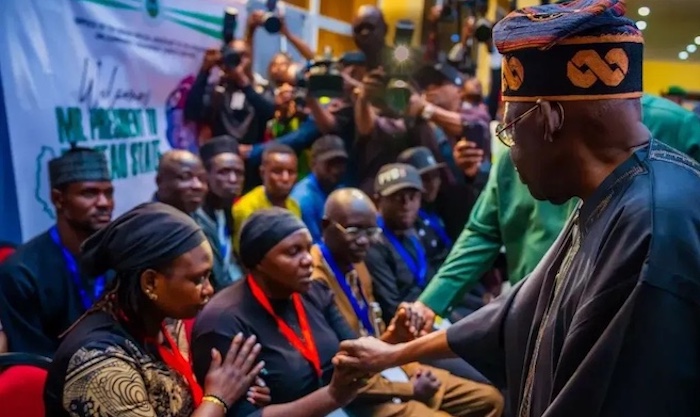
President Bola Ahmed Tinubu’s airport meeting with victims of the Plateau attacks has drawn mixed reactions, with the presidency defending the decision, citing logistical and aviation constraints, while opposition figures criticised the approach as inadequate. The meeting took place on Thursday at Jos Airport in Plateau State after adjustments to the President’s schedule. The Tinubu airport meeting on the Plateau victims issue has since become a focal point of national discourse on leadership response to insecurity.
Presidency Explains Airport Meeting Decision
In a statement issued on Friday by Bayo Onanuga, Special Adviser on Information and Strategy, the presidency said the President’s schedule was constrained by multiple high-level engagements.
According to the statement:
- Tinubu was scheduled to receive Chadian President Mahamat Idriss Déby Itno.
- He also planned a trip to Iperu, Ogun State.
- The meeting with Déby Itno extended beyond the expected time.
The presidency stated that after a briefing from Plateau State Governor Caleb Mutfwang, Tinubu had initially planned to travel to Jos but was limited by operational realities.
A key factor cited was aviation safety:
“The runway does not support night flights due to the absence of navigational aids.”
Officials explained that the road journey from the airport to Jos city takes about 40 minutes, making it impractical to visit affected communities and return before nightfall.
Logistical Constraints and Security Considerations
The presidency emphasised that the Tinubu airport meeting Plateau victims’ decision was driven by safety and timing concerns rather than disregard for victims.
Authorities opted to relocate the meeting:
- Victims and community representatives were brought to a hall near the airport.
- Federal and state officials coordinated the engagement.
- The meeting allowed the President to interact directly within a limited time.
Senior officials present included:
- Minister of Defence
- Chief of Army Staff
- Inspector General of Police
These officials had reportedly visited Rukuba, identified as the epicentre of the violence.
Tinubu’s Engagement with Victims
The presidency maintained that the visit went beyond symbolism.
According to the statement:
- Tinubu met directly with victims.
- He listened to community leaders.
- He assured residents of justice and federal intervention.
The President also proposed:
- Deployment of surveillance technology
- Strengthened security measures
- Community engagement strategies
Officials described the meeting as:
“Solemn and reassuring, boosting residents’ confidence.”
Criticism from Atiku Abubakar
Former Vice President Atiku Abubakar strongly criticised the approach of the Plateau victims to the Tinubu airport meeting.
In a statement signed by Phrank Shaibu, his Senior Special Assistant on Public Communication, Atiku described the visit as disconnected from the realities on the ground.
Key criticisms included:
- Failure to visit affected communities
- Lack of direct engagement with grieving families
- Reduction of the visit to what he called a “symbolic stop”
Atiku stated:
The visit “never extended beyond the airport, never reaching the grieving communities.”
He argued that a true “on-the-spot assessment” required physical presence in affected villages.
What Different Sources Say
- Primary source (Presidency statement): Emphasises logistics, safety, and strategic engagement
- Opposition (Atiku Abubakar): Focuses on perceived detachment and inadequate response.
This divergence highlights broader political tensions around leadership accountability during crises.
Some aspects of the incident could not be independently verified, particularly:
- Full list of victims present
- Exact locations of affected communities
- Detailed timeline of the attacks
Broader Context: Plateau Violence
Plateau State has experienced recurring communal and sectarian violence, particularly in rural areas.
Key context:
- Frequent clashes in Rukuba and the surrounding areas
- Long-standing tensions involving land, ethnicity, and religion
- Repeated calls for stronger federal intervention
Security experts often stress:
- Need for early warning systems.
- Improved intelligence gathering
- Community-based conflict resolution
Implications for Governance and Public Trust
The Tinubu airport meeting on the Plateau victims controversy raises broader questions:
Leadership Visibility
- Citizens expect physical presence in crisis zones.
- Symbolism vs substance remains a key debate.
Security Policy
- Renewed focus on surveillance and intelligence
- Calls for proactive rather than reactive measures
Political Accountability
- Opposition scrutiny likely to intensify
- Public perception may influence future responses.
Conclusion
The Tinubu airport meeting on the Plateau victims situation reflects the complex balance between logistics, security, and public expectations in crisis leadership. While the presidency insists the engagement was effective and strategic, critics argue it failed to demonstrate empathy or direct involvement. As insecurity persists in Plateau State, the effectiveness of proposed measures—not optics—will ultimately determine public confidence in the government’s response.
About the Author