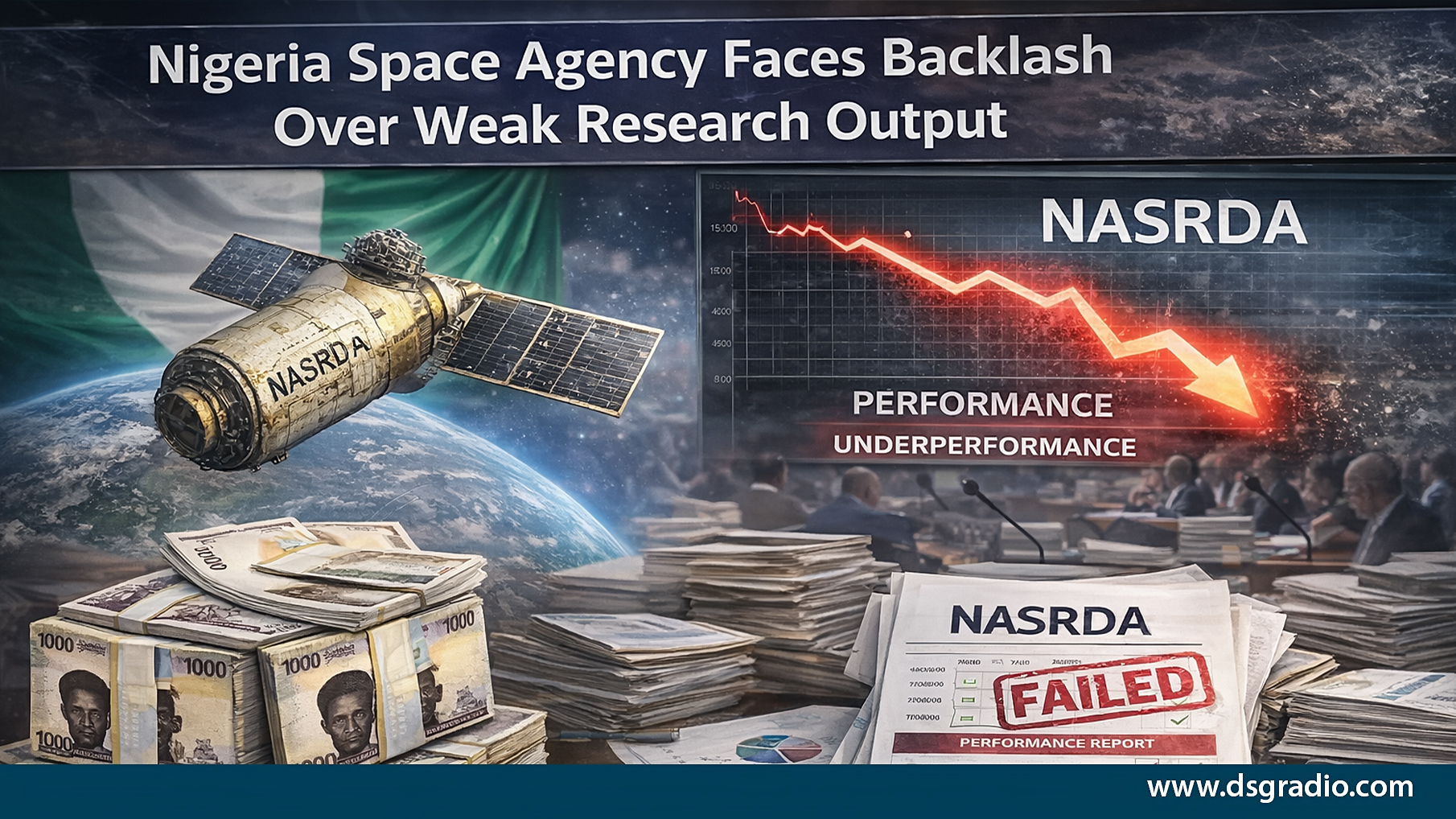
Nigeria Space Agency Output Under Scrutiny Despite Large Workforce
ABUJA, Nigeria — Nigeria space agency output has come under renewed scrutiny following revelations that the National Space Research and Development Agency (NASRDA), despite having the largest workforce among African space institutions, produces significantly low scientific research output.
The findings, based on data referenced in a detailed report and corroborated by academic database searches, highlight a widening gap between Nigeria’s investment in space science and its measurable global impact.
NASRDA: Largest Workforce, Lowest Output?
Established in 1999, NASRDA operates across seven specialised centres with approximately 3,500 staff, making it the largest space agency workforce in Africa.
However, according to data retrieved from Scopus, a global scientific database, NASRDA has produced only five indexed documents affiliated with its institution.
By comparison:
- Egypt’s space agency (1991): ~1,900 papers
- South Africa’s SANSA: 587 papers
- Algeria’s ASAL: 573 papers
These figures reflect indexed publications in internationally recognised journals.
A key limitation noted in the report is that NASRDA publishes in its own Nigerian Journal of Space Research, which is not widely indexed. As a result, much of its work remains invisible to the global scientific community.
“Science published in a journal that the world cannot search cannot be cited,” the report noted.
Nigeria’s Position in Africa’s Space Science Landscape
A 2025 study published in Earth and Space Science found that:
- Africa produced 2,290 space science papers (2014–2023)
- South Africa contributed 40%
- SANSA alone contributed 15%
Nigeria’s contribution:
- 4.4% of Africa’s total space science citations
Notably:
- Kenya’s space agency (founded in 2017) produces papers cited 40% above the global average.
- Nigeria performs at the global average, largely driven by universities rather than NASRDA itself.
This suggests that Nigeria’s academic institutions are active, but institutional coordination through NASRDA remains weak.
Budget vs Output: A Growing Concern
Between 2021 and 2023, Nigeria’s space programme reportedly consumed ₦101.744 billion while missing over 70% of its own milestones.
In 2024, NASRDA allocated:
- ₦4.8 billion (≈40% of capital budget) to constituency-related projects, including:
- Dustbins
- Religious empowerment programmes
- Social advocacy campaigns
Meanwhile:
- Two of Nigeria’s satellites have expired.
- The third is expected to expire in 2026
A former Director-General reportedly stated that the satellites were operating “by grace.”
Accountability Gap and Institutional Challenges
Experts argue that the core issue is not funding, but governance and accountability.
Key concerns include:
- Weak research output tracking
- Lack of internationally indexed publications
- Limited transparency in budget allocation
- Brain drain among Nigerian scientists
The report suggests that Nigeria’s scientists are publishing independently of NASRDA, often building careers abroad.
Proposed Reforms for Nigeria Space Agency Output
The report outlines several recommendations:
1. Budget Protection
- Prevent legislative constituency insertions into NASRDA funding.
2. Research Investment
- Allocate at least 5% of the annual budget to competitive, peer-reviewed research grants.
3. Publication Standards
- Require publication in indexed international journals.
4. Talent Retention
- Introduce:
- Open postdoctoral fellowships
- Structured internship programmes
- International collaborations
5. Public Accountability
- Annual scorecards to the National Assembly detailing:
- Number of publications
- Journal rankings
- Citation impact
Satellite Programme and Strategic Risks
Nigeria’s space programme faces operational risks due to ageing infrastructure.
Key issues:
- Satellite lifespan nearing expiration.
- Limited replacement pipeline
- Dependence on external partnerships
These factors could affect:
- Communication systems
- Weather monitoring
- National security intelligence
What the Original Report Says
According to an analysis published by Independent Nigeria, which examined Nigeria’s space agency performance, the institution’s challenges stem largely from systemic inefficiencies and weak accountability frameworks. The full report can be accessed via this source
Verification Status
- The data referenced is based on academic database searches and a published analytical report.
- Independent verification across multiple global databases was limited.
→ Some claims could not be independently verified.
Conclusion
Nigeria space agency output presents a paradox: a well-funded institution with a large workforce but minimal global scientific impact.
Despite having:
- The talent
- The infrastructure
- The mandate
The absence of accountability and strategic direction continues to limit NASRDA’s effectiveness.
Until structural reforms are implemented, Nigeria risks remaining a marginal player in global space science — despite its ambition to lead in Africa.
About the Author