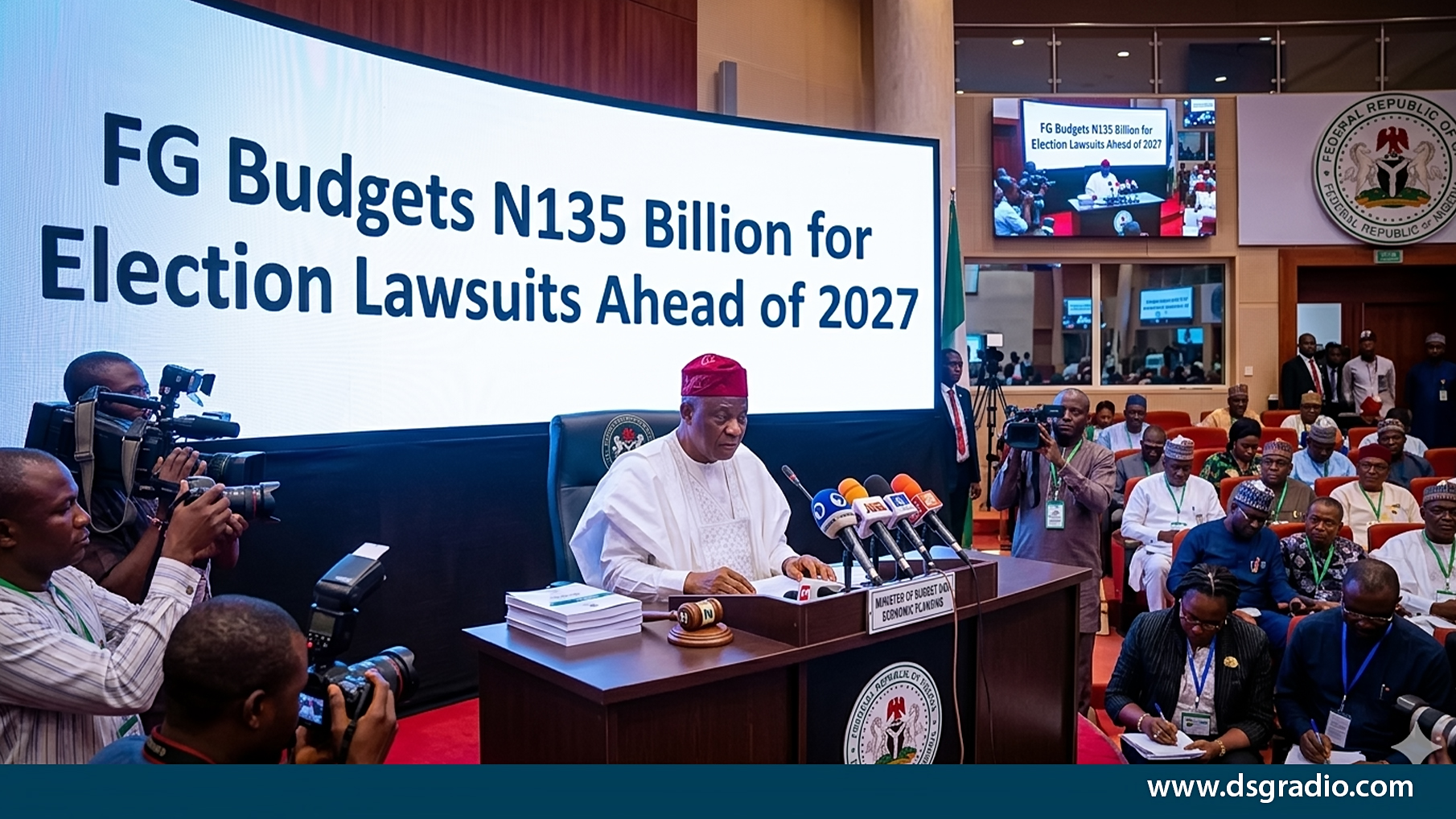
FG Budgets N135bn Election Lawsuits for 2027 Polls
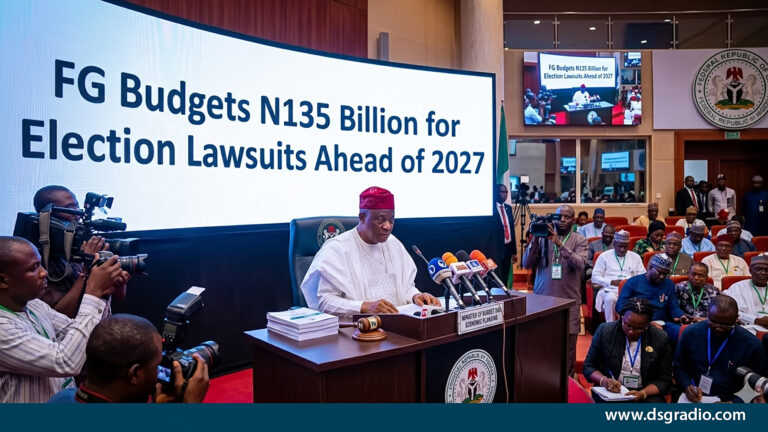
The Federal Government of Nigeria has proposed N135.22 billion for electoral adjudication and post-election provisions in the 2026 budget, a move that signals anticipated legal disputes ahead of the 2027 general elections, according to details contained in the House of Representatives Order Paper dated March 31, 2026. The provision, reported by The PUNCH, has sparked political reactions from opposition parties, who question its transparency and its implications for Nigeria’s electoral integrity.
Breakdown of FG Budgets N135bn Election Lawsuits Allocation
The N135.22 billion allocation falls under Service-Wide Votes, a central pool of government funds used to finance obligations not tied to a specific ministry, department, or agency.
Key highlights:
- Classified under Consolidated Revenue Fund (CRF) charges
- Part of a broader N3.70 trillion CRF allocation
- Represents approximately 3.65% of CRF spending
- Designed to cover:
- Election-related legal disputes
- Settlements
- Administrative post-election processes
Service-Wide Votes typically fund:
- National obligations
- Multi-agency expenditures
- Unforeseen liabilities
This classification indicates that election-related legal costs are treated as central government obligations, rather than responsibilities of a single institution.
INEC Funding and Rising Election Costs
The allocation comes alongside a significantly larger N1.01 trillion statutory transfer to the Independent National Electoral Commission (INEC).
Key INEC figures:
- N1.01 trillion allocated in the 2026 proposal
- Accounts for 21% of total statutory transfers (N4.80 trillion)
- Previously requested:
- N873.78 billion for the 2027 elections
- N171 billion for 2026 operations
This marks a sharp increase from the N313.4 billion spent on the 2023 general elections, highlighting rising costs in Nigeria’s electoral system.
Statutory transfers are:
- Constitutionally backed
- Released directly from the CRF
- Not subject to executive control
This ensures INEC’s operational independence, but it also raises scrutiny over the scale of spending.
Why FG Budgets N135bn Election Lawsuits Matter
The introduction of this new budget line item—which was not previously included in earlier drafts of the 2026 budget—suggests that the government is:
- Anticipating significant post-election litigation
- Preparing financially for legal and administrative fallout
- Recognising ongoing institutional pressures tied to elections
Analysts say this reflects a pattern where Nigerian elections frequently end in prolonged legal battles across tribunals and courts.
Opposition Parties React
PDP Raises Transparency Concerns
Ini Ememobong, National Publicity Secretary of the People’s Democratic Party (PDP), criticised the allocation, arguing it reflects a lack of confidence in electoral transparency.
He stated:
“It means that INEC itself is anticipating that it will not do well and that people will not accept the outcome of the results.”
Ememobong added that:
- Transparent elections would reduce litigation significantly.
- Excessive legal funding raises questions about the integrity of the process.
- External legal engagements may introduce political influence.
He warned that:
- Weak institutions and flawed elections have historically undermined democracy.
- Authorities must prioritise credibility over political interests.
ADC Offers Mixed Reaction
Bolaji Abdullahi, National Publicity Secretary of the African Democratic Congress (ADC), acknowledged that:
- It is normal for INEC to prepare for litigation.
- The commission is often joined in election-related lawsuits.
However, concerns remain over:
- The scale of the allocation
- The lack of a detailed breakdown
- Public accountability mechanisms
What This Means for Nigeria’s Democracy
The FG’s budget allocation of N135bn for election lawsuits raises broader questions about Nigeria’s electoral system:
Key concerns:
- Is the government anticipating widespread electoral disputes?
- Does this reflect institutional inefficiencies?
- Could improved transparency reduce litigation costs?
Governance implications:
- Increasing election costs may strain public finances.
- Legal battles may delay governance transitions.
- Public trust in elections could be affected.
Fiscal Context and Broader Budget Trends
The development comes amid broader fiscal concerns, including Nigeria’s rising debt profile.
For context, the government recently expanded its borrowing framework, as detailed in this related report on
👉 Nigeria’s 2026 borrowing plan increase
This underscores a growing pattern of:
- High public spending
- Expanding fiscal commitments
- Increased reliance on centralised funding structures
Source Attribution
The details of the allocation were first reported by The PUNCH in its coverage of the 2026 budget proposal:
What Remains Unclear
- Exact breakdown of how the N135.22bn will be spent
- Specific agencies are responsible for managing the funds
- Mechanisms for oversight and accountability
Details remain unclear and cannot be independently verified beyond the primary report.
About the Author