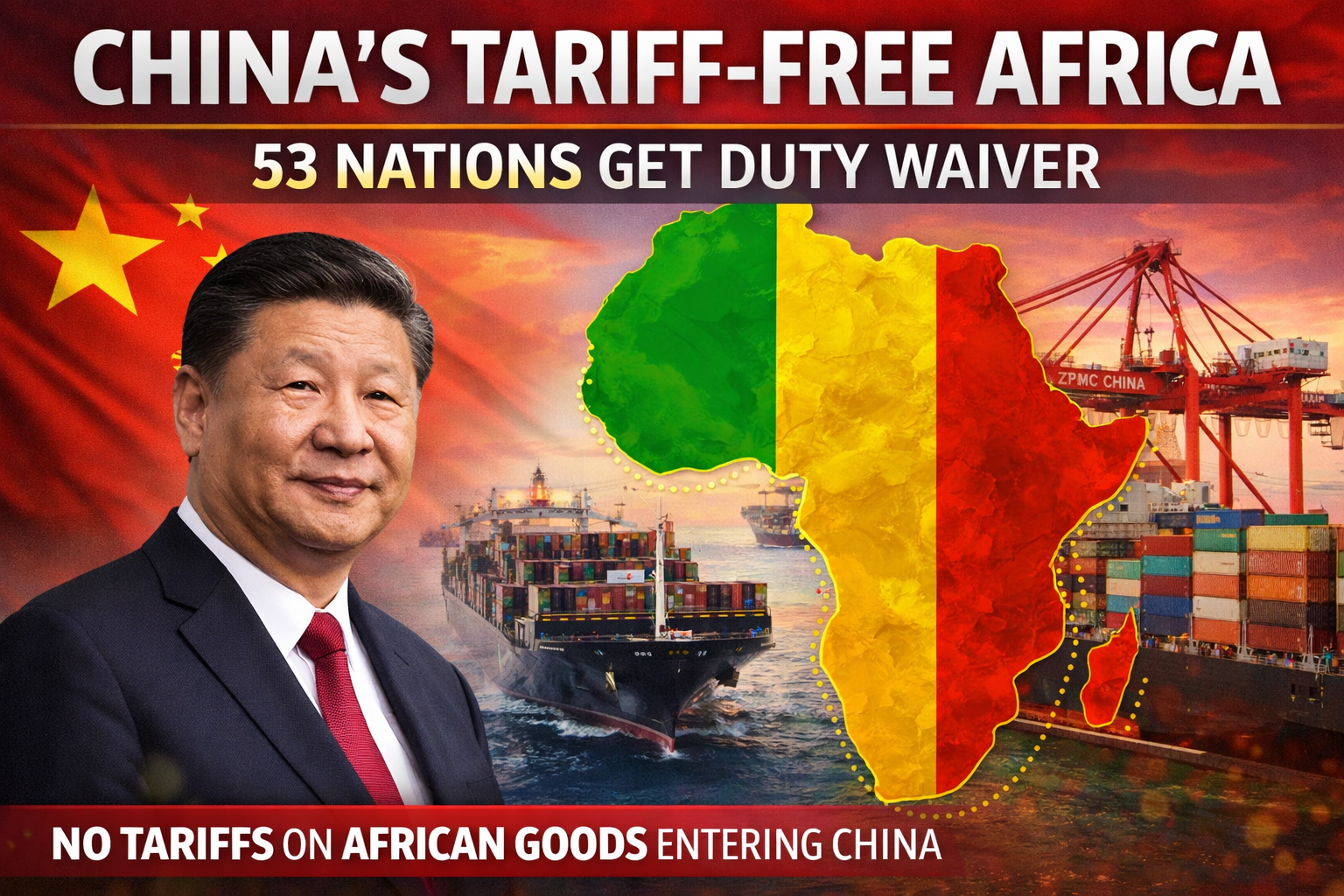
China’s Tariff-Free Africa Policy Expands to 53 Nations
China’s tariff-free Africa policy will take effect from next month, granting duty-free access to imports from 53 African countries with diplomatic ties to Beijing. The Chinese government announced the move as part of efforts to deepen economic cooperation, strengthen supply chains, and expand trade influence across Africa. The decision affects all African nations except the Kingdom of Eswatini, which maintains diplomatic relations with Taiwan. Details about specific implementation timelines beyond “next month” were not specified in the original report.
China’s Tariff-Free Africa: What the Policy Means
According to the report, China will eliminate tariffs on imports from 53 African countries, expanding an earlier policy that covered only the least developed nations.
Key highlights include:
- Tariff removal applies to all 53 African countries with diplomatic ties to China.
- Eswatini is excluded due to its relationship with Taiwan.
- Tariffs of up to 25% on goods like sugar and marine products will be removed.
- The policy builds on earlier measures introduced in December 2024 that covered 33 least developed African countries.
This expansion means major economies such as:
- Nigeria
- South Africa
- Kenya
- Egypt
- Morocco
will now benefit fully from tariff-free trade access to China.
Official Position from China
China’s Ministry of Commerce stated that the China tariff-free Africa policy reflects broader economic reforms and global trade ambitions.
Officials said the move aligns with decisions from the 20th Central Committee of the Communist Party of China (from the July 2024 session) to expand “independent opening.”
Chinese Commerce Minister Wang Wentao reinforced this position during the 14th WTO Ministerial Meeting, stating:
- China will deepen investment cooperation with Africa.
- The goal is to support industrialisation across the continent.
- The policy contributes to building a “China-Africa shared future” framework.
Two days after the WTO meeting, China signed a trade and infrastructure finance agreement with Kenya, signalling immediate momentum for implementation.
Economic Context and Trade Growth
Trade between China and Africa has grown significantly over the years.
According to China’s Customs Service:
- Exports to Africa: $225 billion
- Imports from Africa: $123 billion
China has remained Africa’s largest trading partner since 2008.
The China tariff-free Africa expansion is expected to further accelerate:
- Export volumes from Africa
- Industrial output
- Bilateral trade balance
China’s Tariff-Free Africa: Strategic Motivations Behind the Policy
Analysts have identified several key motivations driving China’s tariff-free Africa decision:
1. Market Expansion
China faces rising domestic competition and is seeking new markets.
Africa offers:
- A growing consumer base
- Demand for electronics, vehicles, and manufactured goods
- Opportunities for Chinese manufacturers in sectors like:
- Smartphones
- Home appliances
- Electric vehicles
2. Supply Chain Security
Africa is rich in critical minerals essential for high-tech industries, including:
- Lithium
- Cobalt
- Copper
Strengthening ties helps China:
- Reduce dependence on Western-controlled supply chains.
- Secure long-term access to strategic resources
3. Currency Influence (Yuan Expansion)
The expansion of trade is expected to:
- Increase cross-border settlements in Chinese yuan.
- Strengthen China’s efforts to challenge the dominance of the US dollar in global trade.
4. Geopolitical Strategy
Some analysts interpret China’s tariff-free policy toward Africa as part of a broader geopolitical strategy.
Key points include:
- Building stronger diplomatic alliances with African nations
- Encouraging support on sensitive issues like Taiwan
- Countering Western influence in global trade and politics
China’s Long-Term Engagement in Africa
China’s engagement with Africa is not new but has intensified in recent years.
Notable developments:
- President Xi Jinping pledged $50 billion in financial aid to Africa over three years (announced September 2024)
- Chinese foreign ministers have visited Africa as their first overseas destination annually for 36 years
- Recent visits include:
- Ethiopia
- Tanzania
- Lesotho
During these visits, Chinese officials promised:
- Expanded development opportunities
- Increased trade cooperation
China’s Tariff-Free Africa: Impact on African Economies
The China tariff-free Africa policy is expected to have wide-reaching implications:
Opportunities
- Increased export competitiveness for African goods
- Reduced trade barriers
- Growth in manufacturing and agriculture
- Potential job creation
Challenges
- Risk of over-dependence on China
- Trade imbalance concerns
- Limited industrial capacity in some African countries
Global Context: US-China Trade Tensions
The move comes amid rising global trade tensions.
According to the report:
- The United States, under President Donald Trump, imposed high tariffs globally last year.
- African countries are increasingly turning to China as an alternative trade partner.
China is also advancing its Belt and Road Initiative, which connects Asia, Africa, and Europe through infrastructure and trade networks.
What Remains Unclear
- Exact implementation date beyond “next month”
- Specific categories of all affected goods
- Enforcement mechanisms across all 53 countries
About the Author