Artemis II Moon Mission Breaks Distance Record as NASA Astronauts Circle Moon
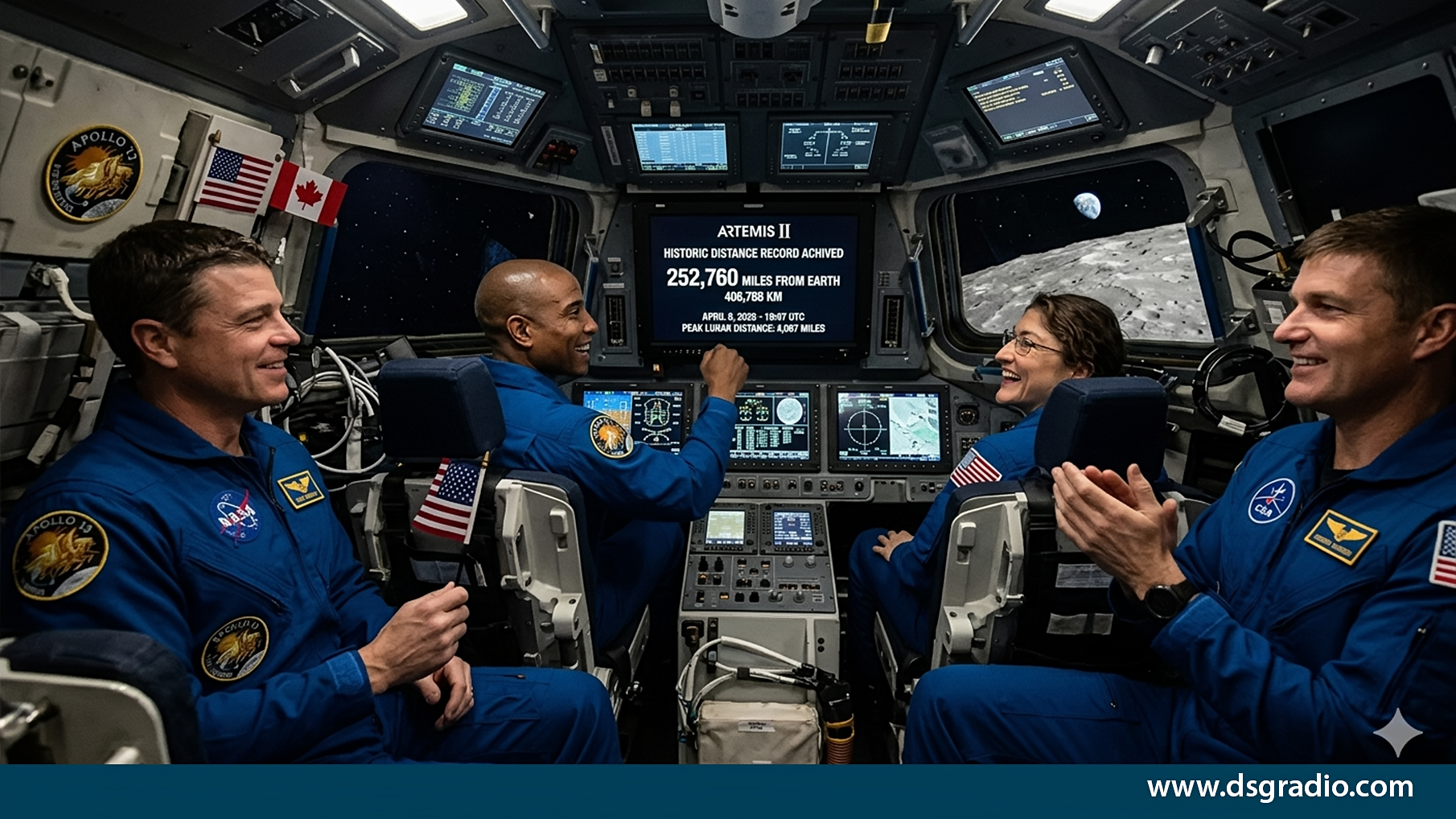
CAPE CANAVERAL, Florida, United States — The Artemis II moon mission has made history as four NASA astronauts travelled farther from Earth than any humans before, reaching over 252,000 miles during a lunar flyby mission aboard the Orion spacecraft.
According to the primary report, the crew spent nearly 7 hours circling the moon, observing its far side and capturing images of regions never visible from Earth. The mission marks a major milestone in NASA’s renewed push for deep space exploration.
Mission Overview: Who, What, When, Where, Why, How
- Who: Four NASA astronauts (names were not specified in the original report)
- What: Artemis II crewed lunar flyby mission
- When: The astronauts launched on Wednesday and reached the moon “early today” (exact date not specified in the original report)
- Where: Launch from Kennedy Space Centre, Cape Canaveral, Florida; lunar orbit around the moon
- Why: To test deep-space human travel systems and prepare for future lunar landings
- How: Using NASA’s Orion spacecraft under the Artemis program
The astronauts lifted off from Kennedy Space Centre in Cape Canaveral, Florida, beginning a carefully planned journey that first involved orbiting Earth for approximately 25 hours before heading toward the moon.
Artemis II Moon Mission: Historic Lunar Flyby
The Artemis II moon mission represents NASA’s first crewed lunar mission in decades and is designed to test systems ahead of future landings.
After leaving Earth’s orbit on Thursday evening, the Orion spacecraft entered what scientists call the lunar sphere of influence—the region where the moon’s gravity becomes stronger than Earth’s.
During the mission:
- The crew flew within 4,067 miles of the moon’s surface.
- They spent nearly 7 hours studying and photographing the far side of the Moon.
- They observed areas never previously seen directly by humans.
Even astronauts from the Apollo era could not observe the moon’s far side in this way due to the trajectory limitations of earlier missions.
Observing the Moon’s Far Side
One of the most significant achievements of the Artemis II moon mission was the crew’s ability to study the far side of the moon, a region permanently hidden from Earth.
According to the report, the astronauts:
- Captured images of previously unseen lunar terrain
- Conducted visual observations of geological features
- Documented surface variations for future scientific analysis
These observations are expected to support future missions, including potential landing site selection under the Artemis program.
Breaking the Apollo 13 Record
The mission has officially surpassed a long-standing milestone in space exploration.
- The astronauts reached more than 252,000 miles from Earth.
- This breaks the Apollo 13 record for the farthest distance travelled by humans.
This achievement underscores the technological advancements in modern spacecraft engineering and mission planning.
Mission Timeline and Journey
The Artemis II mission followed a structured timeline:
- Launch: Wednesday from Kennedy Space Centre, Florida
- Earth Orbit: Approximately 25 hours circling Earth
- Departure: Orion left Earth orbit on Thursday evening
- Lunar Entry: Entered the lunar sphere of influence early the following day
- Lunar Flyby: Nearly seven hours observing the moon
- Return: Expected splashdown in the Pacific Ocean on Friday evening
NASA officials confirmed that the mission remains on track, with the crew expected to safely return to Earth.
🔗 Related Coverage
The Artemis mission has also involved periods of communication disruption, as previously reported in Artemis crew expected to lose contact with Earth, highlighting the challenges of deep-space travel.
For further details on the mission timeline and live updates, as reported by NBC News, the astronauts’ journey represents a critical step toward future lunar landings and long-term space exploration.
🌍 Significance for Future Space Exploration
The Artemis II moon mission is not just a record-breaking journey—it is a foundational step toward NASA’s broader goals.
Key Objectives:
- Validate Orion spacecraft systems with humans onboard.
- Test deep-space navigation and communication.
- Prepare for Artemis III, which aims to land astronauts on the moon.
Experts say the mission could pave the way for:
- Sustainable human presence on the moon
- Future missions to Mars
- Expanded international collaboration in space exploration
🏁 Conclusion
The Artemis II moon mission marks a defining moment in modern space exploration, as NASA astronauts travel farther than any humans before while unlocking new perspectives of the moon’s hidden side.
With a safe return expected, the mission reinforces confidence in NASA’s Artemis program and signals a new era of human exploration beyond Earth.
About the Author