Africa At Crossroads: Democracy, Health, and Economic Survival
Political Instability, Economic Hardship, and Public Health Risks Are Reshaping Africa’s Future
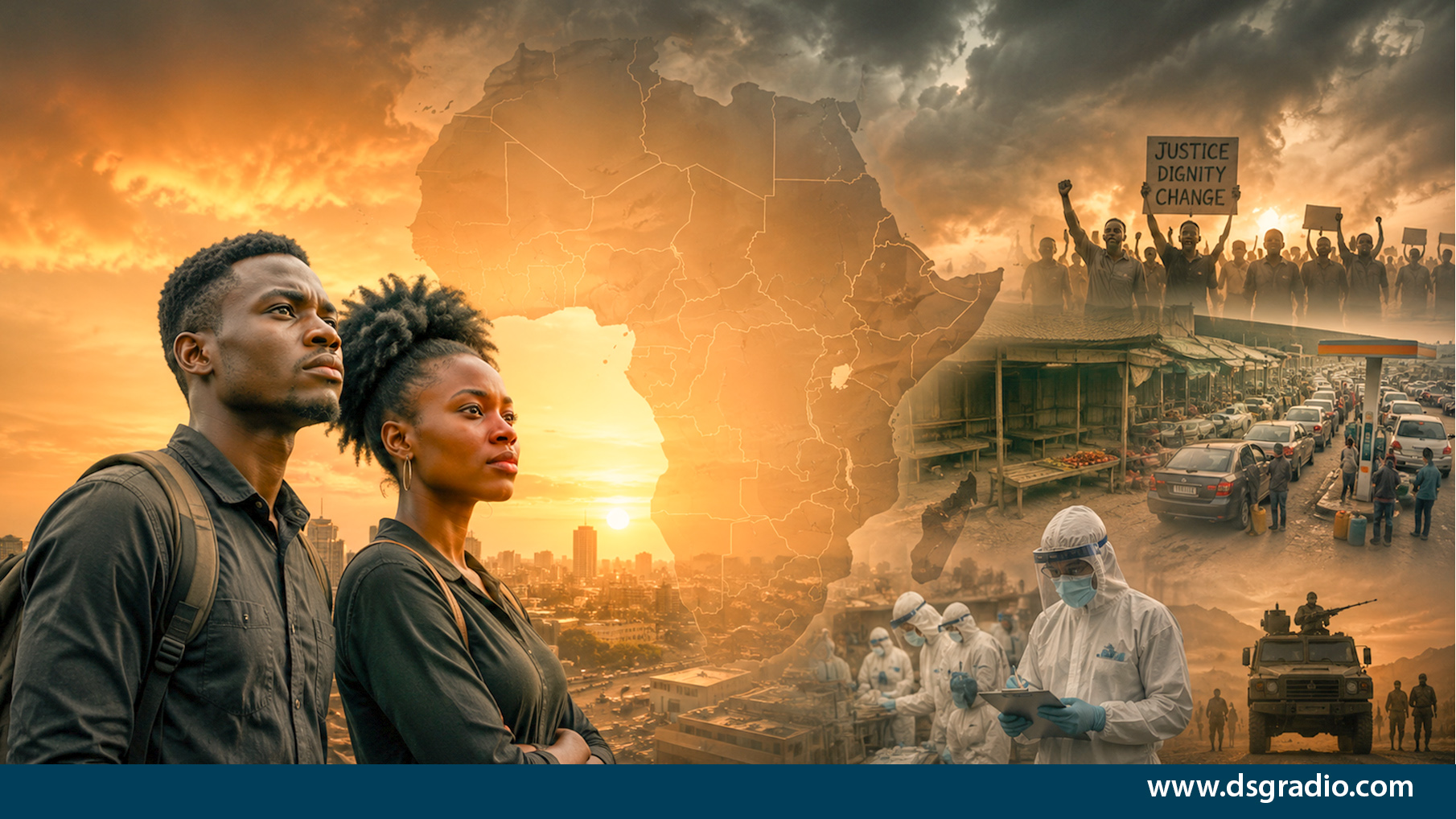
Across Africa, millions of citizens are simultaneously confronting rising living costs, unemployment, insecurity, political uncertainty, and fragile healthcare systems, creating what analysts increasingly describe as one of the continent’s most defining periods since the end of the Cold War. The convergence of political tensions, economic hardship, public health vulnerability, and geopolitical competition is now testing the resilience of African governments, institutions, and societies in ways that could shape the continent’s future for decades.
From political tensions in Senegal and military takeovers across the Sahel to inflation pressures in Nigeria and Ghana, Ebola concerns in Uganda, and growing foreign competition for influence in Africa, the continent is entering a moment in which democracy, economic survival, and public trust are becoming deeply interconnected.
The wider significance extends beyond Africa itself.
The continent has become increasingly central to global economics, strategic minerals, energy security, migration, technology expansion, and geopolitical competition among major powers, including China, Russia, the United States, the European Union, and Gulf states.
Yet beneath the global interest lies a growing internal struggle.
Citizens across many African countries are increasingly questioning whether democratic governance, economic reforms, and regional institutions are delivering meaningful improvements to daily life.
The central question emerging across the continent is becoming more urgent:
Can Africa stabilise politically and economically before instability deepens further?
The editorial framework and continental analysis were drawn from the DSG HERALD NEWS editorial blueprint provided in the source material.
Africa at Crossroads as Democracy Faces Pressure
One of the clearest warning signs across the continent is the growing pressure on democratic institutions.
For years, Senegal was viewed as one of West Africa’s most stable democracies. Unlike neighbouring countries that experienced military coups or prolonged instability, Senegal maintained a reputation for peaceful political transitions and institutional continuity.
That reputation gave Senegal symbolic importance beyond its borders.
At a time when Mali, Burkina Faso, Niger, and Guinea experienced military takeovers, Senegal stood as a counterexample, demonstrating that democratic governance could remain stable in a region increasingly affected by insecurity and political tension.
However, recent political tensions in Senegal have raised concerns among analysts and regional observers about whether even some of West Africa’s strongest democratic systems are becoming vulnerable to instability.
If democratic confidence weakens in Senegal, the implications could spread across the region.
It would raise questions about the credibility of democratic institutions in West Africa and weaken confidence in ECOWAS, which has repeatedly attempted to defend constitutional order following military coups in member states.
The concern is no longer simply about elections.
Increasingly, African citizens are judging governments by outcomes.
Citizens want:
- Economic stability
- Security
- Affordable living conditions
- Electricity
- Jobs
- Healthcare access
- Accountability
- Infrastructure development
Where those expectations remain unmet, frustration grows rapidly.
This growing frustration has become especially visible among younger populations.
Africa’s Youth Are Becoming a Major Political Force
Africa has the youngest population in the world, creating enormous long-term economic potential but also serious political risks.
Millions of young Africans are digitally connected, politically aware, and increasingly vocal about governance failures, unemployment, corruption, and inequality.
Social media has transformed political engagement across the continent.
Platforms such as X, Facebook, TikTok, Instagram, and YouTube now shape political discourse in real time, allowing activists, journalists, and opposition movements to mobilise quickly across borders.
Recent events across multiple African countries illustrate this trend.
Kenya witnessed major protests linked to controversial finance legislation and rising living costs. Nigeria’s EndSARS movement permanently reshaped discussions around policing, governance, and youth activism. South Africa continues facing demonstrations related to inequality and poor public services.
Senegal’s youth mobilisation also became a major political force during periods of heightened tension.
These developments reflect a broader continental pattern.
Young Africans increasingly demand:
- Opportunity
- Stability
- Jobs
- Better governance
- Transparency
- Accountability
However, many continue facing:
- High unemployment
- Weak infrastructure
- Corruption
- Rising living costs
- Limited economic mobility
The growing disconnect between public expectations and government performance is becoming politically significant.
This matters because Africa’s future workforce will largely come from its youth population.
If governments fail to create sufficient opportunities, the consequences could include:
- Deeper instability
- Migration pressure
- Social unrest
- Institutional distrust
- Increased political polarization
Africa’s future may ultimately depend on whether its young population becomes an economic engine — or a generation trapped by frustration.
Why Military Influence Is Rising Again
Another major concern across Africa is the increasing acceptance of military intervention among some populations.
Historically, military coups were associated with instability and authoritarian rule.
Yet recent coups in:
- Mali
- Burkina Faso
- Niger
- Guinea
have revealed growing public dissatisfaction with civilian leadership in several countries.
Many citizens supporting military governments argue that elected leaders failed to address:
- Corruption
- Poverty
- Economic hardship
- Armed violence
- Governance failures
The Sahel region illustrates this crisis most clearly.
Extremist violence, weak state authority, displacement, and deteriorating security conditions have placed enormous pressure on governments.
In some countries, sections of the population increasingly viewed military leadership as more decisive than civilian administrations.
This reflects a dangerous but important political reality:
Democracy without visible economic progress is losing legitimacy among many African citizens.
This trend creates serious long-term risks.
While some juntas initially gain public support, African history shows military rule rarely produces sustainable democratic institutions or broad economic transformation.
Still, the growing frustration with civilian governments exposes deeper structural failures across several states.
Africa At Crossroads Over Economic Survival
Economic hardship has become one of the most important forces reshaping politics and public life across Africa.
Inflation, debt pressure, currency instability, fuel costs, and rising food prices are affecting millions across the continent.
Countries including:
- Nigeria
- Ghana
- Kenya
- Egypt
- South Africa
has faced major economic pressures in recent years.
For ordinary citizens, the effects are immediate and deeply personal.
Transportation costs continue rising.
Food inflation is straining household incomes.
Electricity instability affects businesses and education.
Housing affordability remains a growing challenge in many cities.
Healthcare costs also continue increasing.
The broader concern is that prolonged economic hardship can fuel deeper political instability.
When citizens lose confidence in economic progress, distrust often spreads into wider dissatisfaction with governments and institutions.
Nigeria Economic Slowdown and Continental Impact
Nigeria remains Africa’s largest economy and most populous country, making its economic struggles especially significant for the continent.
The country faces:
- Inflation
- Naira instability
- High unemployment
- Investor uncertainty
- Rising poverty
- Energy challenges
Economic reforms designed to stabilise finances and attract investment have also created short-term hardship for many Nigerians.
The removal of fuel subsidies and broader restructuring policies triggered major increases in transportation and living costs.
For millions of Nigerians, survival has become more difficult.
Nigeria’s economic situation matters across the continent because the country is often viewed as a broader indicator of African economic resilience.
If Nigeria struggles to achieve stable growth while reducing poverty and inflation, wider concerns about African economic models become more pronounced.
Nigeria also reflects a larger structural challenge facing many African economies.
Despite abundant natural resources and large populations, several countries remain heavily dependent on:
- Commodity exports
- Foreign loans
- External debt restructuring
- Imported refined goods
- Foreign exchange inflows
This dependency creates vulnerability during global economic shocks.
It also limits industrial development and local manufacturing capacity.
The deeper challenge for African governments is therefore not only to reduce inflation but also to restructure economies to create long-term resilience.
That includes investment in:
- Manufacturing
- Agriculture
- Technology
- Infrastructure
- Education
- Energy
- Logistics
Without structural reforms, economic growth risks remaining disconnected from improvements in living standards.
Ghana IMF Dependency Debate Raises Wider Questions
Ghana’s economic struggles have also intensified debates across the continent about debt dependency and economic sovereignty.
For years, Ghana was widely viewed as one of West Africa’s promising economies.
However, debt pressure, fiscal constraints, and currency instability forced the country to seek support from the International Monetary Fund.
The situation revived wider questions across Africa:
Can African economies truly become independent while relying heavily on foreign loans and external restructuring programs?
Critics argue that repeated reliance on the IMF reflects deeper structural weaknesses that many African economies have struggled to overcome.
Others contend that external support remains necessary for governments facing severe fiscal crises.
But public scepticism is growing.
Many citizens increasingly believe official economic narratives do not reflect daily realities.
Economic data may indicate growth in some sectors, but ordinary Africans often say survival is becoming harder every month.
Uganda Ebola Outbreak Revives Health Security Concerns
Public health remains another major pressure point across Africa.
The COVID-19 pandemic exposed significant weaknesses in healthcare systems across many countries, including:
- Medical supply shortages
- Weak emergency preparedness
- Poor funding
- Vaccine inequality
- Limited hospital capacity
Recent Ebola concerns in Uganda revived fears about how quickly health emergencies can escalate.
Ebola outbreaks generate particularly serious concern because of their high fatality rates and the speed at which public anxiety spreads.
Health experts repeatedly stress the importance of:
- Rapid contact tracing
- Emergency coordination
- Public communication
- Border surveillance
- Regional cooperation
Uganda’s Ebola concerns also reinforced another important reality:
In Africa, no health crisis remains local for long.
Air travel, trade routes, migration, and porous borders mean outbreaks can quickly become regional threats.
That places enormous pressure on governments to strengthen:
- Disease surveillance
- Laboratory capacity
- Emergency response systems
- Healthcare infrastructure
Nigeria’s Ebola Experience Became a Global Model
Nigeria’s response to the 2014 Ebola outbreak remains one of Africa’s most significant public health success stories.
At the time, there were serious fears that Ebola could spread rapidly through Lagos, one of the world’s largest urban centres.
However, Nigerian authorities implemented aggressive:
- Contact tracing
- Emergency coordination
- Public communication
- Medical monitoring
International health experts later praised the response as a model for outbreak containment.
Nigeria demonstrated that rapid institutional coordination can significantly reduce the spread of dangerous diseases.
The experience also showed African countries can build effective crisis response systems when institutions act quickly and decisively.
Still, structural weaknesses in healthcare remain a major concern across the continent.
Many African health systems continue facing:
- Underfunding
- Staff shortages
- Infrastructure gaps
- Medical brain drain
- Uneven rural healthcare access
These vulnerabilities increase risks during future outbreaks.
For more on Africa’s health vulnerabilities, see Congo Ebola Outbreak Highlights Africa’s Health System Struggles
Misinformation and Public Distrust Complicate Health Emergencies
Another growing challenge is the erosion of public trust.
During COVID-19, misinformation spread rapidly across social media platforms worldwide.
Africa was not exempt.
False claims about vaccines, conspiracy theories, and distrust of government messaging complicated public health responses in several countries.
This distrust now affects broader healthcare communication.
When citizens distrust institutions, it becomes harder to implement:
- Vaccination programs
- Emergency measures
- Disease surveillance
- Public health campaigns
Health communication is therefore becoming not only a medical challenge but also a political and social one.
Governments increasingly compete with online misinformation ecosystems capable of shaping public behavior rapidly.
Africa Is Becoming a Global Geopolitical Battlefield
Africa’s strategic importance has increased dramatically in recent years.
The continent is no longer viewed internationally as peripheral.
Instead, it has become central to:
- Energy transition
- Strategic minerals
- Global trade routes
- Population growth
- Infrastructure competition
- Military partnerships
Global powers including:
- China
- Russia
- United States
- European Union
- Gulf states
are all expanding influence across Africa.
Competition focuses heavily on:
- Minerals
- Oil
- Ports
- Infrastructure
- Military cooperation
- Trade agreements
Africa’s vast reserves of cobalt, lithium, and rare earth minerals have become especially important due to growing demand for electric vehicles and renewable energy technologies.
China has significantly expanded infrastructure investment and trade ties across Africa over the past two decades.
Russia has increased security cooperation in several African states, especially within the Sahel.
Western countries continue seeking influence through diplomacy, investment, development programs, and military partnerships.
This geopolitical competition creates both opportunities and risks.
While investment and strategic partnerships can support development, excessive foreign dependency may create new vulnerabilities.
African governments increasingly face pressure to navigate global rivalries while protecting long-term national interests.
For more on geopolitical competition shaping Africa’s future, see:
- China-Africa Trade Deal Reshapes Global Alliances
- China-Djibouti Relations Reveal High-Stakes Power Battle
Security Crises Continue Reshaping Regional Politics
The Sahel remains one of Africa’s most unstable regions.
Armed extremist violence, weak governance structures, humanitarian displacement, and military transitions continue to reshape regional politics.
Security crises have affected:
- Investor confidence
- Trade routes
- Humanitarian conditions
- Migration patterns
- Diplomatic alliances
Military governments in Mali, Burkina Faso, and Niger have also shifted strategic partnerships, reflecting changing geopolitical alignments.
The wider concern is that prolonged instability in the Sahel could continue spreading insecurity into neighboring regions.
Security spending is also placing additional pressure on national budgets already strained by debt and economic hardship.
For related security analysis, see:
- Mali Security Crisis Tests Russia Alliance Strength
- Mali Militant Alliance Attack Shakes Sahel Security
Can Africa’s Young Population Become an Economic Engine?
Africa’s demographic future remains one of its greatest opportunities.
The continent’s population growth could support major expansion in:
- Manufacturing
- Technology
- Digital commerce
- Consumer markets
- Creative industries
- Entrepreneurship
Technology ecosystems in cities such as Lagos, Nairobi, Kigali, Cape Town, and Accra have already shown significant innovation potential.
Young Africans increasingly drive:
- Fintech development
- Digital media
- E-commerce
- Mobile banking
- Entertainment industries
However, demographic growth alone does not guarantee prosperity.
Without major investment in:
- Education
- Energy
- Infrastructure
- Healthcare
- Industrialization
- Employment creation
Population growth could intensify social and political pressure.
High youth unemployment remains one of the continent’s biggest long-term risks.
Migration pressures are already increasing as many young Africans seek opportunities abroad.
At the same time, social media has intensified awareness of global inequality and opportunity gaps.
Young Africans increasingly compare leadership performance internationally in real time.
That awareness continues to reshape political expectations across the continent.
Can Africa Redefine Its Future?
Africa stands at a crossroads where democracy, economic survival, public health, and geopolitical competition are becoming inseparable.
The continent faces major pressures, but it also possesses extraordinary potential.
Its youthful population, strategic resources, entrepreneurial energy, digital expansion, and growing regional integration efforts could support major transformation over the coming decades.
Yet potential alone is insufficient.
The decisions made today by governments, institutions, businesses, and citizens could shape Africa’s trajectory for generations.
The continent now faces urgent questions:
- Can African economies industrialise fast enough?
- Can democratic systems deliver real progress?
- Can healthcare systems become more resilient?
- Can regional cooperation improve security and trade?
- Can African governments rebuild public trust?
- Can the continent reduce excessive dependence on foreign powers?
The answers will likely determine whether Africa emerges stronger from this period of uncertainty or faces deeper instability.
What is already clear is that Africa’s future will increasingly shape global economics, migration patterns, geopolitics, energy markets, and international security.
Africa is no longer a side story in global affairs.
It is becoming one of the central arenas where the future of global politics and development will be shaped.
For millions of Africans confronting hardship, insecurity, inflation, and uncertainty, the stakes are immediate and deeply personal.
The continent now faces a defining challenge:
Whether it can transform pressure into progress before instability deepens further.
Recommended Coverage
China-Africa Trade Deal Reshapes Global Alliances
An in-depth analysis of how expanding China-Africa trade partnerships are reshaping global power dynamics and economic influence across the continent.
Mali Security Crisis Tests Russia Alliance Strength
Examines how Mali’s security crisis reflects broader geopolitical competition and the shifting balance of foreign influence in Africa.
Mali Militant Alliance Attack Shakes Sahel Security
Explores the worsening instability across the Sahel and the growing challenges facing regional governments and military alliances.
China-Djibouti Relations Reveal High-Stakes Power Battle
Analyses the strategic importance of Djibouti as global powers compete for influence near critical international trade routes.
About the Author