Thaksin Prison Release Reshapes Thailand Politics
Thailand’s former Prime Minister Thaksin Shinawatra has been released from prison on parole after serving part of a reduced sentence, a development that is already triggering debate over the future of Thai politics, the strength of the Shinawatra political dynasty, and the direction of the Pheu Thai Party.
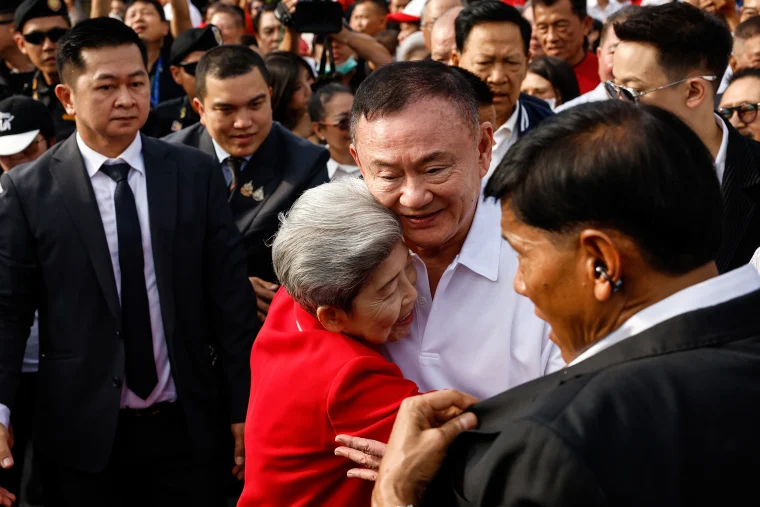
The 76-year-old billionaire politician walked free from Bangkok’s Klong Prem prison on Monday, eight months after a court ordered him to serve prison time linked to abuse of power and conflicts of interest during his time in office between 2001 and 2006. His release marks another dramatic chapter in one of Southeast Asia’s most influential and controversial political careers.
Supporters gathered outside the prison to welcome him, chanting messages of support as he reunited with family members, including his daughter Paetongtarn Shinawatra, who was removed from office as prime minister last year. According to a Reuters report, Thaksin described himself as “relieved” following his release. Reuters
But beyond the scenes of celebration, analysts say the Thaksin prison release could become a major turning point in Thailand’s already unstable political landscape.
Why the Thaksin Prison Release Matters
For more than two decades, Thaksin Shinawatra shaped Thailand’s political direction through populist economic policies that earned him strong support among rural and working-class voters.
His administration introduced healthcare reforms, village development funds, and economic stimulus programmes, transforming him into one of Thailand’s most influential politicians. However, critics accused him of corruption, abuse of power, and consolidating excessive influence over state institutions.
In 2006, Thaksin was removed from office in a military coup while abroad. He later spent years in self-imposed exile, avoiding prison sentences tied to corruption-related cases.
His return to Thailand in 2023 stunned observers across Asia. Many believed the return was part of a broader political compromise involving the military establishment, royal institutions, and political allies.
The latest Thaksin prison release has revived questions over whether the former premier intends to quietly retire from frontline politics or, once again, shape national affairs from behind the scenes.
Thailand’s Political Crisis Deepens
Thailand has experienced repeated cycles of political instability over the last two decades, including coups, judicial interventions, mass protests, and constitutional disputes.
The Shinawatra family became central to those tensions.
Since Thaksin’s rise to power, several governments linked to his political movement have either been dissolved by courts or removed through military intervention. His daughter, Paetongtarn Shinawatra, became the latest casualty when she was removed from office last year.
The country’s political divisions generally revolve around:
- Conservative royalist and military-backed groups
- Pro-democracy and populist political movements
- Urban elite interests versus rural voter blocs
Political analysts say the Thaksin prison release may reopen those divisions at a sensitive moment for the country.
Thailand’s current government, led by Prime Minister Anutin Charnvirakul, emerged after a major political realignment that weakened the once-dominant Pheu Thai Party. That shift reflected growing frustration among younger voters and the declining influence of traditional political dynasties.
Can Pheu Thai Recover?
The future of the Pheu Thai Party remains one of the biggest questions following Thaksin’s release.
For years, the party dominated Thai elections through strong grassroots mobilisation and economic populism. However, its electoral influence has weakened significantly in recent years.
The party suffered one of its poorest performances in the latest elections, signalling a shift in political attitudes among younger voters, who increasingly support reform-oriented parties.
Political scientist Titipol Phakdeewanich of Ubon Ratchathani University warned that Thaksin would need to act cautiously if he hopes to help rebuild the party’s image.
“He overplayed his hand,” Titipol said, according to Reuters. “If he stays behind the scenes, it would be better.”
Analysts believe the Thaksin prison release could either:
- Revitalise Pheu Thai’s traditional voter base
- Or deepen concerns that the party remains overly dependent on one political family
The challenge for Pheu Thai now is balancing loyalty to the Shinawatra brand while appealing to younger voters demanding institutional reforms and less elite political influence.
Controversy Over Hospital Stay
One of the most controversial aspects of Thaksin’s imprisonment involved his lengthy hospital stay.
After returning to Thailand in 2023, Thaksin reportedly spent no nights inside an ordinary prison facility. Instead, authorities transferred him to the VIP wing of a hospital after he complained of chest pain and heart-related problems.
His original eight-year sentence was later reduced to one year through royal clemency.
However, controversy intensified when Thailand’s Supreme Court later ruled that some of the medical procedures prolonging his hospital stay were unnecessary. The court subsequently ordered that additional prison time be served.
The case fueled criticism from opposition groups who argued that Thaksin received preferential treatment because of his wealth and political influence.
Supporters, however, insisted that the former prime minister’s health concerns were legitimate.
Details surrounding the full extent of his medical condition were not fully specified in the original report.
Southeast Asia Watches Closely
The Thaksin prison release is also attracting regional attention across Southeast Asia, where political instability and military influence continue to shape governance in several countries.
Thailand remains one of the region’s largest economies and a major diplomatic player. Political uncertainty in Bangkok often affects:
- Foreign investment confidence
- Regional trade dynamics
- Tourism
- ASEAN diplomatic coordination
The country’s repeated political crises have become a case study of how courts, the military, and elite political networks can shape democratic processes.
Observers say Thailand’s experience mirrors broader regional tensions between traditional power structures and growing public demands for democratic reforms.
Public Reaction Divided
Public response to the Thaksin prison release remains sharply divided.
Supporters outside the prison praised him for policies they say improved living conditions for ordinary citizens during his years in power.
Some described him as a leader unfairly targeted by political opponents.
Critics, however, argue that Thaksin symbolises a political culture built around elite influence and personality-driven politics rather than institutional accountability.
That divide has defined Thailand’s politics for nearly two decades and may continue despite his advancing age.
Under the terms of his parole, Thaksin is expected to wear an electronic ankle monitor until his sentence officially concludes in September.
What Happens Next?
The biggest uncertainty surrounding Thaksin’s prison release is how politically active he intends to remain.
Several possibilities are now being discussed by analysts:
- Acting as an informal adviser to allies
- Helping rebuild the Pheu Thai Party
- Avoiding public political involvement entirely
- Influencing coalition negotiations behind the scenes
For Thailand’s political establishment, the issue is delicate.
Any major return to active politics by Thaksin could reignite tensions between reformist movements, conservative institutions, and rival political blocs.
At the same time, completely sidelining a figure with deep grassroots support may also prove politically risky.
The coming months will likely determine whether the Thaksin prison release marks the quiet closing chapter of a turbulent political career — or the beginning of another phase in Thailand’s long-running political struggle.
Recommended Coverage:
- Tinubu 2027 Support Surges As NELFUND Students Donate ₦10.7m
Nigeria’s political landscape is also witnessing renewed coalition-building and loyalty campaigns ahead of future elections. - Ramaphosa Impeachment Inquiry Reopens ANC Crisis
South Africa’s ANC faces internal pressure similar to the political divisions affecting Thailand’s major parties. - US-Iran Conflict Deepens As Ceasefire Nears Collapse
Global political instability continues to shape diplomatic and economic uncertainty across multiple regions. - Israel-Lebanon Conflict Escalates As Hezbollah Strikes Intensify
International security tensions remain a major concern as governments navigate fragile political environments.
About the Author