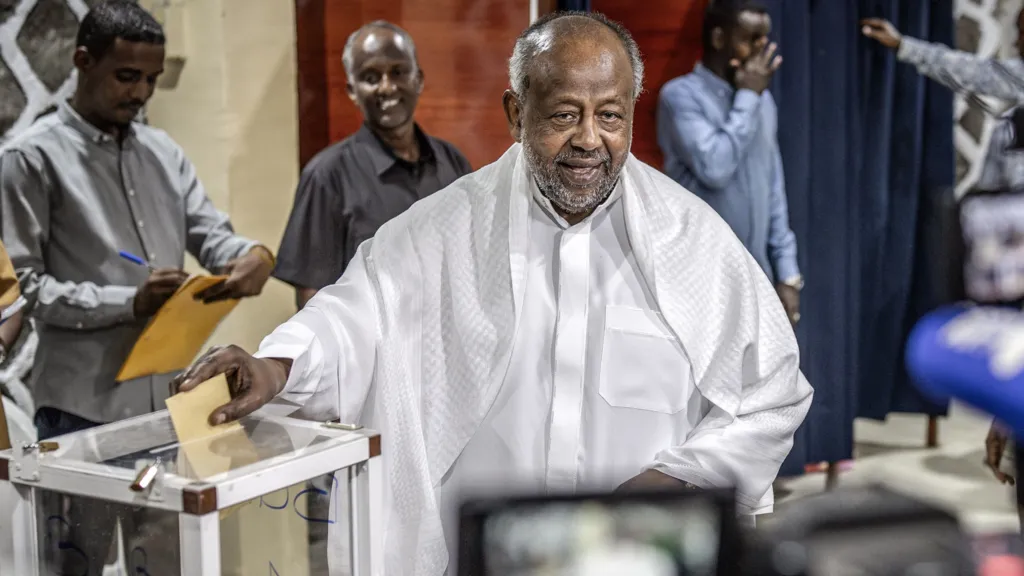
Djibouti Election 2026: Guelleh Secures Sixth Term with 97.8% Victory
Djibouti election 2026: Guelleh’s sixth term has been confirmed as President. Ismail Omar Guelleh, 78, secured 97.8% of the vote in Friday’s election in Djibouti (capital), Republic of Djibouti, according to preliminary official results released by the Interior Ministry. The poll, conducted on April 11, 2026, saw turnout exceed 80%, despite a boycott by major opposition parties. His only challenger, Mohamed Farah Samatar, received 2.19%, highlighting the limited competition in the race.
Election Results and Key Figures
According to official data reported by state authorities and corroborated by international media:
- Ismail Omar Guelleh (Incumbent President): 97.8%–97.81%
- Mohamed Farah Samatar (Unified Democratic Centre – CDU): 2.19%
- Voter turnout: Approximately 80.4%
- Registered voters: Around 256,000
- Population: Roughly 1 million
The results are pending validation by the Constitutional Council, which must officially confirm the outcome before Guelleh is sworn in for another five-year term.
Djibouti Election 2026 Guelleh Sixth Term: Political Context
President Ismail Omar Guelleh has ruled Djibouti since 1999, making him one of Africa’s longest-serving leaders. He is only the second president since the country gained independence from France in 1977.
Key constitutional developments:
- 2010: Term limits removed
- Presidential terms were reduced from 6 years to 5 years
- Age limit (75 years) initially introduced
- November 2025: Age limit removed, allowing Guelleh to contest again
These constitutional adjustments enabled Guelleh, now 78, to remain eligible for office.
Opposition Boycott and Limited Competition
The Djibouti election 2026, Guelleh’s sixth term, was marked by a continued boycott from major opposition groups.
- Opposition leaders, including Dahir Ahmed Farah, have boycotted elections since 2016
- They claim there is no free political space in the country
- Samatar’s party, the Unified Democratic Centre (CDU), holds no parliamentary seats
Reports indicate:
- Guelleh’s campaign rallies attracted thousands
- Samatar’s events saw minimal attendance
- Campaign visibility heavily favoured the incumbent
A voter, Deka Aden Mohamed (38), told AFP he planned to vote for Guelleh, adding he did not even recognise the opposition candidate.
Strategic Importance of Djibouti
Djibouti’s geopolitical relevance plays a major role in Guelleh’s continued leadership.
The country is located at the Bab el-Mandeb Strait, a critical maritime chokepoint connecting:
- The Red Sea
- The Gulf of Aden
- Access to the Suez Canal, one of the world’s busiest shipping routes
Djibouti hosts multiple foreign military bases, including:
- United States
- China
- France
- Italy
- Japan
This positioning makes Djibouti a key global security and trade hub.
Government Narrative vs Criticism
Government Position
Guelleh’s administration argues that his leadership has:
- Maintained stability in a volatile region
- Prevented spillover conflicts from neighbouring countries:
- Somalia
- Ethiopia
- Eritrea
Guelleh celebrated the victory, describing it as a “win for the entire nation.”
Criticism and Human Rights Concerns
Human rights organisations have repeatedly raised concerns:
- Allegations of restricted freedom of speech
- Claims of limited political competition
- Accusations of suppressed opposition activity
The government has consistently denied these allegations.
What Different Sources Say
- BBC reports emphasise the constitutional changes that enabled Guelleh’s candidacy and the opposition boycott
- Al Jazeera highlights the lack of competition and the dominance of the incumbent’s campaign
According to a BBC report, the election reinforces Guelleh’s grip on power following constitutional reforms that removed age restrictions.
Similarly, Al Jazeera reports that the outcome was widely expected due to the absence of strong opposition candidates.
Regional and Global Implications
The Djibouti election 2026 Guelleh’s sixth term, carries broader implications:
Regional Stability
- Djibouti remains a relatively stable state in the Horn of Africa
- Stability is crucial amid ongoing tensions in neighbouring countries
Global Trade and Security
- Control of the Bab el-Mandeb Strait impacts:
- Oil shipments
- Global trade routes
- Foreign military presence reflects Djibouti’s strategic importance
Governance Debate
- Raises ongoing questions about:
- Democratic processes
- Constitutional amendments in African politics
- Long-term leadership tenure
Conclusion
The Djibouti election 2026, Guelleh’s sixth term, confirms President Ismail Omar Guelleh’s continued dominance in the country’s political landscape, extending his rule beyond two decades. While the government credits his leadership with stability and economic relevance, critics point to democratic deficits and restricted political space.
With Djibouti’s strategic global position and internal political dynamics, Guelleh’s new term is likely to remain under close international scrutiny.
About the Author