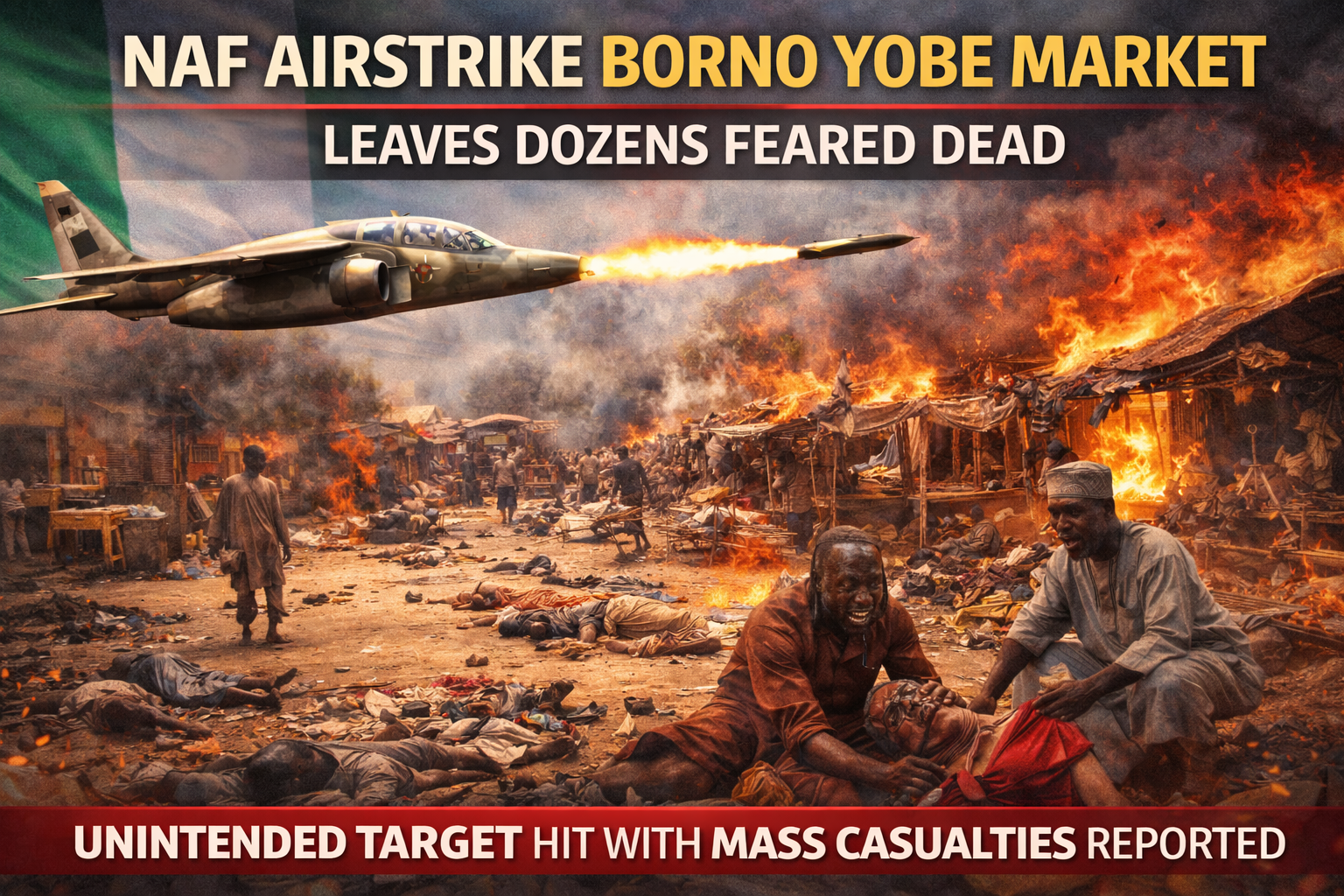
NAF Airstrike Borno Yobe Market Leaves Dozens Feared Dead
A NAF airstrike Borno Yobe market incident has left civilians feared dead after a Nigerian Air Force (NAF) operation targeting suspected Boko Haram insurgents struck a busy trading hub on Saturday, April 11, 2026, along the Borno–Yobe border.
The strike reportedly hit Dilli Market (also known as Jilli Market), located between Gubio Local Government Area (Borno State) and Geidam Local Government Area (Yobe State). The attack occurred during peak trading hours, with eyewitnesses reporting mass casualties as explosions tore through the crowded marketplace.
What Happened at Dilli/Jilli Market
According to official and local sources, the incident occurred on Saturday evening, though some eyewitness accounts suggest it happened earlier that day, around 2:46 p.m.
The market serves as a major commercial hub connecting communities, including:
- Giedam (Geidam), Yobe State
- Gubio, Borno State
- Chibok axis
- Benisheikh, Borno State
Eyewitnesses reported that:
- Multiple fighter jets were involved
- Explosions occurred in quick succession
- Civilians attempted to flee but were caught in the strikes
One eyewitness stated:
“I counted 56 corpses myself… more bodies are still being recovered.”
This aligns with reports that four fighter jets carried out the operation, although the visibility of one jet was unclear.
Casualty Figures Remain Disputed
Casualty figures from the NAF airstrike on the Borno Yobe market remain highly contested.
Reported figures include:
- At least 10 deaths (early local estimates)
- Over 30 deaths (local government account)
- Up to 56 deaths (eyewitness report)
- 14–20 injured persons hospitalised
The Public Relations Officer of the Yobe State Police Command, Dungus Abdulkarim, confirmed awareness of the incident but emphasised that figures are still being verified.
“At this moment, we do not have confirmed casualty figures… details are still being verified.”
Victims were reportedly taken to:
- Specialist Hospital, Geidam
- Teaching Hospital, Damaturu
Some of the injured later died, increasing the death toll.
Officials and Government Response
Brigadier General Abdulsalam Dahiru (rtd), Special Adviser to the Yobe State Governor on Security Matters, clarified a key jurisdictional detail:
- The incident occurred within Borno State, despite its proximity to Yobe
He cited confirmation from the Chairman of Geidam LGA that Jilli village falls under Gubio LGA, Borno State.
Meanwhile:
- Emergency responders were deployed
- Security agencies began an on-ground assessment
- Official documentation and verification are ongoing
As of press time, the Nigerian Air Force has not issued an official statement regarding the strike.
Why the Airstrike Happened
Local intelligence suggests the operation targeted suspected Boko Haram insurgents believed to be active in the area.
According to sources:
- Insurgents reportedly visit the market to collect levies
- They also procure supplies from traders
- The strike may have been based on tracking suspected insurgent movement
However, one source indicated:
“The fighter jet was tracking suspected insurgents but may have missed its intended target.”
This raises the possibility of misidentification or targeting error, a recurring concern in conflict zones.
What Different Sources Say
Different reports provide varying casualty figures and timelines:
- According to a Vanguard report, civilians were feared dead, but official figures were not confirmed
- Daily Trust (via secondary reporting) suggests at least 56 fatalities
- Local officials estimate 30+ deaths, with additional fatalities among hospitalised victims
This discrepancy highlights:
- Challenges in real-time verification
- Limited access to conflict zones
- Dependence on eyewitness accounts
Background: NAF Operations Against Boko Haram
The Nigerian Air Force has intensified operations in the North-East, particularly in:
- Sambisa Forest
- Tumbuns region
- Lake Chad basin
Earlier in January 2026:
- NAF reportedly neutralised over 40 terrorists
- Operations disrupted planned insurgent attacks
These operations rely heavily on:
- Actionable intelligence
- Aerial surveillance
- Precision strikes
However, incidents like the NAF airstrike Borno Yobe market highlight the risks of:
- Civilian exposure
- Intelligence errors
- Collateral damage
Civilian Safety Concerns Grow
The incident has renewed concerns over:
- Civilian protection in conflict zones
- Rules of engagement in air operations
- Accountability in military strikes
Key issues include:
- Markets are being used as dual-purpose locations (civilian + insurgent activity)
- Lack of clear separation between combatants and civilians
- Limited early warning systems
Implications for Counterterrorism Strategy
The NAF airstrike on the Borno Yobe market raises critical questions about Nigeria’s counterinsurgency approach:
Strategic concerns:
- Accuracy of intelligence gathering
- Civilian risk mitigation
- Public trust in military operations
Potential consequences:
- Increased community distrust
- Reduced cooperation with security agencies
- International scrutiny
Conclusion
The NAF airstrike Borno Yobe market incident underscores the complexity of Nigeria’s fight against Boko Haram, where civilian and insurgent spaces often overlap.
While the military continues its campaign to dismantle terrorist networks, the reported civilian casualties at Dilli/Jilli Market highlight the urgent need for:
- Improved intelligence precision
- Stronger civilian protection frameworks
- Transparent investigation and accountability
As authorities continue verification, details remain unclear, and the final casualty figure has yet to be officially confirmed.
About the Author