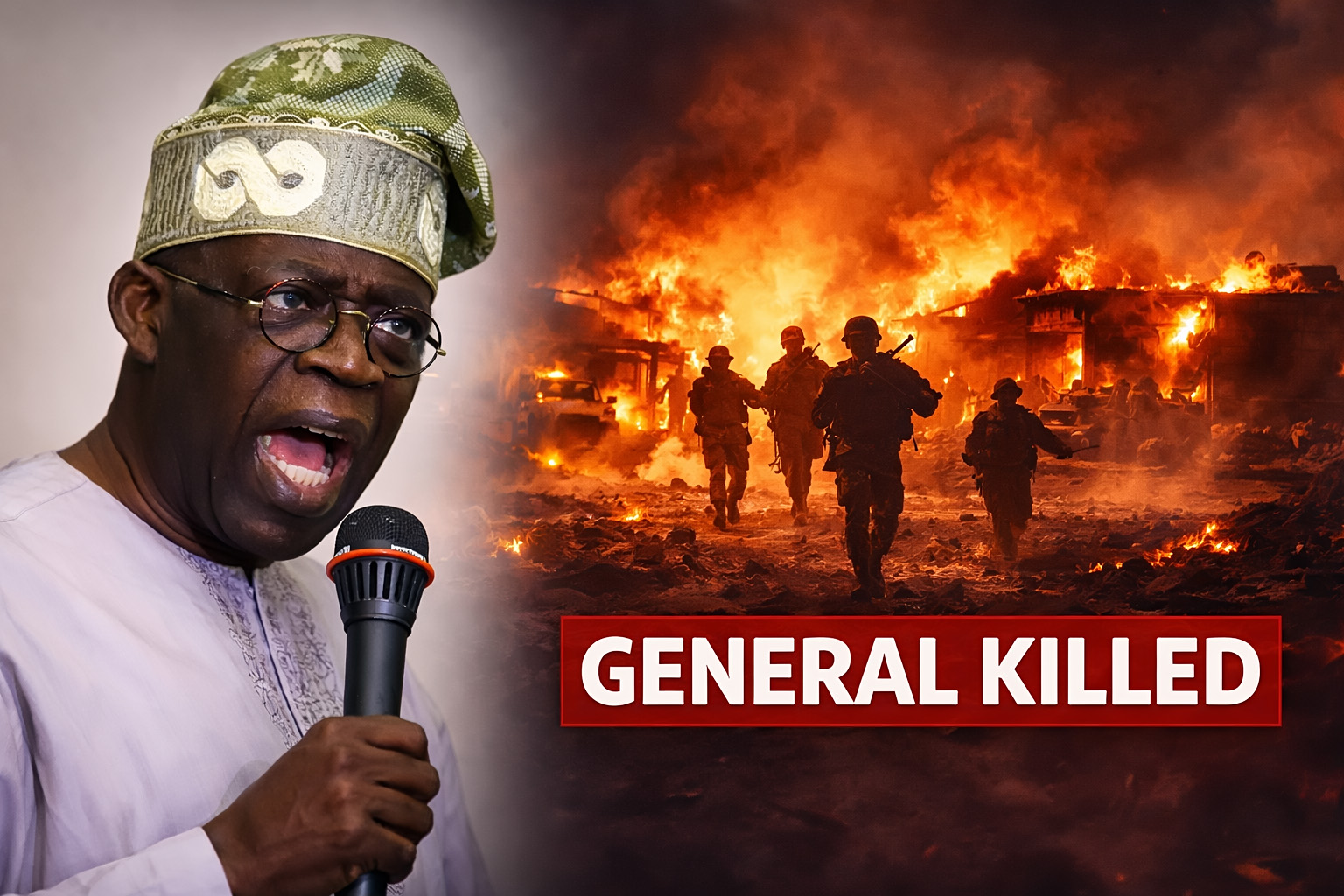
Nigerian Brigadier General Killed in Borno Attack
Nigerian Brigadier General Killed: Brigadier General Oseni Omoh Braimah has been killed in a deadly terrorist assault on a military base in Benisheikh, Kaga Local Government Area of Borno State, in the early hours of Thursday, marking a significant escalation in Nigeria’s ongoing insurgency crisis.
According to multiple reports, including local officials and intelligence sources, the attack also resulted in the deaths of several soldiers, with estimates suggesting at least 18 troops were killed, although the Nigerian military confirmed only that “a few” casualties occurred.
Details of the Benisheikh Terrorist Attack
The assault took place at a base belonging to the 29 Task Force Brigade under Operation HADIN KAI, located about 75 kilometres from Maiduguri, the Borno State capital.
Key details from the incident include:
- The attack occurred overnight into early Thursday
- Terrorists overran parts of the military installation
- Vehicles and buildings were set ablaze
- Brigadier General O.O. Braimah was among those killed
- Casualties among soldiers reported as at least 18 (unconfirmed officially)
Zannah Lawan Ajimi, Chairman of Kaga Local Government Area, confirmed the general’s death, stating:
“Unfortunately, the brigade commander, Brigadier General O.O. Braimah, lost his life.”
Two intelligence sources also corroborated the fatality, indicating that the attackers temporarily overwhelmed the brigade.
However, the Defence Headquarters offered a different account, stating that troops repelled the attackers with “exceptional courage” and “superior firepower,” forcing them to retreat.
Nigerian Military Response and Official Confirmation
The Nigerian Defence Headquarters confirmed that the attack occurred but did not release the full casualty list or identities of fallen soldiers.
According to the military:
- Insurgents attempted to breach defensive perimeters
- Troops resisted and forced a retreat
- Some soldiers were killed during the engagement
Details such as the exact number of casualties and the full operational damage remain unclear.
Nigerian Brigadier General Killed: President Tinubu Reacts
President Bola Ahmed Tinubu responded to the incident with a strong statement, mourning the soldiers and praising their bravery.
In a statement signed by his spokesperson, Bayo Onanuga, the President described the fallen troops as:
“Unforgettable and irreplaceable heroes.”
Tinubu emphasised that:
- The attack reflects desperation by insurgents
- Nigerian forces have been conducting sustained offensives
- The government remains committed to defeating terrorism
He urged military personnel not to lose morale and assured continued federal support in equipment and welfare.
The President also called on Nigerians and the media to support the armed forces and avoid glorifying attacks on troops.
Rising Terrorist Violence Across Nigeria
The Nigerian Brigadier General killed in the Borno attack comes amid a broader surge in violence across multiple regions of the country.
Security analysts and data from conflict monitors indicate:
- Increased insurgent activity since 2025
- Expansion of terrorist operations beyond the northeast
- Rising attacks in the northwest and central Nigeria
Recent developments include:
- Two suicide bombings in Maiduguri since December
- Over 90 people killed in coordinated village attacks in northwest Nigeria
- Increased activity linked to Islamic State West Africa Province (ISWAP) and Al-Qaeda-affiliated groups
According to the report, Kebbi State has also emerged as a hotspot, with attacks linked to a group known as Mahmuda, affiliated with Al-Qaeda.
Regional and International Security Concerns
The deteriorating security situation has drawn international attention.
The United States State Department recently authorised the departure of non-emergency personnel from Abuja, citing security risks.
Additionally:
- Militants from the Sahel region are increasingly crossing into Nigeria
- Terrorist networks are expanding toward coastal West Africa
- Joint operations, including U.S.-assisted strikes in Sokoto, have targeted insurgent groups
These developments reinforce concerns that Nigeria’s insurgency is becoming part of a broader regional crisis.
Historical Context: 17 Years of Insurgency
Nigeria has been battling insurgency since Boko Haram’s uprising in 2009, a conflict that has:
- Led to the emergence of multiple splinter groups
- Caused tens of thousands of deaths
- Displaced millions of people
The death of Brigadier General Braimah marks:
- The second high-ranking officer was killed in five months.
- A continuation of targeted attacks on military leadership
His death follows that of Brigadier General Musa Uba, who was killed by ISWAP in November.
Nigerian Brigadier General Killed: Implications for Nigeria’s Security Strategy
The Nigerian Brigadier General killed in the Borno attack raises critical questions:
- Are insurgents regaining strength despite military offensives?
- Is the conflict spreading beyond traditional hotspots?
- What adjustments are needed in Nigeria’s counter-terrorism strategy?
Security experts warn that:
- Increased coordination among terrorist groups is likely.
- Border regions remain vulnerable.
- Civilian communities face growing risks.
This aligns with previous incidents reported by DSG Herald, including the
- Tinubu Easter Message Nigeria Security Pledge
- Borno police station attack that left officers dead
- Bandit attacks in Katsina communities.
Conclusion
The killing of Brigadier General Oseni Omoh Braimah in Benisheikh underscores the persistent and evolving threat posed by insurgent groups in Nigeria.
While the military continues to project resilience and operational strength, the scale and frequency of attacks suggest that the conflict remains far from over.
As Nigeria confronts this renewed wave of violence, the coming months will be critical in determining whether current strategies can effectively contain—and ultimately defeat—the insurgency.
About the Author