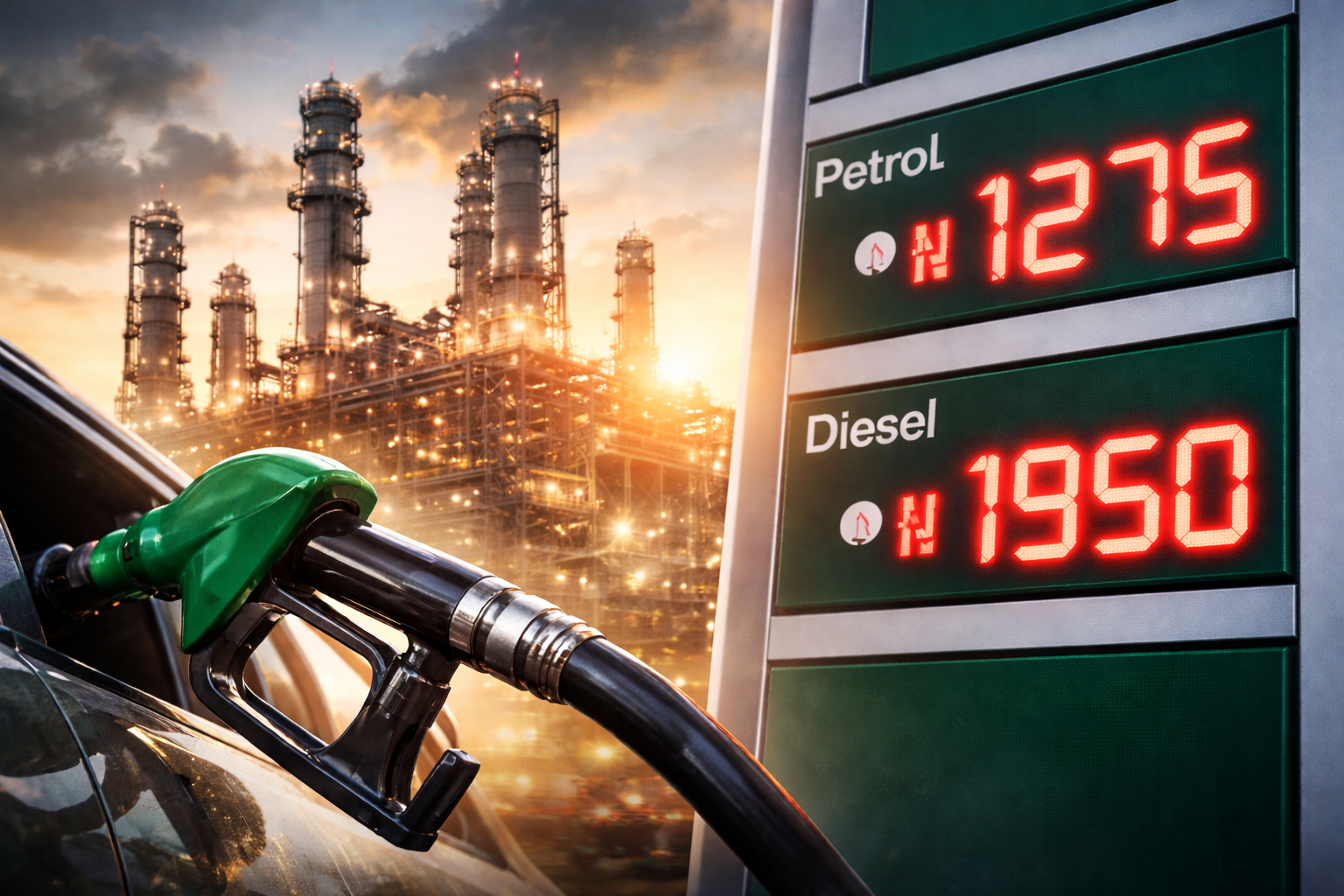
Dangote Refinery Petrol Price Hike Raises Fuel Costs Nationwide
LAGOS, Nigeria — April 2026: The Dangote refinery petrol price hike has pushed the gantry price of petrol to N1,275 per litre and diesel to N1,950 per litre, marking a significant increase driven by global oil market volatility and geopolitical tensions in the Middle East.
According to a report , a senior official at the Dangote Petroleum Refinery confirmed the adjustment on Tuesday night, citing rising international crude oil benchmarks and prevailing market realities as the key drivers behind the price changes.
Breakdown of the Dangote Refinery Petrol Price Hike
The latest pricing adjustment shows a sharp increase across both major fuel products:
- Petrol: Increased by N75 (from N1,200 to N1,275 per litre)
- Diesel: Increased by N200 (from N1,750 to N1,950 per litre)
- The petrol increase represents approximately a 5.02% growth.
- Diesel is now approaching the N2,000-per-litre threshold.
Market data from Petroleumprice.ng corroborated the increase, confirming the percentage rise at the gantry level.
Official Explanation: Global Market Pressures
The refinery official attributed the Dangote refinery petrol price hike to external global factors, particularly tensions in the Middle East.
“The adjustment is in line with global market trends… These are external factors that directly influence refined product pricing,” the official stated.
He further explained that:
- Global crude oil price fluctuations directly affect refined fuel costs.
- Nigeria remains tied to international pricing benchmarks.
- Local refining does not fully insulate the country from global shocks.
Why Nigeria Still Feels Global Oil Shocks
Despite the operational launch of Africa’s largest Dangote Petroleum Refinery, Nigeria continues to face price volatility due to structural realities.
Key Factors Influencing Fuel Prices:
- Dependence on global crude oil pricing benchmarks
- Exchange rate fluctuations
- Logistics and distribution costs
- Deregulated the downstream petroleum sector
Analysts note that while the refinery reduces import dependency, it does not eliminate exposure to international market forces.
Impact on Consumers and Businesses
The increase in Nigeria’s fuel prices in 2026 is expected to have widespread economic consequences.
Immediate Effects:
- Higher transportation costs
- Increased production expenses for businesses
- Rising cost of goods and services
Broader Economic Risks:
- Increased inflationary pressure
- Reduced consumer purchasing power
- Slower economic recovery
Experts warn that diesel prices nearing N2,000 per litre could significantly impact industries reliant on generators and logistics.
Expected Nationwide Pump Price Increase
Industry stakeholders anticipate that marketers will pass the increased gantry prices to consumers.
This means:
- Pump prices are likely to rise in the coming days.
- Retail fuel costs may vary across regions.
- Consumers should prepare for further increases.
Global Context: Middle East Tensions Driving Prices
Global oil markets have remained volatile amid escalating tensions in the Middle East, a region that accounts for a significant share of global crude supply.
Key implications include:
- Supply chain uncertainty
- Risk of disruption to oil transport routes
- Increased speculative trading in oil markets
These factors have directly contributed to the Dangote Refinery petrol price hike.
Expectations vs Reality: Local Refining and Price Stability
The Dangote Refinery was widely expected to:
- Reduce fuel import dependency.
- Stabilise domestic fuel prices.
- Improve supply reliability
However, experts now argue:
- Price stability is unlikely without decoupling from global benchmarks.
- Local refining alone cannot shield Nigeria from global oil volatility.
Outlook: What Happens Next?
The Dangote refinery petrol price hike signals continued volatility in Nigeria’s fuel market.
Possible Future Developments:
- Further price increases if global crude prices rise
- Government policy interventions (if any)
- Increased pressure on inflation and the cost of living
For now, consumers and businesses remain exposed to global energy market dynamics.
About the Author